- Home
- Events

Early bird tickets available now
Find out more
Events calendar
Explore now
Keep up to date
Find out more
- Programmes







Opinion
Latest Opinion

Perhaps architecture needs more tradition, not less
Nigel Ostime has recently been appointed as the new master of the Architects Livery Company. He believes centuries-old institutions still have a valuable role to play in bringing people together around a shared profession
Advertisement
Advertisement
More Opinion

Planning reform alone will not deliver better places
Once the economic constraints lift, developers and local planning authorities must understand the role of design in the process of quality placemaking, argues Ben Derbyshire

Protection of what, exactly? On the title and function debate at AHMM
At a debate last week hosted by the Future Cities Project at AHMM, ahead of the Battle of Ideas Festival on 17 and 18 October, four architects and engineers debated whether an architect’s function, not just the title, should be protected in law. Oriana Fernandez reports

Why building safety cannot be left entirely to the free market: A history of building regulations (part III)
Eleanor Jolliffe considers attempts to reduce and simplify the regulations and how the Grenfell Tower tragedy changed everything

Designing security into high-value homes without compromising architectural character
In high-value homes, security is judged by how effectively it safeguards a property without it actually looking protected. Cameron de Wys explores strategies to integrate sophisticated systems so thoroughly that they become virtually undetectable

Architects must go beyond carbon in thinking about embodied value
Concerns about emissions have driven interest in adaptive re-use. But embodied carbon is only part of the story. Architects should consider what other forms of value are hidden within existing structures, says Studio Moren’s Dexter Moren

The most important commission a city can make is a vision
Judging this year’s UK Design Capital of the Year award has reminded Martyn Evans that the greatest act of civic design is not designing a building at all — it is deciding what kind of city you want to become

Building envelope performance starts with the whole system
Danilo Gomes explores why building envelope design increasingly requires a coordinated approach to fire, thermal, acoustic and moisture performance, and considers the role of early collaboration in demonstrating compliance

Scotland’s fires provide many lessons for the heritage sector
Tragic events in Glasgow should prompt a UK-wide reckoning about maintenance, funding and what genuine regeneration requires, writes Matthew Mckeague, chief executive of the Architectural Heritage Fund says

Construction’s talent pipeline has been hiding in schools for years
The skills debate is back. But Class Of Your Own founder Alison Watson argues that construction already has a proven education pipeline – and that industry categorisation and schools policy have combined to keep it invisible
Construction’s talent pipeline has been hiding in schools for years
The skills debate is back. But Class Of Your Own founder Alison Watson argues that construction already has a proven education pipeline – and that industry categorisation and schools policy have combined to keep it invisible

The government is right to be more interventionist on planning
Governments have tried assuming every council will plan maturely and conscientiously. But this hasn’t worked so Matthew Pennycook’s more robust approach is needed, writes Paul Smith.

Retrofitting starts below ground
UKGBC’s April 2026 report highlighted that most buildings are set to remain in use until at least 2050. Retrofit is therefore critical and Jon Chevin explores why ground stability should be considered from the outset

Why architects need to rethink door specification under Martyn’s Law
Rob Mottram, head of product and compliance at steel door manufacturer Robust UK, explains how Martyn’s law impacts door specification

Class L confusion – why a label isn’t a standard when it comes to battery storage
Matt Partridge argues you shouldn’t take a fire rating at face value when it comes to battery storage. He says a “class L” label on a battery storage cabinet tells you very little about how it will perform in a real lithium-ion fire – and explains what to look for ...

The impact of two world wars and the ‘golden era’ of the public sector architect: A history of building regulations (part II)
Eleanor Jolliffe considers the social trends and events of the past millennium that led to the development of rules which dictate the way we build

What does your building say about the place it’s in?
Janie Mullaney argues the best way to avoid flat, featureless facades with all their character value engineered away, is to talk to facade manufacturers early in the design process

Why solar-control glass should be part of the UK’s overheating debate
Phil Brown says recent heatwaves should be a wake-up call about the overheating risk in our housing stock and that solar-control glass must be part of the solution

Where do I start with AI?
Tools like Claude and Chat GPT are the solution to architects’ woes, but we are using them the wrong way, says Oliver Lowrie

The real planning problem starts after permission is granted
Securing consent faster is only part of the challenge. If contractors are appointed too late, projects can inherit the most expensive version of the approved scheme, writes Beth West

The Old Truman Brewery taught me that great places can’t be rushed
The success of the Brick Lane complex was realised through organic evolution and experimentation, not chasing a quick return, writes Martyn Evans

Choosing natural stone for swimming pools – what you need to know
Ellie Parker explores the challenges of specifying of natural stone for swimming pool environments – and explains why picking the right stone is more tricky than it might appear

Paul Morrell: The problem with reforming construction professions is knowing where to start
Former government chief construction adviser examines MHCLG’s call for evidence on professions, trades and occupations - and argues progress will stall unless government is clear about what it can fix

Thermal comfort – the missing piece of urban mobility
Federica Buricco says that, in the face of climate change, we need to change the way we design our cities to make active travel more appealing in the heat and outdoor living comfortable all year round

Meeting SEND demand through design
Traditional design and construction approaches are struggling to keep up with a surge in demand for Special Educational Needs and Disabilities facilities. We need to rethink how we deliver these places for those who need them, writes John Edwards

So comprehensive and yet so lacking, so controlling and yet so silent: A history of building regulations (part I)
Eleanor Jolliffe considers the social trends and events of the past millennium that led to the development of rules which dictate the way we build

An Olympics in the North should embrace the region’s polycentric DNA
The possibility of the UK hosting an Olympics outside London appears more real than ever. The North’s strength lies in its plurality, which makes it an ideal location

Into the wilderness? Or just an alternative view of the landscape?
The story of human culture is about taming the wild and making it home, but a new book has David Rudlin questioning how best to conserve the natural world that surrounds us

Beyond the ceremony: My reflections on RIBA’s big award anniversaries
Each project recognised this and every year tells a story about what architecture can achieve and reinforces the value of architects in shaping places to which everyone can relate. That is something worth celebrating, writes Jack Pringle, chair of the RIBA board

When everyone is responsible, noone is – the accountability gap in construction products reform
Brittany Harris argues that the government’s proposed reforms to the construction products regime will only succeed if accountability is clearly defined and backed by reliable digital evidence throughout the supply chain
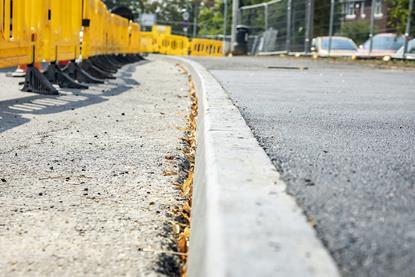
Why national recognition changes everything for recycled kerbs
Phil Sutton welcomes a change in the rules that will allow the easier specification of more sustainable kerbing

What a successful landscape-led urban framework looks like for future communities
The key to bringing beneficial change through public space design to densely populated, multi-generational urban areas, such as Central Somers Town, is demonstrating a people-first approach that centres residents’ voices and uses green spaces to strengthen community and access, argues Anne Wynne at DSDHA

Could composites be the future of high-performance building systems?
Guillaume Klein argues that a new European standard for composites should prompt architects and specifiers to rethink material choices

Will Burnham’s ‘Manchesterism’ be a lifeline for housebuilding?
The next prime minister must resist the temptation to unpick everything and instead build on existing progress, writes Ben Derbyshire
