








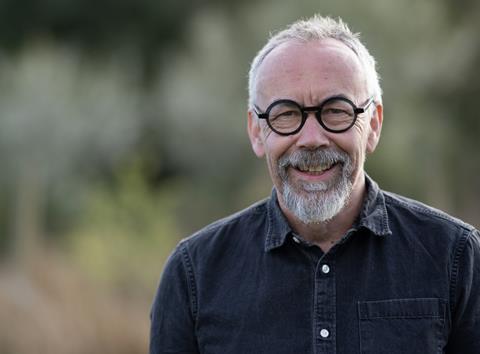
Kelvin Campbell passed away over Christmas. David Rudlin pays tribute to a fascinating contrarian who was always inspirational if also slightly intimidating

A few years ago, I sat with Kelvin and a few others having a pint in a bar in Dublin’s redeveloped docks. Kelvin wasn’t happy.
The square in front of the cafe and all the surrounding buildings had been built in accordance with the Urban Initiatives masterplan that he had led. But the results were not what he had been aiming at.
Each block had been developed as a single, big corporate building, rather than the collection of smaller buildings joined to each other as illustrated in the plan. Rather than a collection of independent cafes and bars around the square, our venue was a vast establishment run by a bland chain with bad beer and muzak.
I was impressed for two reasons: Firstly, as a fellow urban designer, I was jealous that he had been responsible for such a high-profile masterplan and, one that had been built to boot! Second was the way that he identified the problem; even when plans are built exactly as you draw them, they turn out to have no soul. The issue is not with the design but the corporate process by which these places are built.
By this time Kelvin had already published his hugely influential book Massive Small, written to address this very problem. In it he proposes a new form of “smart urbanism” as an antidote to top-down planning.
To quote from the book: the idea was to “mobilise people’s latent creativity by harnessing the collective power of many small ideas and actions… When many people do this, it adds up to a fundamental shift. This is what we call making Massive Small Change.”
>> Also read: Urban Initiatives remodels South London’s Aylesbury Estate
This was not just a touchy-feely appeal that the community knows best. He argued that top-down systems were necessary to allow bottom-up systems to flourish. What he was proposing was a system by which a huge diversity of fine-grained things were enabled, rather than those monolithic, corporate buildings in Dublin dock.
Kelvin was born in South Africa and, after graduating in architecture from the University of Witwatersrand, he joined first the National Building Research Institute and then the Urban Foundation in Johannesburg. His interest was in self-help housing as a way of improving conditions for the poor.
I once saw him lecture on this; the first slide showing just a grid marked out on an empty site, the second showing the same area 20 years later as a fully functioning four-storey neighbourhood with a fine-grained mix of uses and buildings.

All that had been needed was a framework, some simple rules and a package of assistance for the first builders. This was very much the inspiration for the Climax City book that I wrote a few years later.
Like many of us, Kelvin would find these ideas almost impossible to translate into an urban design practice in the UK. When Boris Johnson as mayor of London asked him what to do about the 9,000 people living in garden sheds in London, Kelvin suggested formalising the arrangement and giving people the wherewithal to turn those sheds into permanent, Building Regs-compliant housing!
He had moved to London in 1986, initially working for PRP Architects before setting up Urban Initiatives in 1989. A year later I joined URBED and Urban Initiatives became a really annoying competitor – whenever we saw Kelvin and colleagues such as Simon Carne and Marcus Wiltshire coming out of an interview before us, our hearts sank.
Urban Initiatives grew to more than 60 staff, with offices in London, Dublin and Edinburgh, which is huge for an urban design practice.
In the 1990s they were commissioned along with Rob Cowan by the Conservative secretary of state John Gummer to write the first national urban design guidance. Assuming that the initiative would be dropped when New Labour came to power, they were gratified when it emerged as By Design, which remains a seminal policy document.
The last project we lost to Urban Initiatives was the Birmingham Big City Plan. This was a huge commission and the resulting report was one of the most cogent and inspiring city strategies ever produced in the UK.
The big fee carried Urban Initiatives over the first few years of the recession and austerity. But the rule in an urban design office is that the bigger the budget the bigger the expectations, and the more money you lose. Urban Initiatives would fold within a few years, with Urban Initiatives Studio taking forward the work under new directors.
You often came away from a conversation with him feeling like you have been in an intense debate!
It allowed Kelvin to devote himself to writing and research, winning the 1851 fellowship and producing the book Making Massive Small Change: Building the Urban Society we Want. It is a toolkit and compendium of ideas and was described by Edgar Pieterse as a “stunningly created Kama Sutra for city making”. If that doesn’t make you want to read it, nothing will.
I last met Kelvin at his wonderful studio in a converted mill house in Wendover. We were working on a masterplan for a nearby site and he wanted to persuade our client to allocate part of the site for a self-build scheme.
Then, as always, he slightly intimidated me and, while our views on urbanism were almost identical, you often came away from a conversation with him feeling like you have been in an intense debate!
At the front of his Massive Small book he includes a quote from Christopher Hitchens’ Letter to a Young Contrarian that seems apt: “To be in opposition is not to be a nihilist. And there is no decent or charted way to make a living at it. It is something you are, and not something you do.”
I am indebted to the Living Tribute to Kelvin by Kobus Mentz and Rob Cowan, first published last June and republished after his death.
Postscript
David Rudlin is founding principal of Rudlin & Co and visiting professor at Manchester School of Architecture.
He is a co-author of High Street: How our town centres can bounce back from the retail crisis, published by RIBA Publishing.







No comments yet