






Despite being just 40 miles apart, development prospects in Edinburgh and Glasgow could hardly be more different, Rab Bennetts writes
Growing up mostly in Edinburgh, it was generally accepted that you didn’t go to Glasgow. It was big, dirty and violent. Then again, some Americans think law and order has broken down in the UK and it’s not safe to venture outside. It is strange how these notions take hold.
There is no doubt, though, that Edinburgh and Glasgow could hardly be more different, despite being just 40 miles apart. And that is not only the dialect and the rainfall.

Glasgow’s image as a big industrial city was certainly accurate, from the early days of the industrial revolution to the last quarter of the 20th century. Its rapid expansion, based on cotton and tobacco (supported by slavery) and manufacturing of everything for the Empire from machinery, ships and locomotives, led to a million-strong city at its peak with housing that was grim and working conditions that in 1919 almost produced a replica of the Bolshevik uprising.
The situation looks very different now and, after decades of industrial decline, the census data suggests that Glasgow is now home to around 650,000 people, but that is partly due to boundary changes introduced in the Thatcher era, allegedly to cripple the hostile council through budget restrictions. The wider Glasgow region is larger for sure, but it is an interesting contrast to Edinburgh, whose population has grown in the postwar period from around 430,000 to something like 520,000 now, with a further 30,000 or so anticipated.
In what should be the vibrant centre, it feels that very little is happening apart from student housing
Some commentators even think that Edinburgh’s expansion and Glasgow’s contraction may mean the two cities swap places as Scotland’s largest city in 20 to 30 years’ time, but all is not what it seems.
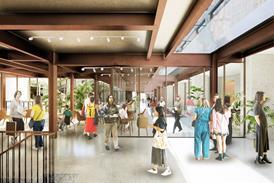
Edinburgh struggles to find sites for the undoubted demand for housing and, while policies favour brownfield development, the cost and small size of most urban plots mean that large suburban developments are springing up in the west near the airport and to the east all the way to North Berwick and Dunbar, with consequential implications for commuting, car ownership, schools and density. In what should be the vibrant centre, it feels that very little is happening apart from student housing.
The former port hinterland around Leith and Granton has a promising masterplan by 7-N and others, but the design of most developments beyond the city boundary is predictable and dull, except for one at Longniddry, masterplanned by Taylor Architecture & Urbanism with various architects. Unusually, it borrows extensively from vernacular forms and, I have to admit, is the most interesting of the suburban estates.
Supply and demand inevitably affect prices and Edinburgh is said to be one of the most expensive areas outside London. A two-bed flat in, say, the well-built tenements of Marchmont would set you back well over £400,000.
As might be expected, the pattern in Glasgow has a very different texture, with the multiple legacies not only of declining industry, but also 1970s motorways, slum clearance and – only 30 years later – demolition of the towers that replaced the slums. But places like the Gorbals provide considerable hope, with some really good new housing developments based on courtyards (which is ironic, bearing in mind the historic tenement format) by highly regarded architects such as Page & Park, Elder & Cannon, Stallan Brand and others. Moreover, existing housing in central areas can be half the price of Edinburgh, with large flats available for not much more than £200,000.
Glasgow is buzzing, partly because it retained its long-standing affinity with the artistic community but also because of the new recruits to its blend of edgy regeneration
Meanwhile, down in London, property prices have far outstripped the younger generation’s ability to pay. The effect on the creative sectors has been particularly harsh thanks to the property boom unleashed by Boris “I-won’t-build-Dubai-on-Thames” Johnson when he was mayor. When he did exactly that, younger creative professionals found during covid that they could work anywhere remotely and started to seek out affordable housing elsewhere, including Glasgow.
Last weekend’s terrible fire at Union Corner notwithstanding, there is a definite sense that Glasgow is buzzing now, partly because it retained its long-standing affinity with the artistic community but also because of the new recruits to its blend of edgy regeneration. The city is also far more open to development than Edinburgh, although this cuts both ways, with some developments getting consent too readily.
Edinburgh on the other hand, needs to be careful that it does not price out its younger, city-centre generation, even though demand from the financial sector is not what it was. Driven by tourism, the Scottish capital also has a particular problem with AirBnB, which has hollowed out significant parts of the centre in a way that deprives local people of urban housing and raises the cost for everyone else. Regulation through licences and planning refusals is starting to have an impact, though.
Looking more closely at the data, it seems that Glasgow’s population has actually crept up recently and there are ambitious plans to repopulate the centre. I wonder if the population predictions will be fulfilled. Will Edinburgh stagnate while Glasgow regenerates?
Postscript
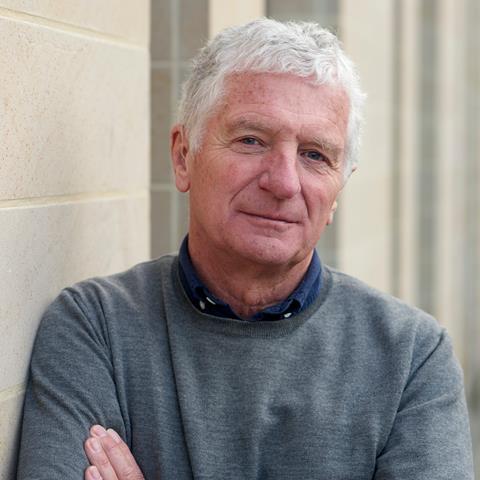
Rab Bennetts co-founded Bennetts Associates in 1987 with his partner Denise Bennetts.







No comments yet