







At a debate last week hosted by the Future Cities Project at AHMM, ahead of the Battle of Ideas Festival on 17 and 18 October, four architects and engineers debated whether an architect’s function, not just the title, should be protected in law. Oriana Fernandez reports
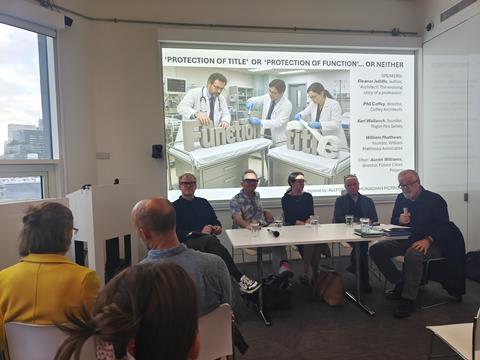
The image projected on the wall
Before anyone had uttered a word, the room had already made the argument for them. The image from the Eventbrite listing was projected on the wall, the first thing anyone saw before finding a seat: three doctors in an intensive care unit, tending to two concrete-formed words laid out on hospital trolleys.
One figure held down FUNCTION while a second prepared a syringe. A third wound bandages around TITLE, patient beds visible behind them. It was AI generated and faintly absurd, and I did not think much of it walking in.
Architect and academic Austin Williams opened by framing three positions: protect the title of architect only, as now; protect the function too, which both bodies are exploring; or protect neither, his own test case. He described a “fairly technocratic” ARB and a “very moribund” RIBA fighting each other over the answer.
Phil Coffey, originally billed, did not appear; instead Russell Curtis stood in. Neither ARB nor RIBA sent anyone to attend, let alone speak, beyond the room’s own RIBA members and volunteers in attendance.

Four positions, two arguments
Eleanor Jolliffe, an associate at Allies and Morrison and BD columnist, opened. Designing a building, she argued, means coordinating structure, services, accessibility and planning consent, not just deciding where a window goes. “Are we really comfortable to let all of that be done by someone who just fancies giving it a go?”
She pointed to pharmaceutical dispensing, probate papers and brain surgery, none of which the government lets just anyone have a go at, and asked why buildings should be different, closing with: “Let anyone draw the sketch, but to execute it, let’s safeguard who’s allowed to do that.”
Karl Wallasch, chartered fire engineer and founder of Trigon Fire Safety, was disarmingly honest about the hole in his own case. He arrived in the UK from Germany with no fire-specific qualification and was, within two years, working on one of Europe’s tallest towers, here in London.
“Did anybody ask me on my projects if I’m a chartered fire engineer? No.”
Twenty years on, he still names projects he should not take, and wants both title and function protected regardless.
Curtis, founding director of RCKa, argued the opposite: RIBA’s proposal bundles separate tasks other regulated professionals already perform, “which kind of makes a mockery of the whole thing.” He named architects’ own fees as the real beneficiary, closing on “a hammer looking for a nail and finding a thumb”.
William Matthews, director at William Matthews Associates, closed the round. “The profession is in a depression and we are depressed as architects.”
Twenty-five years in France, where function is protected, taught him it produces practitioners who sell sign-off for a fee: “If you want to put in that planning application, you have to come and see me, fifteen hundred quid, in you go.” Of RIBA’s campaign framing: “When I saw the RIBA’s title, End the Anyone Can Do It Era, I just screamed, no, anyone should be able to do it.
I kept waiting for someone to point out that his complaint about compliance and Curtis’s about its cost cannot both be true. Nobody did. The two men argued against the same policy from opposite directions all evening and never noticed they disagreed with each other as much as with Jolliffe and Wallasch.
The room turns on itself
Williams turned the argument back on each panellist. To Wallasch: Had he not just demonstrated, by his own unregulated career, the strongest case against the regulation he wanted? Wallasch conceded the tension, crediting a good team rather than the system.
To Curtis, he raised doctors and dentists, both regulated by function, and asked why architects, equally capable of harming someone unintentionally, should be treated differently.
To Jolliffe, on whether Tadao Ando’s team excused his lack of formal training, she said she was defending the napkin sketch, not the team.
Williams also cited RIBA’s own 2024 figure that only 6% of UK housing is architect-designed, and told the room that 35% of the biggest housebuilders have no ARB-registered architect at all. Nobody on the panel returned to either figure; the numbers just sat there, unclaimed by either side.
Curtis, for his part, conceded the profession’s weak spot: architects have “always struggled to articulate or quantify the value that we add.” When the discussion reached training, Jolliffe was blunt: “It’s the incompetent policy rather than incompetent architects.” And an audience member argued that architects have lost authority by being sidelined from this conversation, and that this loss is the real reason the debate is happening at all.
What the floor knew
Guy Shackle, chair of the RIBA London North London Architects Group, spends much of his time in Hackney looking at what the past decade has built, and rates it worse than housing 40 and 50 years older. He argued the golden thread already collapses when a developer hires a trophy architect for planning and a cheaper one for delivery, and predicted ARB “won’t exist in three or four years’ time”.
Two more comments came from the floor. One argued that declining build quality reflects corporations pushing liability onto smaller, individually named signatories such as architects and fire engineers, rather than improving outcomes. Another cited a published poll showing 80 to 90% public support for protecting function, and asked whether that support was about safety or something broader.
Williams’s show of hands found strong support for protecting title, weaker for function, and, to laughter, almost none for his own position of neither. “OK, I’ve got a lot of work to do,” he conceded.
Too many architects, too few answers
Curtis saved the awkward question for the end: does the profession need protecting from unqualified competition, or does it simply need fewer architects? Registrations are up around 50% in a decade, and 63 schools now run Part 1 and Part 2 courses, he said, pointing to Italy, where function is protected yet the median architect’s salary sits around eighteen thousand euros a year. On his own evidence, protection had fixed nothing about the economics, and I have yet to hear a convincing reply.
Wallasch argued for individual rather than corporate liability: “It must be an individual.” In Germany, he said, “the police don’t turn up in your practice, they turn up at your home”.
Jolliffe closed with the historical instinct she had opened with: building regulation moves in a pendulum, privatisation to scandal to state control and back again, and she believes the profession is at a swing point now. Her definition of competence would have fitted on the napkin she defended earlier: knowing the limits of your knowledge, and when to stop and ask somebody else.
Back on the Wall
Williams closed with a comparison from the Victorian era: children stopped working in chimneys not because anyone grew a conscience, but because wealth and technology made it unnecessary. Safety regulation, on his reading, follows material change more often than moral clarity.
The Great Fire of 1666 produced London’s first fire-driven building regulations; the most significant response since followed the Grenfell Tower fire in 2017. Both were catastrophes before they were policy.
I left convinced that we had asked the right question of the wrong room. The panel disagreed honestly, the floor was sharper than the platform, and the contradictions went home unresolved.
But a debate about who should be allowed to design buildings was held entirely among people who already do, and whatever protection comes will be settled elsewhere, by the two bodies that sent nobody to listen. And a room full of architects reaching for doctors and dentists never once looked up at the three doctors already bandaging its own two words on the way in.
Postscript
Oriana Fernandez is an architectural and urban designer, and a mentor on the RIBA’s Future Architects student mentoring scheme, and the University of Westminster’s Future Ready mentoring programme. She also serves as the acting secretary of the RIBA North London Architects Group, and juror for the annual RIBA London Student Awards.






No comments yet