






Ben Flatman explores a sensitive reworking of Clerkenwell’s New River Head, where Tim Ronalds Architects weave galleries, education spaces and a cafe into a historic site shaped by four centuries of change
Drawing and storytelling are integral to architectural practice, fundamental tools for communicating design intent and engaging clients in the creative process. It is fitting, then, that a new cultural institution dedicated to illustration, named after arguably the UK’s foremost illustrator, should emerge from a site already rich in narrative and be shaped by a practice so attuned to questions of heritage and place.
The Quentin Blake Centre, now reimagined by Tim Ronalds Architects, occupies part of the former New River Head waterworks, a backland enclave in Clerkenwell with a richly layered history. For a short time, I lived nearby, overlooking the site. Its boarded-up buildings and forlorn-looking yard were clearly crying out for a use worthy of their eccentric character but it was difficult to imagine quite what that might be.
The coming together of architect, client and place in this project therefore feels like a particularly happy resolution. Ronalds’ work has long been concerned with the exploration of narrative through historic fabric. And as Lindsey Glen, the centre’s director puts it, “the New River Head is already so full of stories”.
Illustration and memory
Illustration, Glen argues, is “part of all of our lives”. She describes it as a universal language, shaping how we understand the world around us, and views the museum itself as being at “the intersection between built heritage and illustration and how we can tell the narrative of place”.
In the UK, few figures loom larger in this field than Quentin Blake. For many, his work is inextricably linked with childhood memories and the anarchic energy of Roald Dahl’s characters.
There is also something particularly resonant about placing a centre dedicated to illustration within Clerkenwell, an area historically associated with printing and engraving. The nearby presence of Cruickshank Street, named after the 19th-century illustrator George Cruickshank – a key influence on Blake himself – provides a further connection.
As Glen notes, to locate the centre “in a place steeped in heritage, design and the printing industries feels really right”.
A site rich in narrative
The origins of New River Head lie in one of the great infrastructure projects of early modern London. Completed in 1613, the New River was a conduit to bring clean water from Hertfordshire, at a time when existing supplies were dangerously polluted. At Clerkenwell, water was stored in reservoirs before being distributed to the city below.
Over time, engineers expanded and adapted the buildings, leaving behind what Liz Ferguson, the centre’s client-side project manager, and a former Herzog & de Meuron staffer, describes as the “footprint of each generation of technology”.
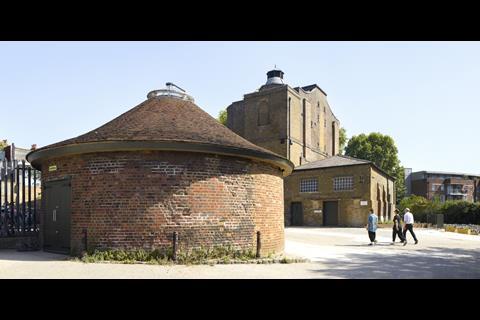
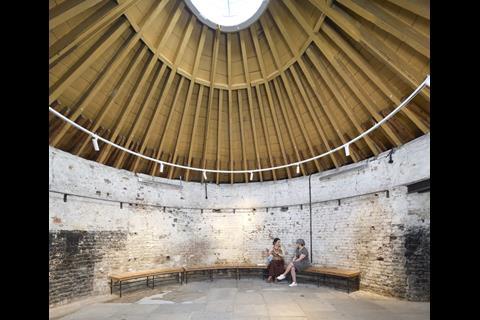
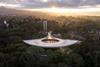
A wind-powered pump was installed in the early 18th century in an attempt to boost water pressure. It proved ineffective, and was soon dismantled, although the windmill’s circular base has somehow survived. By 1768, a steam-powered beam engine designed by John Smeaton had taken its place, housed within the substantial Engine House that anchors the site today.
In 1920 Herbert Austen Hall’s Metropolitan Water Board offices were constructed on the site of the former reservoir. But by the late 20th century, following the privatisation of Thames Water, the site was split up and sold off, mainly for residential use.
The engine house had long ago fallen into disuse and, after its sale the site entered a prolonged period of decline. For decades it stood largely empty, its buildings slowly deteriorating.
Various redevelopment schemes were proposed, including residential and mixed-use projects, but these met with strong local opposition. Community groups, most notably the Amwell Society, consistently argued for public access. There was, as Olivia Ahmad, the centre’s artistic director notes, “a really strong push” from residents for the site to have “a community-focused use”.
The Quentin Blake Centre, founded in 2002, was previously based at Granary Square in King’s Cross. That space, owned by the National Arts Collection Fund, functioned as a kind of museum incubator, allowing the young institution to test the appetite for a permanent home dedicated to illustration. As Ahmad notes, “that appetite proved real,” prompting the search for a larger and more permanent base.
‘The minor deity that looks after illustration’
The opportunity to acquire the New River Head arose in 2019, following a serendipitous conversation between a trustee and a former member of Islington’s planning department. As director Glen recalls, “Quentin fell in love [with the site] straight away,” while Ahmad adds that “Quentin always says ‘the minor deity that looks after illustration’ must have arranged it for us”.
An architectural competition followed in 2020, with more than 70 submissions. Six practices were invited to interview. Tim Ronalds’ proposal stood out for its contextual approach, which sought to work with the grain of the site. As Ahmad recalls, “Tim’s concept just unlocked the existing footprint in such a subtle and intelligent way that we fell in love with it from the start”.
The team were also impressed by the practice’s work on Wiltons Music Hall and the Hackney Empire. “He keeps the integrity of buildings but is also good at incorporating the oddities of different kinds of use”, explains Ahmad. “And he lets the building be itself”.
A ‘found space’
The minimal new-build interventions with this project also reflect a relatively modest budget and the extensive site constraints. Owing to the tangle of underground pipes and infrastructure that still criss-cross the site, the strategy was to work almost entirely within the existing buildings.
Our idea from the beginning was to leave the historic buildings as intact as possible inside and out – more difficult than it sounds
Tim Ronalds, founding director, Tim Ronalds Architects
“Our idea from the beginning was to leave the historic buildings as intact as possible inside and out – more difficult than it sounds,” says Ronalds. “We wanted the buildings to feel that they were occupied as ‘found space’ by the art of illustration.”
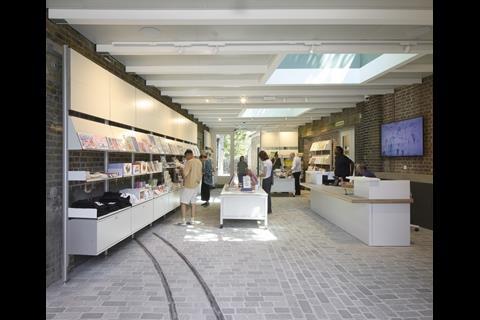
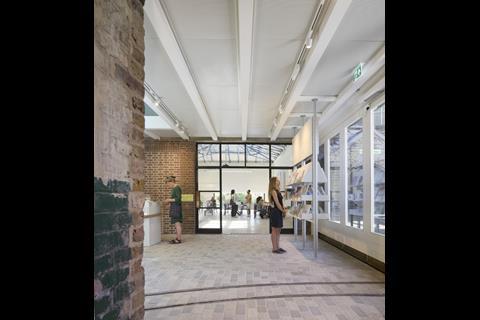
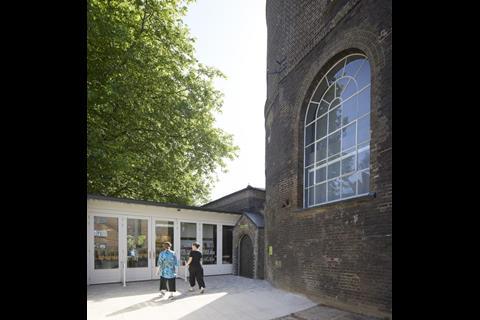
The principal new addition is a lightweight single-storey entrance foyer and shop, its cobbled floor extending into the surrounding external landscape. Elsewhere, interventions include new floors introduced within existing volumes, and gallery display walls set slightly proud of the historic fabric.
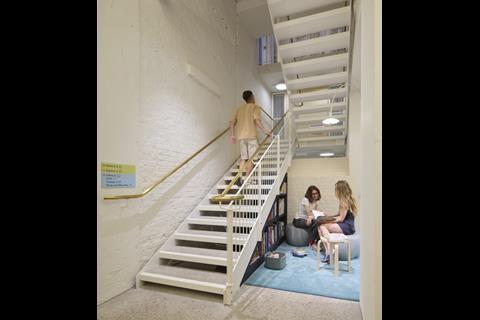
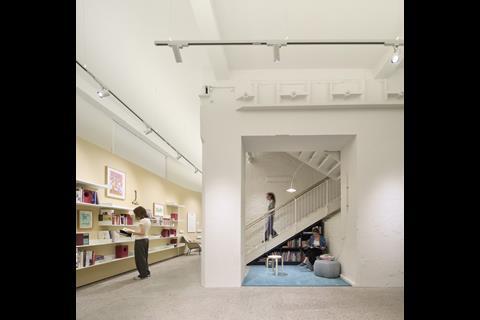
Materials are deliberately restrained. Polished concrete floors with granite aggregate run through the galleries and cafe, while the new stair core is detailed with brass handrails. In places, existing window frames have been retained without glazing, with new panels set back behind them, reinforcing the sense of a contemporary museum space sitting within an older shell.
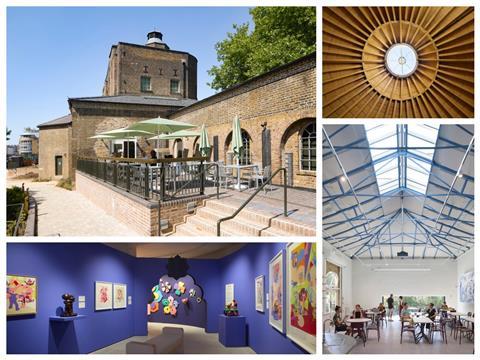
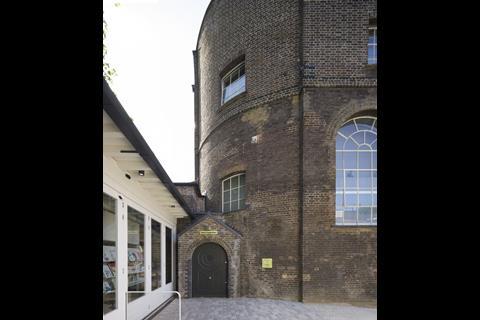
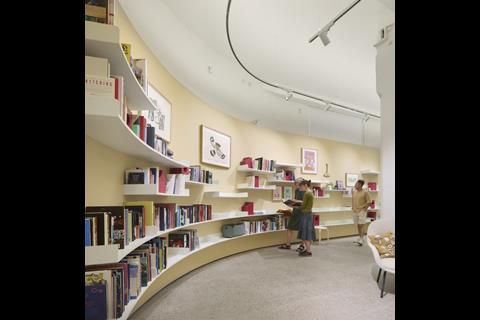
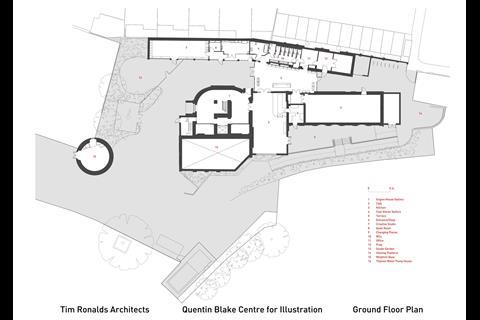
The Engine House forms the heart of the scheme, with its metre-thick walls and the ghost of Smeaton’s beam engine at its core. At ground-floor level, it now accommodates a library of some 1,000 books, a space intended for use by school groups and educational programmes.
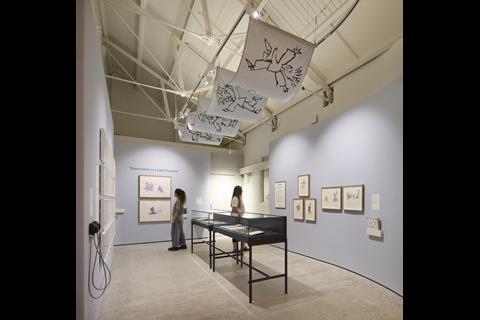
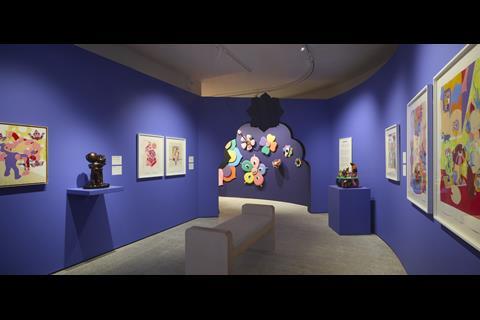
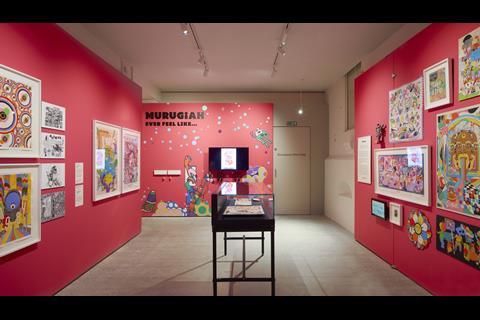
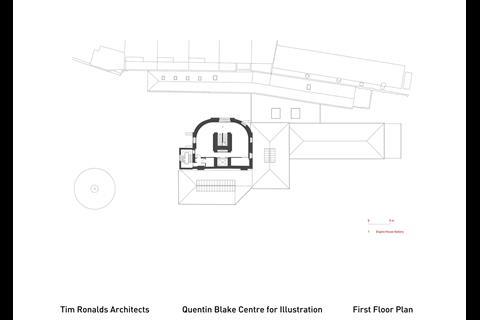
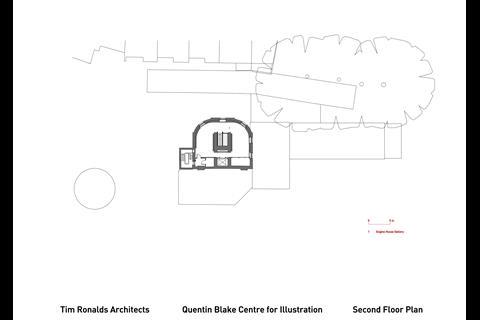
Above, gallery spaces wrap around the building’s core, culminating in a second-floor gallery dedicated to the display of Quentin Blake’s own work. Temporary exhibitions occupy the ground and first floors, including the Coal Store Gallery, the largest exhibition space.
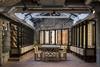
The galleries are deliberately inward-looking. A decision was taken early on that they would be artificially lit, in order to provide the stable environmental conditions required for works on paper. While this limits the visual engagement with the outside world, it creates a sense of seclusion and a powerful setting for the exhibitions themselves.
One of the first exhibitions is by Murugiah, a London-based multidisciplinary artist and designer of Sri Lankan descent. Trained as an architect, he emphasises his close involvement in shaping the exhibition, which combines illustrations with wall-mounted sculptural elements. “I shared my architectural education with the Quentin Blake Centre,” he says, describing the galleries as “incredible spaces” and “something quite unique in London”.
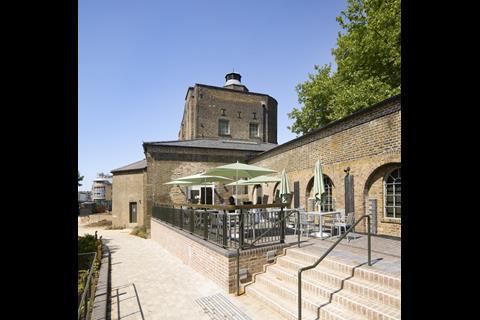
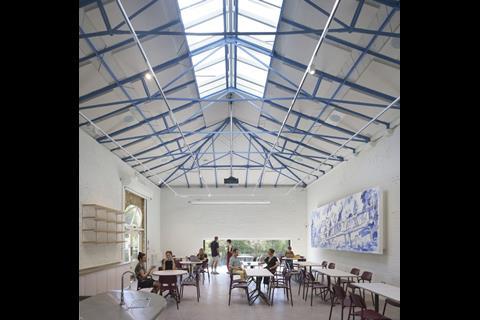
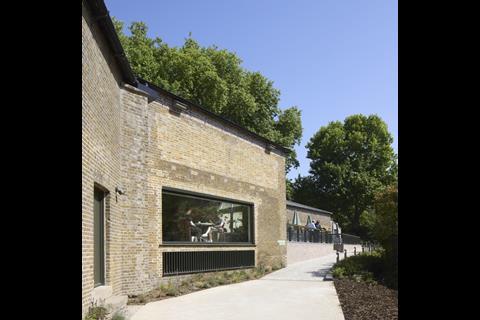
Elsewhere, the Boiler House has been transformed into a cafe. Level changes and partitions were removed to create a large hall that can also host private events – a key requirement for an institution that currently receives no government funding.
Quentin Blake’s presence is marked through a large mural that explores the history of the site. A new low-level window opens out onto the landscape, establishing a stronger visual connection to the exterior, while a new terrace provides outdoor seating.
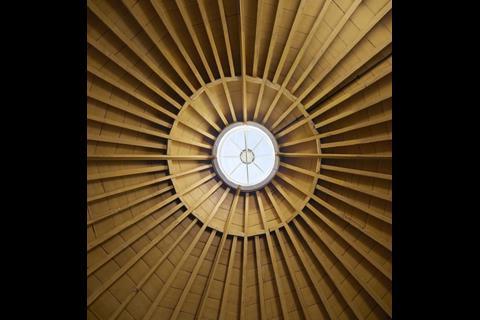
The Windmill base, which has received the most light touch of renovations, is earmarked for smaller exhibitions and residencies. Meanwhile, a modest classroom-like space supports engagement with schools and community groups, reinforcing the centre’s educational mission. Glen describes a key ambition as being enabling visitors to “build the visual skills and confidence to draw their own story”.
A low profile
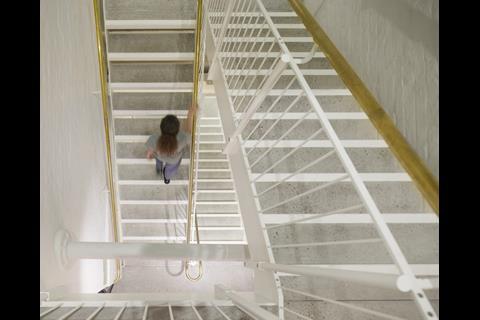
On occasion, however, the restraint that characterises the project can feel like a missed opportunity. A beautiful cast iron staircase could not be fully incorporated into the main circulation due to modern regulatory requirements, although it remains in use as an emergency exit route.
Similarly, a large north-facing window with a fanlight transom on the Engine House is visible from the exterior but has been boarded up internally and excluded from the experience of the galleries. And at the base of the Engine House, a small, almost “hobbit-like” door sits unused, an intriguing fragment that has not found a meaningful role within the new scheme.
More broadly, one might ask whether the architecture could have done a little more to foreground the presence of Quentin Blake himself. Given the vibrancy and immediacy of his work, the relative restraint of the architectural expression, as well as the centre’s graphics and branding, can feel slightly at odds with the contents of the galleries. At the time of opening this not only includes the work of Blake and Murugiah, but an exuberant and occasionally explicit exhibition entitled Queer as Comics.
There is also perhaps a case for a more assertive outward identity within the streetscape. The question of visibility is particularly relevant given the site’s somewhat hidden location.
The entrance off Myddelton Passage, linking Myddelton Square to the rear of Sadler’s Wells Theatre, offers an intimate approach, and hints at the site’s potential to become a node within local pedestrian routes, perhaps drawing in people walking between Angel and Exmouth Market.
By contrast, the western entrance from Amwell Street, which is presumably where there is most footfall, feels underwhelming. Shared with Thames Water, whose continued presence on the adjacent modern pumping station site provides a tangible link to the site’s infrastructural past, it lacks the sense of arrival that such a destination arguably needs. This is, however, acknowledged as part of an ongoing phase of work.
>> Also read: Young V&A by De Matos Ryan and AOC
The external spaces clearly remain something of a work in progress. While cobbled surfaces have begun to be reinstated and areas of planting introduced, the full landscape design, by Sue Amos, has yet to be realised. And heritage interpretation boards, illustrated by Nina Chakrabarti were still to be installed when Building Design visited.
A second phase will see further enhancements, including the introduction of a nature pond, a gesture that seeks to symbolically reconnect the site with its origins as a place of water storage and distribution.
“We won the architectural competition in 2020 and at last it is finished and open to the public!” says Ronalds. And the Quentin Blake Centre for Illustration is, in many ways, a remarkable project.
Started on site by contractor Rise Contracts in October 2024 and opening to the public in June 2026, it has been delivered on a £7.5m construction budget, with a total project cost of £12.5m. The client team are universally complimentary about Rise, who Glen describes as “absolutely brilliant”. And they are equally complimentary on Ronalds. “We feel really lucky to have worked with an architect like Tim who really loves and respects the site’s history and wanted to let it breath and be seen,” says Glen.
And this is undoubtedly another beautifully executed heritage scheme by Ronalds, handled with care within significant cost and contextual constraints. It does not shout or rely on big architectural gestures to make its mark. Instead, it feels like a place where old and new stories sit comfortably alongside each other. There are moments, though, where a little more narrative boldness might have given it greater impact.
Project details
Client: Quentin Blake Centre for Illustration
Architect: Tim Ronalds Architects
Main contractor: Rise Contracts
Structural engineer: Eckersley O’Callaghan
Services engineer: Max Fordham
Sustainability consultant: Max Fordham
Cost consultant: Core Five Consulting
Planning consultant: Montagu Evans
Acoustic consultant: Ramboll UK
Access consultant: Earnscliffe
Landscape design: Sue Amos
Gallery design: All Things Studio / Wolfe Hall
Wayfinding design: Fraser Muggeridge Studio
Location: New River Head, Clerkenwell, London
Start on site: October 2024
Completion date: May 2026
Gross internal floor area: 1061m²
Form of contract or procurement route: Traditional procurement
Project cost: £12.5m
Construction cost: £7.5m





No comments yet