








Water was pouring through the roof and stonework falling off of the John Vanbrugh-designed palace in Oxfordshire. Blenheim is spending £12m restoring an acre of lead and slate roof, restoring the stonework and water-damaged painted ceilings to make it able to withstand a once-in-500-years storm, while ensuring the palace stays open to one million annual visitors, Thomas Lane reports
Shortly after Kelly O’Driscoll started her new job as the head of built heritage at Blenheim Palace, the parlous condition of the enormous, Sir John Vanbrugh-designed pile made itself known. A stone cannonball detached from a frieze high up on the building in Woodstock, Oxfordshire, and landed on the steps below.
“Luckily it was during the night,” she says, adding that it happened during the Christmas period when there were thousands of visitors. “It was quite intimidating.”
Now the frieze and other stonework adorning the building are being restored as part of a £12m project to replace an acre of roof over the part of the building centred on the main entrance. The work also includes the repair and restoration of the Great Hall painted ceiling by Sir James Thornhill and Louis Laguerre’s paintings of the Battle of Blenheim in the adjacent saloon which have been damaged by leaks through the roof.
“When it snowed, we would have buckets in the Great Hall with water dripping through the painting,” O’Driscoll says.
The work also includes boosting Blenheim’s resilience to climate change. “The problem is that we know that climate change is getting worse, severe rainfall events are becoming more frequent, and the standards for calculating rainwater capacity are becoming out of date,” explains Edward Lewis, the practice director for conservation architect Donald Insall Associates who is working closely with O’Driscoll on the project.
“What we tried to achieve here, bearing in mind the significance of everything – and that this is a totally back to basics project – is a one-in-500-year storm threshold, plus a 40% climate change buffer.”
Risk management
Refurbishment projects are notorious for going over budget and programme because there are always unwanted discoveries during the work. O’Driscoll says it is essential that the project comes in on budget and finishes by November this year, because Christmas events at Blenheim are a big money spinner.
“Our budget is £12m. A penny over isn’t happening,” she says. “We have to deliver this before setting up for Christmas 2026, so we have to be out by 1 November.”
Meeting this aspiration required meticulous planning and preparation. One of the biggest challenges was keeping Blenheim’s internal stakeholders happy. A large proportion of Blenheim’s income comes from one million annual visitors. Money also comes from events including horse trials, a music festival, sporting and Christmas events. £1m comes from its use as a filming location alone.
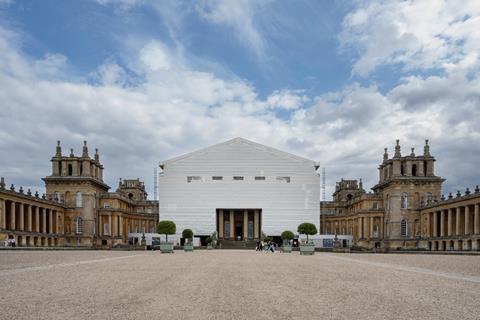
Shrouding the central part of the palace in scaffolding and disruptive building work did not go down well with those responsible for events because of the negative impacts on income. “One of the hardest things was understanding exactly what’s going to happen; when the scaffolding will have a wrap on, and it when it won’t,” O’Driscoll says.
The answer was a storyboard, complete with visualisations showing what the building would look like at key dates during the work. To help keep revenue coming in, discounts were offered for weddings and events.
O’Driscoll says one-off visitor numbers are down but repeat visitor numbers are up, although they don’t spend much money. This change could be down to O’Driscoll’s decision to make a virtue out of necessity by opening the construction works to public view. Visitors ascend the scaffolding to a platform, which offers views of the work through glazed openings in the hoardings and over the surrounding countryside.
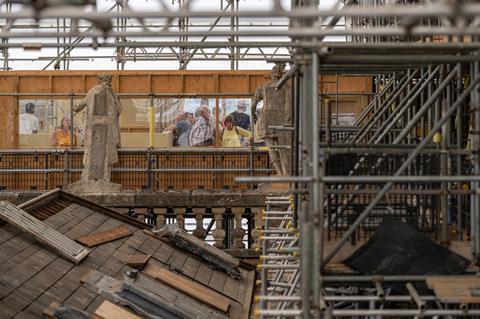
Understanding the state of the roof and stonework was a critical part of the strategy to keep a firm rein on costs and programme. There was almost £1m worth of surveys, investigations and design work before we even started on site, which I think has paid off,” O’Driscoll says.
Preparatory work also included selective patch repairs to arrest further decay, including drying out wood to discourage death watch beetle. Logistics were carefully considered including when work might need to pause for an event. Ensuring contractors had as much information to bid against as possible mitigated the risk of subsequent cost claims against unexpected events.
The scaffolding
Scaffolding access to the roof and north and south facades was a big part of the job. A temporary works designer was engaged because of the operation’s complexity.
“We had significant structural, as well as performance and building use constraints,” Lewis explains. “We need to make sure that we’re keeping all the fire escapes and main entrance open and not affecting revenue.
“There are buried drains that are big enough for me to walk through. The ground below the terraces is all made ground and not properly compacted. There are lateral loads that need to be braced against the building. The problem is that the building has got something like 300 chimneys, so all the walls and even some of the horizontal parapets are full of voids. So where do you safely put the load?”
Another issue was draining rainwater off more than an acre of temporary roof. “All that rainwater has to go into the below-ground drainage system. We analysed this and realised that we could potentially flood the basements if that went straight into the drains.”
The answer was retention tanks to manage the flow of water in heavy rain; this has the benefit of providing water for the garden team.
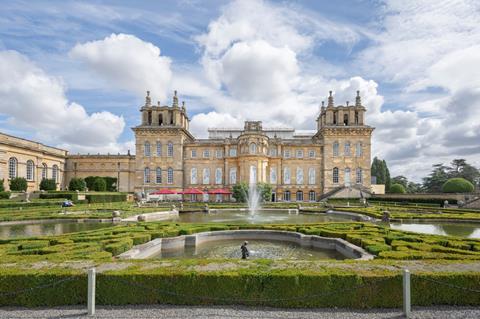
Two options were considered, a phased and a full scaffolding solution on the grounds the former would be cheaper. Lewis says market soundings suggested the full scaffold option was going to cost anything between £1m and £3m.
“At one stage the actual building works were going to be about 50% and the site set-up, logistics, temporary works, prelims, overheads, profit the other 50%.”
A change to the scaffolding design meant O’Driscoll and Lewis managed to procure the full scaffold for £1.7m. It took six months to erect.
State of the roof
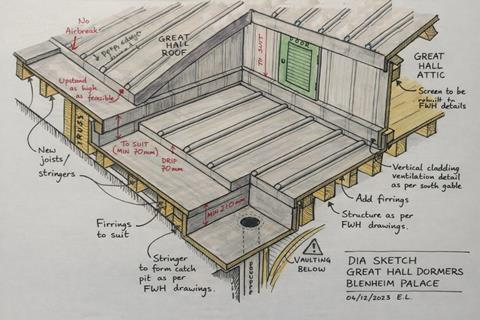
Blenheim Palace was originally built between 1705 and 1722 with a lead roof. Most of this was changed to slate in the 19th century, apart from the section over the Great Hall. Slate needs a greater fall than lead, so the roof structure of the slated areas was raised to compensate.
The lead covering the Great Hall was in poor condition, with repairs on repairs. The 342 linear metres of lead-lined gutters between the parapet and pitched sections were suffering from multiple issues.
The gutter drip details – the step down from one section of lead to the next – were only 40mm deep, which meant water could creep up underneath the lead via capillary action to the wood below. Lewis says that drip details should be at least 60mm.
There was standing water in some of the gutters as these did not have a fall or had warped and, in many areas, the wooden base had rotted away and been subsequently bodged with replacement bits of wood. “In a lot of areas the gutters were quite simply held up by blocks or bits of wood shoved in. There was no rhyme or reason to the construction at all,” Lewis says.
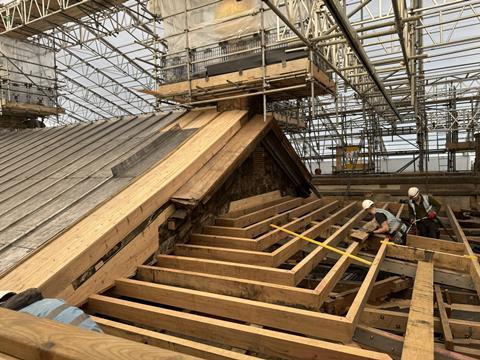
A secondary section of roof behind the main pitch of the Great Hall was originally leaded, but had been replaced with slate. “This was replaced in the Victorian era with a butterfly roof, which meant that we ended up with a valley gutter. That valley gutter is going over the back of the [Thornhill] painting, and that’s where the significant damage is,” O’Driscoll says.
The wooden roof structure was wet and rotten with funghi, beetle and woodworm damage. The ceilings had collapsed under two lower sections of roof over redundant servants’ quarters last used in the 1950s. “If our trustees asked why this project was so important, I would say, ‘this is what our [painted] ceiling will look like if we do nothing’,” O’Driscoll says.
Climate change resilience
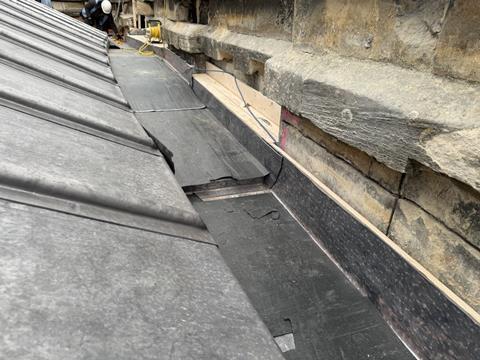
The roof restoration includes adaption for increased rainfall, specifically ensuring water is safely drained off the roof into the downpipes. Investigations revealed there were just six downpipes with four doing most of the work.
The downpipes were mostly buried in the stonework and did not always go vertically down the building – one on the north side of the Great Hall featured an offset connected by a lead trough. “It’s literally just a lead trough through a wall above the spiral staircase. If that overflows, it would cascade down the spiral staircase, and the water would flood into the Great Hall. The impact of that going wrong is obviously huge,” Lewis says.
Thankfully, analysis revealed that the downpipes had sufficient capacity to take away the water in a severe storm. But the restored gutters had to be up to getting heavy rainfall to the downpipes.
“What we had to do, which was a design headache, was to redesign every single gutter from scratch, so that all of the catch pits, sumps, drips, and the sizes of the lead bays are correct,” Lewis explains. “When you’re detailing lead, it’s not just about getting the drip height right. It’s understanding that lead is a very thermally reactive metal, so it’s great for roofing, but it shrinks and expands. And, as it shrinks and expands, it fatigues and splits and wears out.”
New works
The other big challenge, Lewis says, was ensuring that the new roof was well ventilated by adding vents to the eaves, the parapets and hips. “Making every drip 20mm taller and adding 75mm to your eaves detail seems like a small thing, but the cumulative impact of those incremental changes is really quite significant,” Lewis says, “but it has to be done if we don’t want the building to fail in 300 years’ time.”
The old roof coverings have been stripped off and the structure exposed. Rotten timber has been replaced by scarfing in new sections, particularly the truss ends as these are under the leaking gutters. Most of the timber sarking boards have been replaced with new softwood.
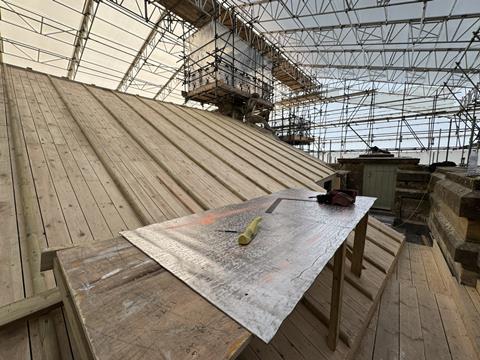
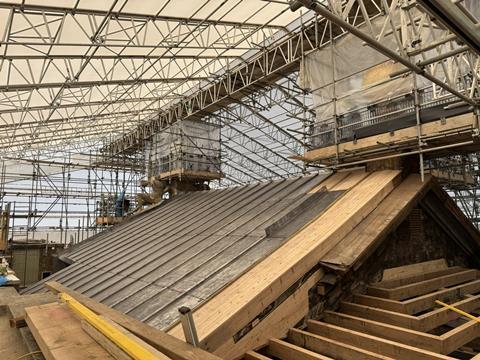
The original, hipped roof behind the main pitch of the Great Hall roof is being reinstated after remnants of the old structure were discovered under the Victorian replacement. “This was a decision that we took to get rid of the valley gutter after having crawled into the roof space and found those hips. It is a bold decision to essentially restore the original shape and rebuild it as a hipped roof, because you are doing all of this above the painted ceiling,” Lewis says.
The painting is being monitored for vibration to ensure that it is not damaged. New oak is being used for the new hipped roof structure.
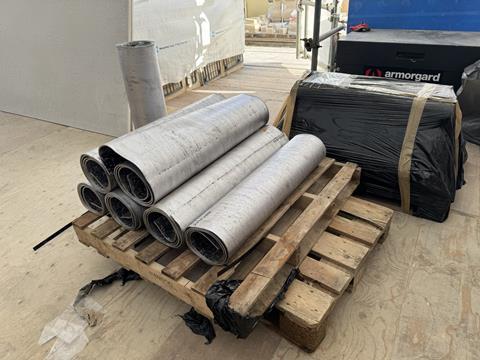
The old lead reclaimed from the roof has been melted down and cast into new sheets as the original would have been sand-cast rather than rolled. This is being used in grades up to code nine, some 5mm thick.
“This is very heavy, thick lead, because the thicker it is, the less vulnerable it is to movement and fatigue. And the larger the area you can cover with the sheet,” Lewis explains.
Lewis and O’Driscoll are very aware that fire is a big risk on historic building refurbishments, given the devastating fires at Notre Dame in Paris and the Glasgow School of Art. The local fire brigade were invited to spend a day at Blenheim, O’Driscoll says.
There are rising mains to the roof for use by the fire brigade, a ban on charging power tools overnight and on halogen lights. There is a strict hot works policy. The main activity is lead welding, which is done on a bench where possible. If this has to be done onsite, there must be a protective undercloak and there is a ban on butt welding.
Hot works can only take place in one place at a time with a six-hour watching brief after this is completed. In practice this means that hot works can only take place in the morning.
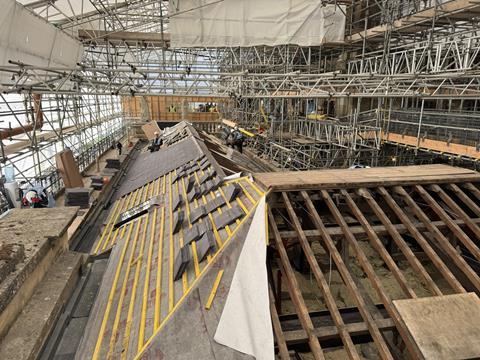
The pitched roof sections are being covered in Welsh slate. The former servants’ quarters are being insulated with mineral wool. The Great Hall is left uninsulated as the main problem in this area is overheating, so this area is being ventilated to remove excess heat.
“Hotter summers are resulting in greater swings of temperature and humidity in the roof space,” Lewis explains. “The hotter it gets in there, the higher the atmospheric humidity becomes. The higher the atmospheric humidity, the more the wood swells. And, given that the timber is supporting the painting, the constant thermal movement of that timber is not a good thing.”
The saloon is being insulated at rafter level because holes in the ceiling mean the roofspace will maintain equilibrium with the space below.
Stone
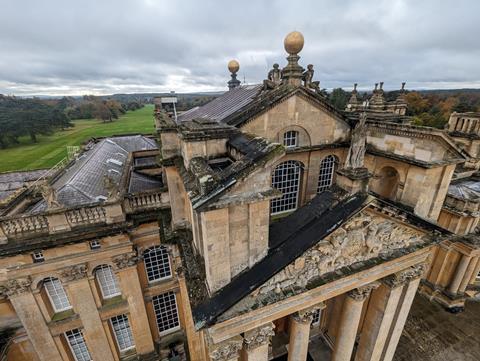
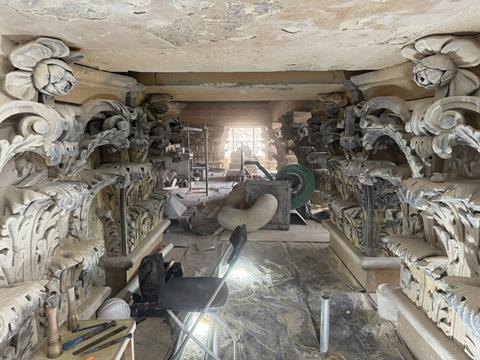
The casual observer cannot tell that Blenheim has 300 chimneys, because these are not visible from the ground. The combination of pollution from coal fires over the centuries chemically attacking the stonework and iron fixing cramps expanding from corrosion has resulted in large chunks of stone falling off the building.
Partially sheltered areas are the worst affected because these still get wet but are not regularly washed by rain, which would remove contaminants. Badly damaged stonework is being replaced with new material, while dirty areas are being cleaned.
Lewis says the stone is being cleaned primarily to conserve it as this removes contamination and restores the breathability of the material. Cleaning the stone is less straightforward than it sounds, however, thanks to the presence of 70 species of protected lichens.
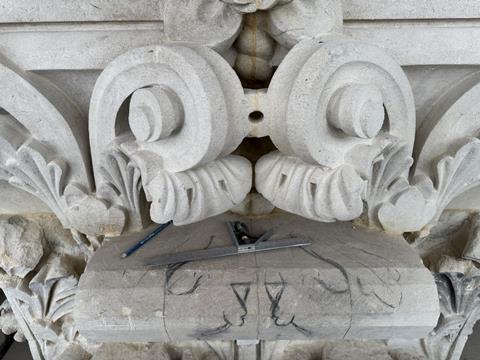
“We have a lichenologist at Oxford University who is very precious about our lichens,” O’Driscoll says. The answer is laser cleaning, as clean, pale areas reflect the energy from the laser but dark, dirty areas absorb it.
“It works brilliantly on the sulfation deposits, because by their very nature, these are black. They are readily absorbed by the laser, so they basically vaporise and turn into dust. a It’s fantastic process, because it’s clean, doesn’t affect the patina or the lichens, and you can be really targeted and selective,” Lewis explains.
The paintings
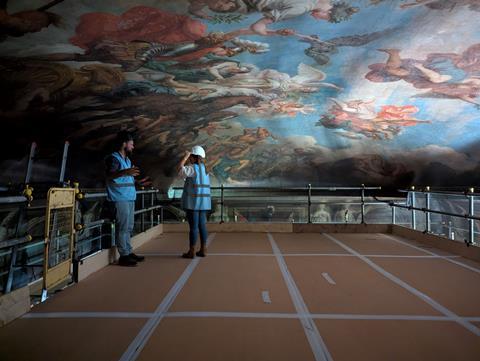
Inside, the paintings are being restored with the help of a £1.1m grant. Access to the Thornhill painting in the Great Hall is via a high-level platform as a large vault under the floor precluded the use of freestanding scaffolding and the need to keep the hall clear at lower level for visitors.
A print of the Thornhill painting is fixed under the platform to give the impression of the original. “People walk in and they don’t even realise it’s a fake ceiling,” says Lewis. A birdcage scaffold has been erected in the saloon.
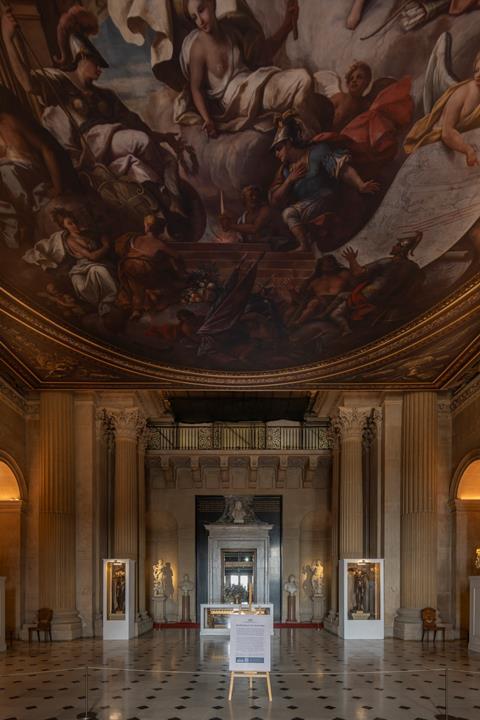
The Thornhill painting has suffered from water damage and mould growth plus areas of the painting were overpainted in 1968. The Laguerre in the saloon is arguably in worse condition as it has a big crack in it. This painting, and the painted walls of the saloon are filthy thanks to pollution from tobacco smoke and coal and gas fires.
The paintings are being cleaned, with damaged areas touched in. A new cleaning method has been pioneered at Blenheim which uses a solvent gel that has the advantage of being low odour and more effective than a liquid.
The job must be completed in November, but O’Driscoll won’t be able to relax once this is done as she is only part-way through a £40m, 10-year project to conserve the palace and extensive grounds. Next up is the conservation of a couple of bridges and the Temple of Health. Then it is back to the palace to tackle the library roof. All of which will hopefully ensure that Blenheim has a future for at least another 300 years.
Project team
Client Blenheim Palace Heritage Foundation
Architect, contract administrator and project coordinator Donald Insall Associates
Cost consultant Ridge
Structural engineer FW Haywood & Associates
M&E & civil engineer Ingleton Wood
Scaffolding design RDG Engineering
Scaffolding Allen & Foxworthy
Main contractor DBR
Stonework Alex Wehnam
Lead roofing Andrew Rafferty
Painted ceiling restoration Opus Conservation







1 Readers' comment