








In north London’s Harringay warehouse district, small practice Studio Verve is breathing new life into former industrial buildings – and keeping gentrification at bay, Phil Clark reports

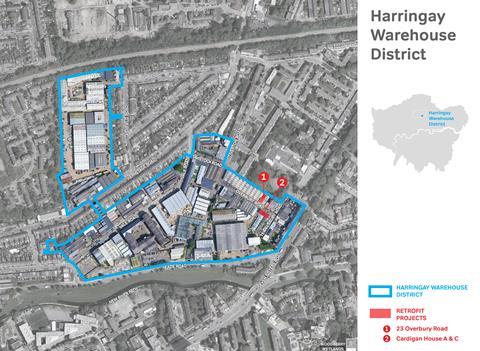
Tucked away from the main thoroughfares of north London’s Haringey, an intriguing, colourful and quirky ongoing experiment in anti-gentrification is under way. Within the borough is a district devoted to warehouse co-living and working, primarily for young creatives and professionals, that looks set to evade the fate of many such bold experiments in reinventing industrial building clusters.
These often contract the dreaded virus that is change of use – starting life as spaces for those needing cheap and flexible accommodation before morphing into prime residential flats for higher earners. And so gentrification ensues.
From textile factory to creative hub
There’s certainly no whiff of gated community or high-end luxury living as you approach the southern part of the district. Turning off the main Seven Sisters Road, there’s a cul-de-sac of car MOT facilities that are teeming with activity and detritus – and on a nearby street an abandoned van bursting with waste has been left to fester.
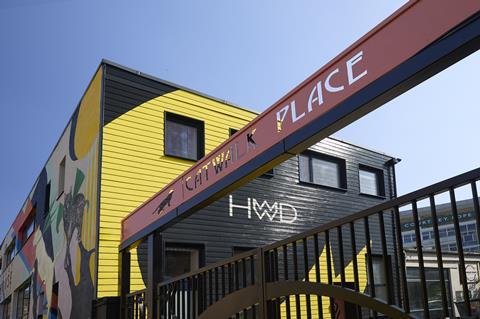
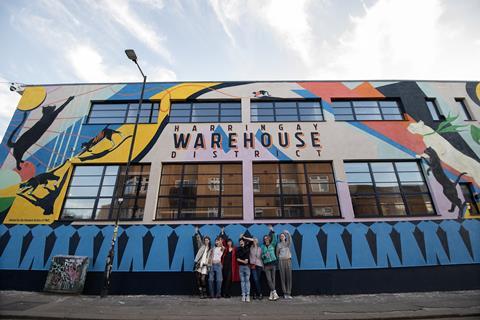
This makes the bold murals on one of the warehouses refurbished by small, female-led architectural practice Studio Verve stand out as all the more distinctive and refreshing. It plays to the spirit that has emerged in the district in the past couple of decades.
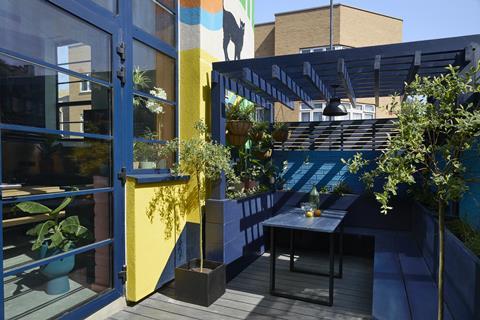
Residents responded to an open call by Verve - helped by long time resident and artist Carolina Khouri - to create a mural for one of the warehouses that the practice was refurbishing and mucked in with brushes to help artist Anna Sebastian complete the work. Local resident artists spent three weeks painting the mural which culminated in a street party. The mural is inspired by the area’s textile industry past, and the black cats contrasting with the bold colours are a reference to Catwalk Place that runs alongside the building.
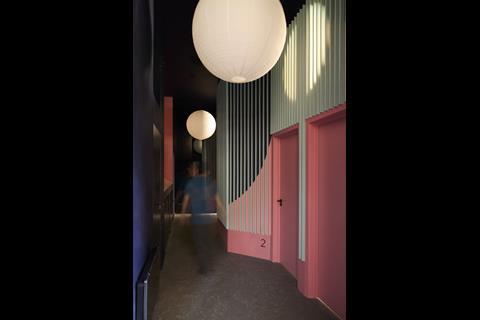
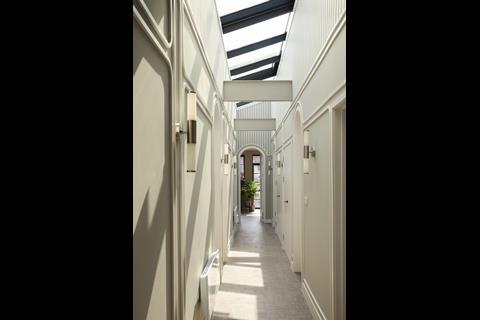
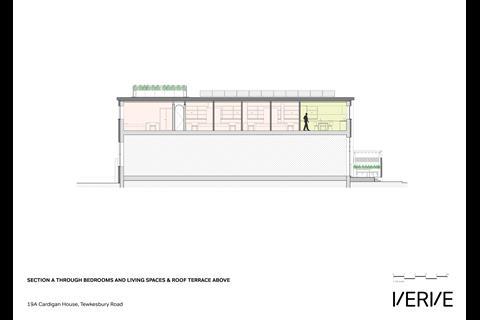
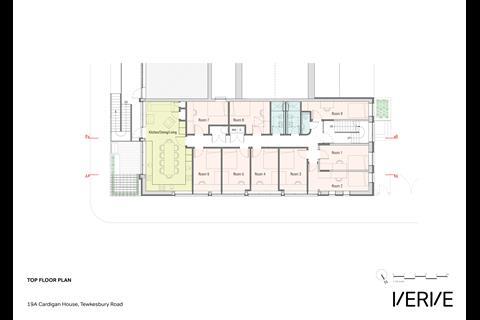
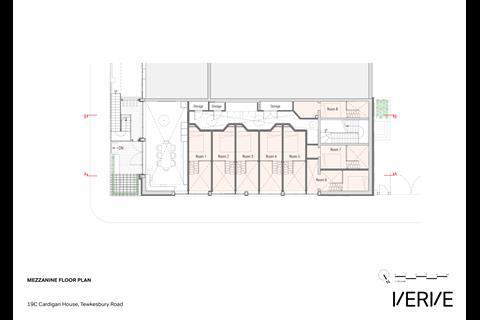

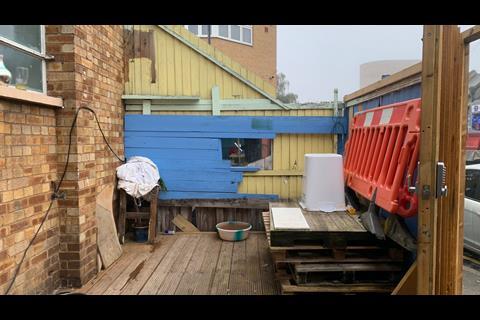
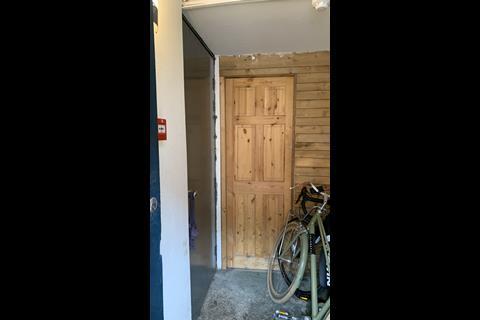
Verve’s core challenge was to significantly improve living conditions in two of the warehouses as well as making them less leaky, more sound-proof, lighter and safer. The firm is working with a client – Provewell – that has been steeped in the area for nearly three decades but realised the need for architectural upgrades over low-cost on-going repairs.
As is typical of such buildings, they were constructed mainly of simple materials appropriate for light industry. Consequently, prior to Verve’s interventions they suffered issues such as lack of natural daylight or ventilation, damp and water ingress, as well as insufficient fire safety measures. Verve founder Vivian Chan says the firm faced plenty of challenges with the state of the buildings. “The plumbing was disastrous,” she says.
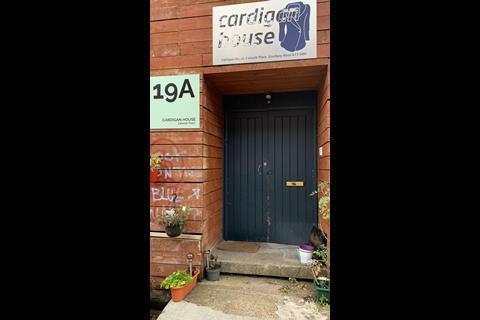
Verve had to balance ambition in creating distinctive spaces in keeping with the character in the district against a “tight” budget, according to Chan. The firm performed conversions to two parts of the Cardigan House building, which was a former textiles factory and is now proudly wrapped around with the bold new mural.
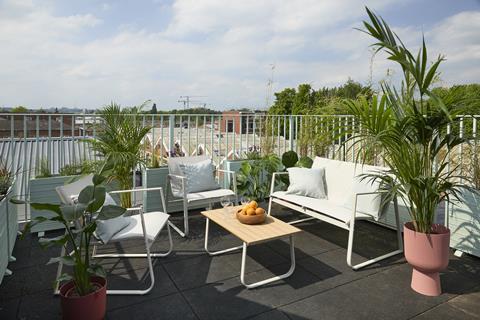
On the top floor they created nine bedrooms for co-living and working and were able to create a terrace on the rebuilt roof – replacing less than adequate and cramped spaces.
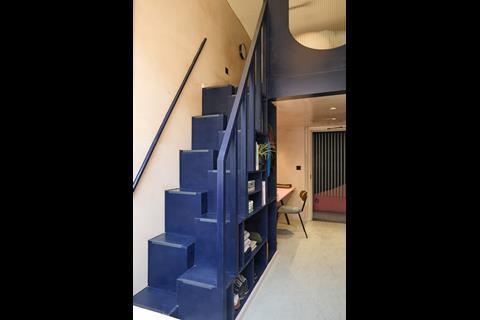
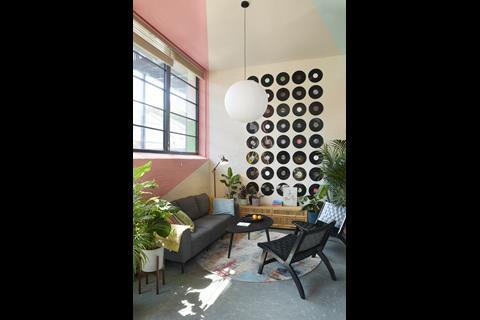
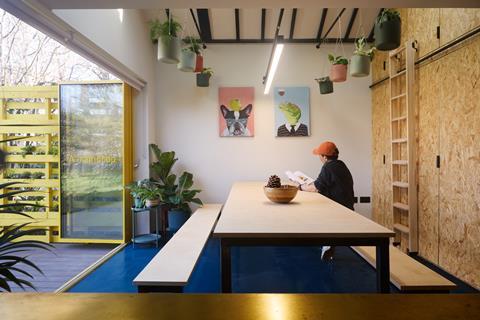
On the ground floor there are eight ensuite maisonette-style so-called “microlofts” which offer residents a small sleeping space on one level with a workspace below. All the units have windows and are surrounded by bold geometries and colourful high-ceiling (3.8m tall) communal spaces – offering more working areas inside and out as well as plenty of storage and, crucially, an area for drying clothes.
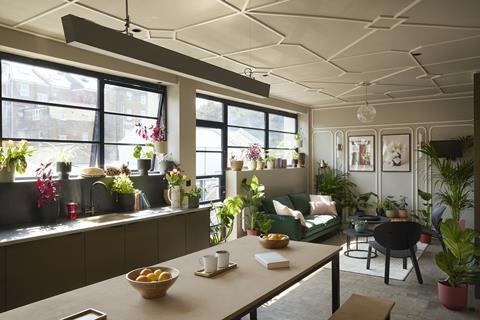
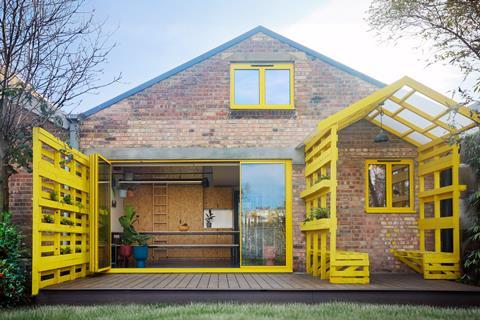
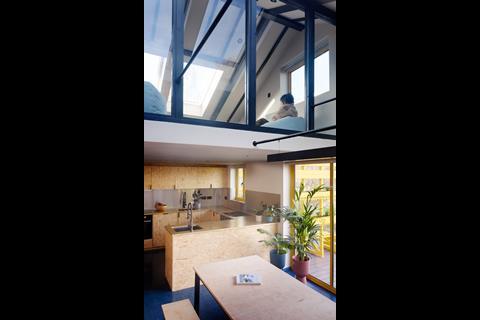
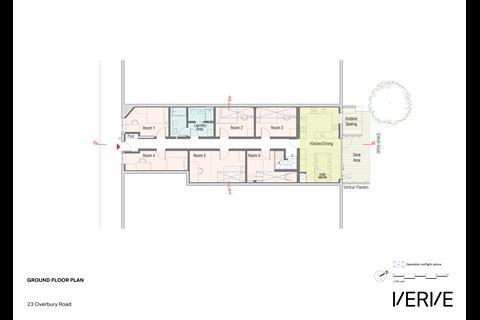
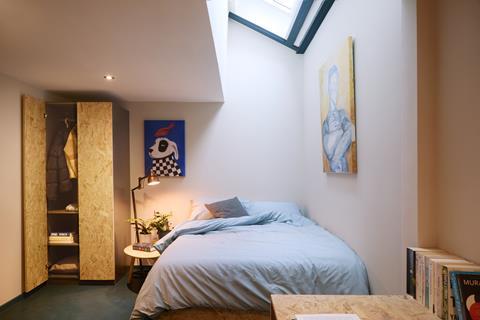
Across the street, at 23 Overbury Road, the third project is within a former bakery and has eight bedroom spaces with modest materials and punchy colours. Each of the bedrooms has external windows or rooflights which replace ugly and inefficient polycarbonate sheeting. Verve then opened up a large section of the external wall into a shared living and kitchen space, which now overlooks neighbouring council-owned land.
All the schemes are working to decent energy efficient standards, with insulation installed as well as air-source heat pumps providing the heating. Chan says the EPC rating for Cardigan House has moved from an EPC rating of E to B, thanks to the scheme – and it’s been future-proofed with the opportunity for this to become A as the roof can accommodate PV panels.
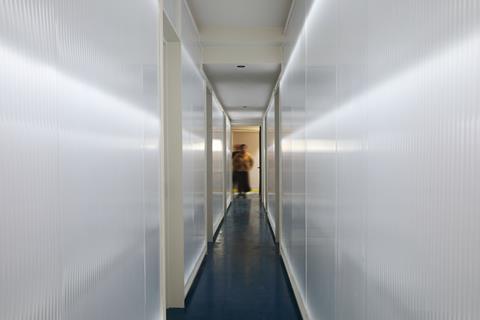
And all the projects also prioritised strong walls with double boards to ensure good acoustic performance and allowing for artists to hang up their work, including heavy sculptures.
Evolution of Harringay’s warehouse community
Things rarely stand still in the area, and the nature of the tenants is evolving. Some of the larger warehouse spaces initially attracted tribes such as circus performers and musicians – now it’s more a mix that includes professionals as well as creatives. As Chan puts it: “As people come and go, and culture shifts, there is a push and pull between ideas of what the Harringay warehouse district (HWD) should and shouldn’t be, which is healthy in any community.”
This isn’t a redevelopment opportunity; it’s a long-term managed portfolio approach that we’re taking
Chris Horn, Provewell
The schemes are part of the slow evolution of the district being overseen by enlightened clients such as Provewell, which runs its warehouses through a venture called Spaces for Creatives.
Provewell was founded by Shulem Aksler and has operated in the borough (as well as neighbouring Hackney) since the 1990s, when it was beset by dilapidation and decline with squatters occupied some of the warehouses.
Now Provewell has established itself as one of the primary landowners and landlords in the district, providing accommodation for more than 2,000 tenants. This requires long-term commitment so that the properties have “management wrapped around” them, says Chris Horn, speaking on behalf of the company.
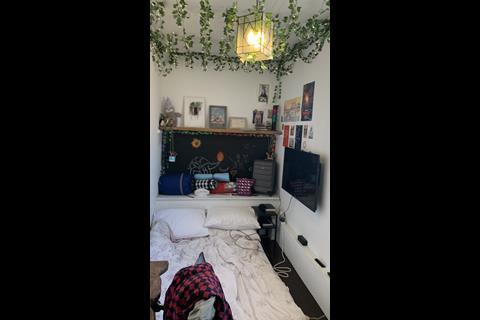
Horn says the firm’s approach is incremental due to the nature of the buildings and the community. “This [the district] isn’t a redevelopment opportunity; it’s a long-term managed portfolio approach that we’re taking,” he says, adding that Provewell looks “to work our way around the area, space by space” for retrofit work.
The firm has had some hand in ensuring that the district does remain distinctive and staves off gentrification. Early in its time operating in the borough, it faced scrutiny from council planning officers due to the state of the buildings.
“They were pursuing landlords with some enthusiasm,” says Horn. As the upsides of the established communities became more apparent, the council has increasingly “come round to the value of this work”.
As people come and go, and culture shifts, there is a push and pull between ideas of what the district should and shouldn’t be, which is healthy in any community
Vivian Chan, Studio Verve
Provewell realised it needed to be more proactive and find a path between “regulation and control and the creative energy and character of the area”, so commissioned planning experts Tibbalds in 2020 to create a framework for future development to capture the area’s special characteristics. “When we submit for planning permission, we also submit the framework,” Horn says.
Planning policy innovation: codifying warehouse living
As a result, co-living is now codified by the borough council – in its last local plan, released nearly a decade ago, it set out a specific warehouse living policy (DM39) which defines the repurposing of the building type as a “sui generis” (unique) use. The Haringey local plan offered encouragement to schemes falling into this category to support thriving creative industries and diversity of employment in the borough.
A new local plan set to be introduced in 2027 looks to be holding to this. A draft released last autumn says: “Existing warehouse living sites spaces have played a vital role in sustaining and growing creative production by supporting informal networks, shared resources, and a culture of experimentation.”
The principle of this code was stress-tested when an attempt was made to demolish a collection of warehouses in the district called the Omega Works, which included a former piano factory, to turn them into “warehouse living units” and residential units of up to nine storeys high, by building owner Majorlink in 2021. Given how close-knit these spaces are and the community spirit established in the district, it was no surprise that residents pushed back hard to shelve the plans.
Locals launched a campaign called Save the Warehouses which attracted the support of local MP David Lammy, who expressed “deep concerns” over the plans, as well as receiving 6,000 signatures and 300 objections to the planning application online.
In November last year, the scheme was rejected by the council, which the campaign group stated at the time on social media was proof that grassroots action was possible “even in big bad London!”
Future development
Provewell is not averse to new-build as part of its growth – it has added some converted shipping containers close to the area and has put forward plans for over 100 live-work units on Seven Sisters Road, designed by Morris and Company. It is also looking to improve the look and feel of local amenities, including the streets, to reflect the shift in use from industrial to residential.
The approach in the warehouse district feels very much in keeping with its time – incremental development over a big bang, building to a tighter budget and favouring, where possible, retrofit over new-build. Yet at the same time, both the client and architect stress in any work they do with positive spirit.
As Horn says, this is developing with an “ethos of humanising the space and have a lot of fun with it”. Fun – a word we could hear more of these days.
Project team
23 Overbury Road scheme
Structural engineering consultant: Space Consulting
Energy consultant: OG Energy
Building control: Assent Building Control
CDM adviser: South Downs Safety
Contractor: Refectio
Cardigan House (19A and 19C Overbury schemes)
Structural engineering consultant: Space Consulting
Energy consultant: Elmhurst Energy
Building control: Complete Building Control
Contractor: Freshview Group

Through ongoing analysis and expert commentary, Regen Connect highlights the policies, funding streams and local priorities that matter most to the construction and development sector.
This coverage will culminate in a special report to be published at our Building the Future Live Conference in London on 7 October.
How you can get involved:
Throughout the year, our team will be gathering insight from across the sector to inform editorial features, debates and events. We welcome contributions from practitioners who want to share experience or shine a light on emerging trends.
Click here for more on the campaign
Be part of the conversation – contact us to contribute or get involved by emailing our deputy editor at dave.rogers@building.co.uk and to find the campaign on social media follow #regenconnect
Postscript
All photos of current project: Romain Forquy






2 Readers' comments