





FCBStudios’ latest addition to Birmingham’s Paradise masterplan pairs bold terracotta detailing with net-zero credentials, creating a vibrant workplace beside the city’s historic Town Hall
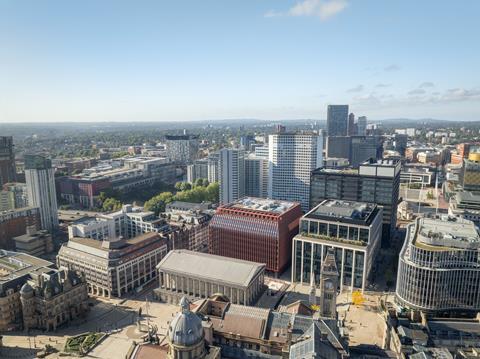
Three Chamberlain Square is shaped by two sets of columns. The first are unremarkable to look at – simple, square pillars of exposed concrete on an office floorplate – but may change the way we think about workplace design. The second are big, nearly 200 years old, and impossible to ignore.
Designed by FCBStudios, Three Chamberlain Square is the fourth commercial building to be delivered as part of the £1.2bn Paradise masterplan in central Birmingham. It is also one of the first new workplaces to emerge from those long covid-driven discussions about the future of the office. With 17,500sq m of all-electric, grade A office space equipped to be net-zero carbon in operation, it is the first BREEAM Outstanding building and first NABERS five-star base building in the West Midlands, and has impeccable smart and wellbeing credentials, with WiredScore and ActiveScore Platinum ratings.
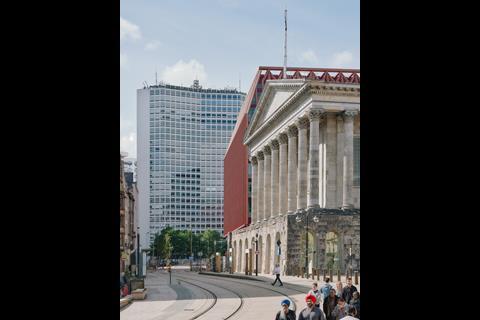
All this takes place on one of the most historically sensitive locations in the city centre, right next to the grade I-listed Birmingham Town Hall. With its temple-like portico and colonnade of mighty Corinthian columns, the town hall is the sort of building that demands a response. The first two Paradise schemes on Chamberlain Square – commercial buildings by Eric Parry Architects and Howells respectively – chose to echo its pale limestone with facades framed by light-toned precast concrete. FCBStudios has taken a different route.
This is a different kind of building for Birmingham, and we wanted to bring a new spirit, of vibrancy and colour
Alina White, FCBStudios
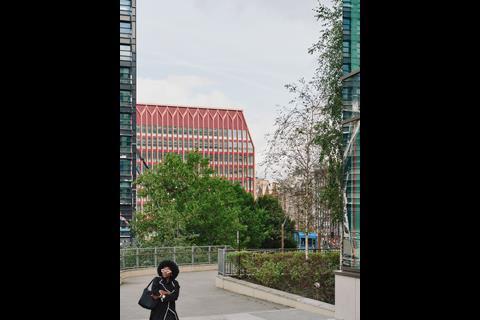
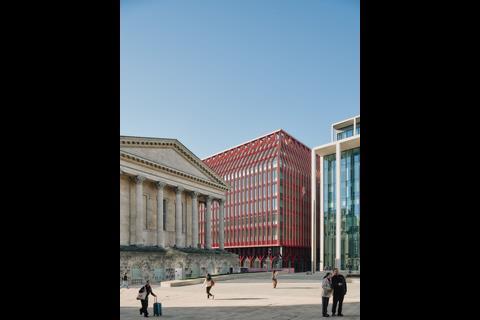
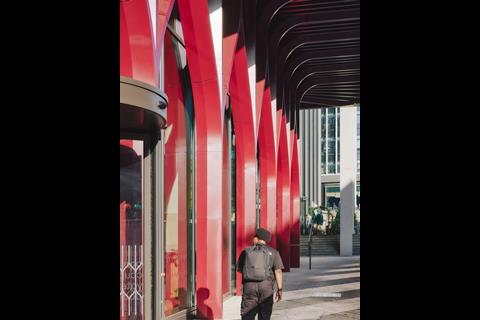
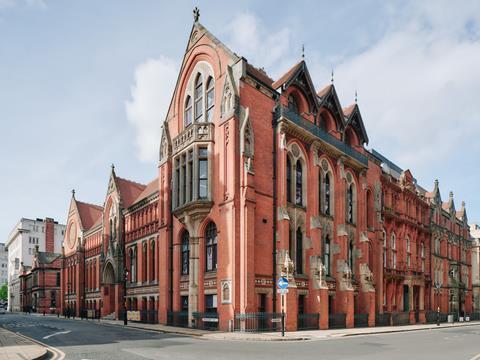
“We wanted to respect the town hall but also to complement it with something new,” says partner Alina White. The facade of Three Chamberlain Square is a flamboyant concoction of fluted orange terracotta fins and burgundy-red metal panels. S-shaped ogee arches wrap around the base and form a coronet around the pitched roof, like an ornate 10-storey birdcage. The best way to fit in with Corinthian columns, it seems to be saying, is to stand apart.
Facade design
Even under a grey winter sky, the terracotta has a warmth to it. “This is a different kind of building for Birmingham, and we wanted to bring a new spirit, of vibrancy and colour,” says White. “In some lights, it’s quite orange, in others, it’s muted and brown.”
In all, there are more than 8,000 terracotta panels, together with 3,000 windows and burgundy-red aluminium spandrels. The glazing ratio has been limited to 40% to control solar gain, but the architects have manipulated colour, texture and depth to make the building feel more transparent.
Approached from an angle, the terracotta fins appear quite opaque. As you get closer, they open up like a lantern, a second tier of inset brown metal panels making the windows appear larger than they are.
Despite the deliberate contrast with the town hall, the terracotta helps to place Three Chamberlain Square as a Birmingham building. In the late 1800s, the gothic revival and arts and crafts movement set the city ablaze with lavish architecture in red brick and terracotta, and this Victorian finery can still be seen on the streets surrounding Chamberlain Square, on landmarks such as The Exchange and Birmingham School of Art.
FCBStudios has borrowed some of these gothic motifs for its birdcage-like facade. Ogee arches – used on the entrance to the Victoria Law Courts (1891) – wrap around the lower two levels, before unfurling to form a canopy on all sides.
At the top of the building, the setback roof envisaged in the Paradise masterplan has been replaced by a single, Mansard-like fold, echoing the steep gables beloved by arts and crafts designers. Finally, the vertical fins come together in another procession of ogee arches that rise like a terracotta crown above the neighbouring streets.
All of this performs a valuable function. The building’s prominent location means it is seen from various directions, acting as foreground and background, notably to views of the town hall from across the square. It was therefore important that it should have no front or back, just a continuous silhouette.


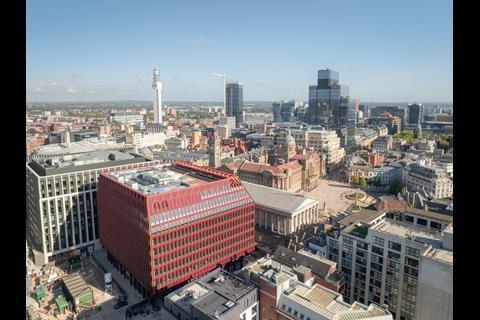
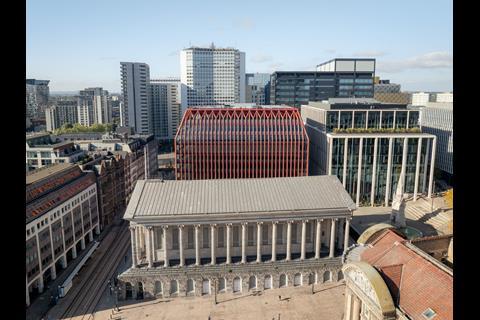
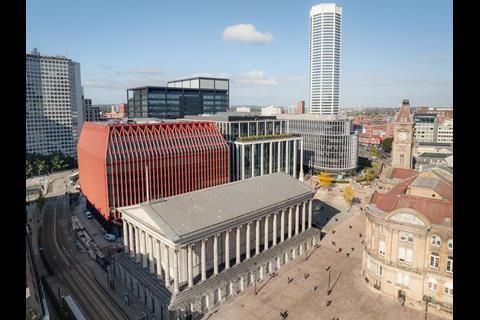
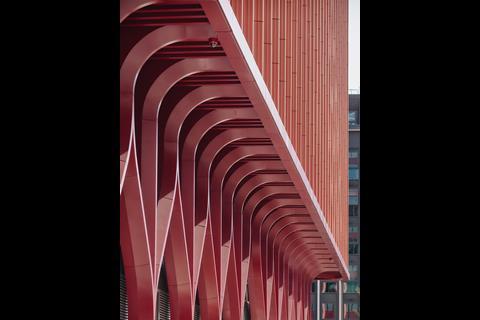
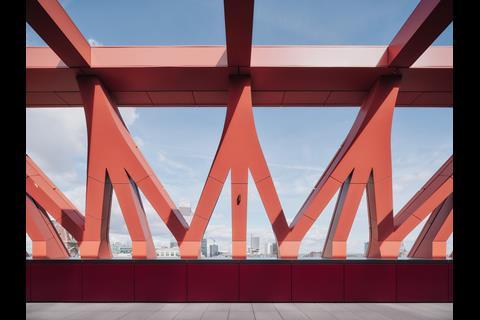

The crown also conceals rooftop plant, including a PV array and two air-source heat pumps, and frames a pergola overlooking the square. “We wanted it to feel enclosed and safe and a bit like you’re in an outdoor room,” says White. “There’s a nice moment in the day when the sun shines through the pergola, casting a shadow of ogee arches onto the town hall.”
Interior design
If anything, the town hall looms larger when you step inside Three Chamberlain Square. From the reception and setback first floor, the full-height glazing seems to magnify the Corinthian columns, and they continue as a prominent backdrop to the upper levels.
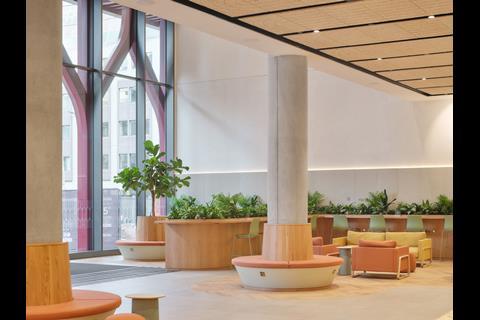
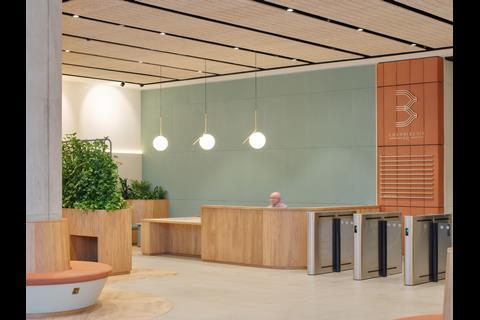
In the 10m-high reception, the palette is natural and low-key, with muted greens and oranges, extensive planting, wood furniture and flooring, and wood wool acoustic ceiling panels. The wall coverings were actually grown as panels: the mycelium-based material was cultivated in ribbed moulds, emerging as an organic, irregular form that holds an uncanny mirror to the town hall’s weatherworn columns.
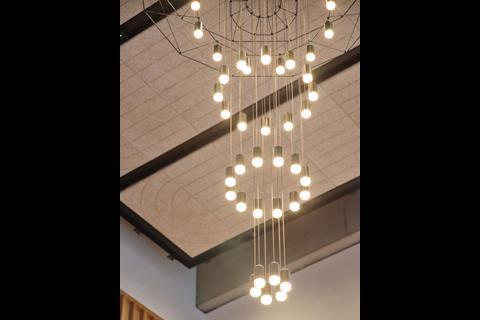
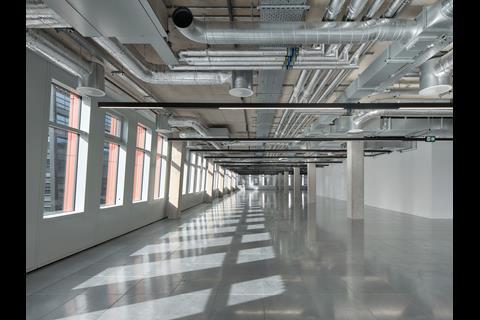
In the office spaces upstairs, the aesthetic changes. There are fewer natural finishes, and services are exposed on raw concrete soffits, with lines of minimalist strip lighting hanging below. Despite the general air of technical efficiency, the 2,100sq m floorplates feel almost domestic in scale.
This is partly due to the use of actual windows, which make the spaces feel more enclosed, and lack the vertiginous thrill of curtain walling. On the upper floors, meanwhile, the cranked columns and sloping roof create corners that could almost be described as cosy.
White points out that it is only below desk level that the walls are opaque, so this has little effect on views or daylight levels. Some of the windows are also openable, allowing tenants to let in fresh air and connect to the street life below. “It’s really useful at times of low occupancy, maybe if workers come in at weekends,” she says. “They can get some air moving without having to run all the services.”

Embodied carbon
The other striking thing about the office floors is the number of columns: as many as 22 fill a typical floorplate. Until recently this would have been viewed as heretical, impeding the flexibility craved by commercial tenants. The British Council of Offices (BCO) advocated long spans of between 9m and 15m; here, the grid has been condensed to 7.5m x 7.5m.
It’s become accepted wisdom that if you want a flexible space, you need 15m – but you don’t
Alina White, FCBStudios
The thinking behind this is twofold. First, short spans don’t inhibit flexibility. “It’s become accepted wisdom that if you want a flexible space, you need 15m – but you don’t,” says White. The grid still offers plenty of flexibility, she argues, with space for banks of eight desks, and the option to partition off individual offices or larger conference rooms. The designers held early talks with property agents, who agreed that shorter spans would have no bearing on commercial viability.
The second reason is that a tighter grid dramatically cuts the embodied carbon of a concrete frame. The original brief set a target for embodied carbon not to exceed 600kgCO2e/m2. In the final building, this was whittled down to 449kgCO2e/m2, equating to LETI Band B.
There is nothing groundbreakingly innovative about how this was achieved, says Tim Stidwill, partner at structural and service engineer Cundall. Rather, it was an attritional process of analysis, scrutiny and refinement. “We looked at various solutions – timber, steel, hybrids – and analysed two bays of the structure over the full height of the building,” he says.
A 7.5m span meant that a conventional 300mm slab could be slimmed down to 225mm if it was also post-tensioned – using 25% less concrete. When 50% of the cement was swapped out for lower-carbon replacements, this came out as the only A-rated option, although Stidwill notes that the RICS methodology they used does not take the carbon sequestration of timber into account. (In the event, the contractor chose not to use cement replacements in the floor structure, but did shave another 10mm off the slab depth.)
Thinning down the slab also reduced the overall weight of the building, and meant the columns and the foundations could be smaller. Because the load is spread evenly across the footprint, the engineers managed to avoid using material-intensive piles. Instead, a concrete raft, 300-1,000mm deep, has been cast onto the hard sandstone that lies just below central Birmingham.





Services design
The services engineers took a similarly interrogative approach to guidelines. Calculations were based on an occupation density of one person per 10sq m, for example, rather than the recommended 8sq m. “From the outset, the fundamental strategy was to achieve realistic and reasonable operating loads for the average occupier, rather than designing for peak loads that might only apply for one or two days of the year,” says Stidwill’s colleague, Cundall partner Mike Gosling.
The fundamental strategy was to achieve realistic and reasonable operating loads for the average occupier, rather than designing for peak loads that might only apply for one or two days of the year
Mike Gosling, partner, Cundall
Again, assumptions about the need for flexibility were challenged: “Generally, flexibility can add quite a lot of carbon, as you end up oversizing systems. We went down more of an adaptability route, with roof space for an additional air source heat pump if needed, and capacity for tenants to move their electrical load between different floors.”
This all felt radical during the design process, but the industry has since caught up. “Where we ended up is actually where the BCO got to with its 2023 recommendations,”says Gosling.
The strict annual performance requirements of NABERS means that, for now, work continues. “NABERS doesn’t stop at the point of practical completion; it’s based on actual metered data. We’re fine-tuning the building to make sure that it performs as it was designed to, and having conversations with the tenants about what they can and can’t do.”
That is how you maintain a rating like NABERS, adds FCB’s White, “Management, tenants, everybody has to want to be a part of it.”
Which brings us back to the crafted terracotta facade, standing in defiant if respectful contrast to the town hall’s Corinthian columns. “If we want somewhere to last for a long time, it has to be somewhere that people want to be, or that people walk past and think, ‘that’s interesting, I wonder who works there?’ It is really important to show that these environmental measures can be done beautifully.”
Project team
Client Federated Hermes
Development manager MEPC
Architect Feilden Clegg Bradley Studios
M&E and structural engineer Cundall
BREEAM assessor CCC Project Services
Main contractor Sir Robert McAlpine
Project Manager AtkinsRealis



2 Readers' comments