



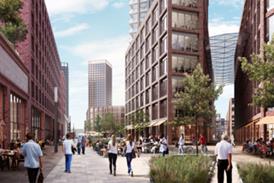





When venues work for women, families and first-time attendees, they become more commercially resilient and socially valuable for everyone, writes HOK’s Kirsty Mitchell

Yesterday (Sunday, 8 March) was International Women’s Day, a time when attention is rightly focused on participation, pay gaps and representation in sport. But a more consequential shift is taking place in the physical spaces in which sport happens.
The rise of women’s sport is exposing how outdated many UK stadiums have become. Attendances have surged by 239% in three years, yet most stadiums remain calibrated for a narrower, older demographic.
In late 2025, the Women’s Super League published the world’s first design guidance for elite women’s football venues. This arrived just as Brighton secured approval for England’s first purpose-built stadium for the women’s game.
The central question is whether our planning system will evolve quickly enough to capture the economic opportunity that this represents.
This is not simply a sporting issue. It is a test of whether Britain can still deliver infrastructure which reflects how people live today.
Stadiums are among the largest pieces of civic architecture most cities commission. Too often, they are treated as isolated, single-use facilities rather than year-round assets capable of anchoring regeneration.
For decades, British stadiums were conceived as inward-looking fortresses, optimised for control and occasional peak use. Women’s sport is challenging that legacy by placing human experience at the centre.
When venues work for women, families and first-time attendees, they become more commercially resilient and socially valuable for everyone.
The rethink begins long before the turnstile. A stadium’s success is now measured from the transport node inward. For women and families, lighting, legibility and personal safety are not secondary considerations. They are decisive factors in whether someone attends again.
If a venue feels intimidating to reach, the design has already failed. This reframes stadiums as part of a wider public realm and transport conversation, strengthening the case for government-backed investment and coordinated urban renewal.
Inside the venue, we are seeing a shift from rigid seating bowls to social environments. Research shows supporters of women’s sport prioritise connection and comfort over tribal separation.
Flexible seating zones, integrated food and beverage spaces, and concourses designed for dwell time encourage people to arrive earlier and stay longer. When a fan spends three hours at a venue instead of two, loyalty deepens and revenue increases.
Facilities illustrate how design assumptions have lagged behind reality. The traditional 80/20 male-to-female toilet ratio is a relic. Moving towards a 45/45/10 split and family rooms better reflects actual modern audiences. Parents, older supporters and disabled fans all benefit.
Women’s sport has revealed a mismatch between cultural momentum and planning frameworks designed for another era
Acoustics are another overlooked dimension. Women’s sport generates different sound profiles: higher-pitched singing and live DJs. Designing for clarity and warmth, rather than sheer volume, creates atmospheres that feel celebratory rather than aggressive.
Whether it is a sold-out WSL match or an Ibiza classics event at the AO Arena, sound design is a key driver of inclusivity.
The same thinking is transforming athlete facilities. In women’s football and basketball, player arrivals have become major broadcast moments. Modern designs replace anonymous concrete corridors with arrival routes that acknowledge visibility and identity. This “fit-walk” culture signals that elite women’s sport deserves elite infrastructure, not retrofitted leftovers.
The economic case is clear. In the United States, purpose-built venues such as Kansas City Current’s Riverside Stadium have driven record attendances while anchoring mixed-use regeneration. Inclusive design is not a compromise but an upgrade to how cities deploy land and capital.
Britain now faces a choice. Women’s sport has revealed a mismatch between cultural momentum and planning frameworks designed for another era. The government has an opportunity to treat inclusive stadiums as catalysts for regeneration, rather than letting many sit idle for over 300 days a year.
When designed properly, these venues support local jobs, animate neighbourhoods throughout the week, and give communities a focal point for civic pride.
The recently opened Roig Arena in Valencia illustrates this approach. Conceived as part of a wider urban transformation, it transcends the conventional sports venue role.
When you design for women, you design for humans
It activates the surrounding community while attracting visitors from around the world, demonstrating how user-centred design can shape an enduring civic destination. It attracts footfall throughout the week and has sparked mixed-use development in that quarter of the city.
As International Women’s Day reminds us, equity is embedded in the spaces we build and the priorities we fund. When you design for women, you design for humans.
Inclusive venues do not narrow their audience; they expand it. They generate more revenue, deeper loyalty and stronger communities.
If Britain wants stadiums which deliver lasting value rather than becoming underused monuments, planning policy must evolve. Women’s sport has built the demand.
The failure to respond will not be one of culture or commerce: it will be one of planning and political will. This is not a niche agenda about women’s football. It is a test of whether our national infrastructure is fit for the future.
Kirsty Mitchell is an architect, sport and entertainment, at HOK







No comments yet