







Residents of Crouch End in north London have had a long and sometimes fraught wait for Reginald Uren’s 1935 former council HQ to reopen, but they now once again have a building to enjoy and cherish
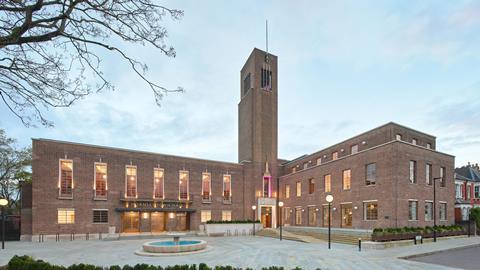
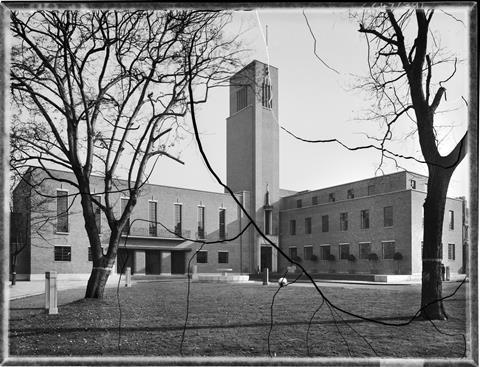
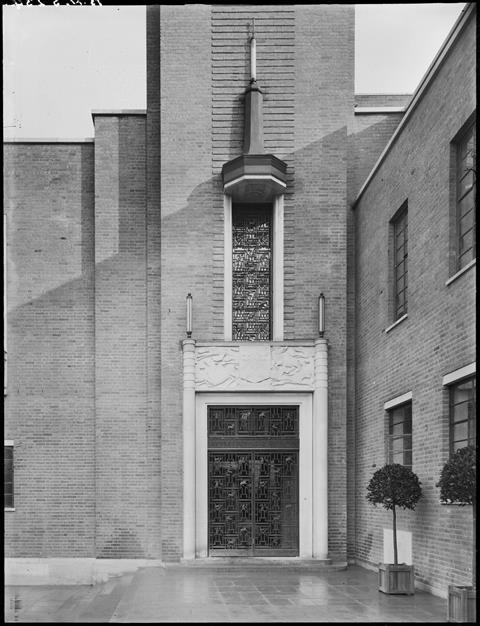
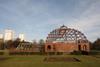
In 1935, Dutch modernism landed in Crouch End. Designed by the 27-year-old New Zealander Reginald Uren, Hornsey Town Hall looked more like a utopian factory than a council HQ.

There were double-height Crittall windows, and annexes for gas and electricity showrooms. There was an assembly hall with a sprung dance floor. There was a synchronometer in the basement controlling the building’s 78 clocks, to make sure that meetings started on the dot. And there was even a factory gate: a huge bronze screen somewhat incongruously depicting woodland animals and emblazoned with the epithet “Administration”.
Much of that municipal world has disappeared, not least Hornsey council itself, merged into Haringey in 1965. By 2000, the council had moved out of the town hall and, by the 2010s, it was on Historic England’s heritage-at-risk register. The grade II*-listed building was trapped in a spiral of inaction, falling further and further into disrepair and becoming ever less viable.
Successive schemes by DSDHA, Bennetts Associates and John McAslan foundered. Enter Make Architects, alongside Hong Kong-based developer Far East Consortium – at first glance, an unlikely fetishist of mid-century local government.
In 2018, FEC bought a 130-year lease for £3.5m. To pay for a £20m-plus restoration, it proposed to build 135 private-sale apartments, mainly in two blocks at the rear of the site.
Unlike the previous consented scheme, there were no homes in the town hall itself; instead, the former office floors would become a 68-room aparthotel. This, FEC argued, would better overlap with the public uses, which included an arts centre based around the restored assembly hall, a rooftop bar and terrace, restaurants and co-working areas.
The hotel also helped to win over Historic England. “The rooms are more or less the same size as the original cellular offices, so we were able to keep the historic plan form,” says Katy Ghahremani, director at Make. But the local community’s response was more cautious.
Was this the revival of a much-loved institution? Or a Faustian pact? Could it be both? “Everyone was a bit jaded by the time we arrived,” says Ghahremani. “Developers had spent over a decade trying to make various ideas work but each time something had gone wrong.”
It has been a long and often fraught wait. Originally scheduled to complete in 2021, the project was beset by covid and rising material prices. In 2024, contractor Ardmore posted an £11m pre-tax loss, citing problem contracts; a year later, its construction arm filed for administration. The local press began to express doubts that the arts centre would ever be delivered.
But now, finally, Crouch End residents can get to judge the project for themselves. The revamped town hall was unveiled just before Christmas: the hotel, café, public lounges and coworking hub are open; the apartments are almost fully sold; and key spaces including the assembly hall, council chamber and main committee room have been restored, awaiting an events programme from recently appointed building operator General Projects which runs the art programmes as well as the building’s studio, office and co-working spaces.
The Town Hall Square separating the complex from Crouch End’s busy high street has been revived, with new planting and a layout based on Uren’s original sketches. Two restaurants on either side of the square as well as the rooftop bar are expected to open later in the year.
The patina of history
Step inside Hornsey Town Hall and every detail, from door handles to light fittings to sculptural stonework, oozes interwar charm. Working closely with Historic England, Make has taken a light approach, happy for the building to look a little worn around the edges.
“Generally, we have tried just to repair bits that were damaged, and fix stuff that wasn’t working,” says Ghahremani. “But it was really important to retain that patina of history.”
In the public areas at the front of the building, materials such as terrazzo, limestone and black marble have been polished but otherwise allowed to show their age. Even in the former administrative spaces, where the palette becomes more utilitarian, the cork floor tiles have been largely retained, having proved surprisingly resistant to the weary tread of officialdom.
Where possible, light fittings have been restored – as have the 78 clocks. “There was a clause in the specification that the restorer had to have more than 25 years of experience,” says Ghahremani. “We found an 80-year-old clockmaker in Oxfordshire.”
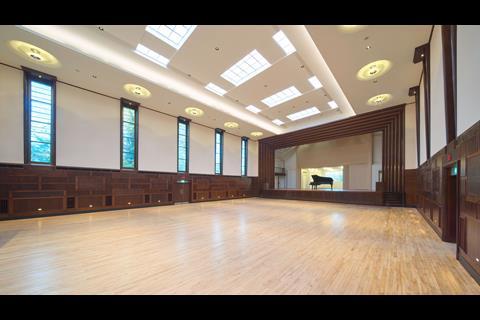
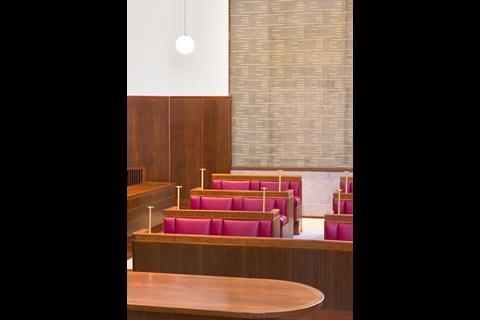
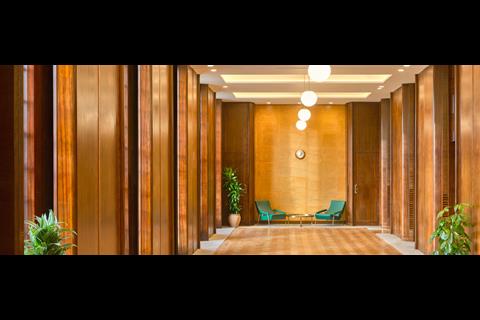
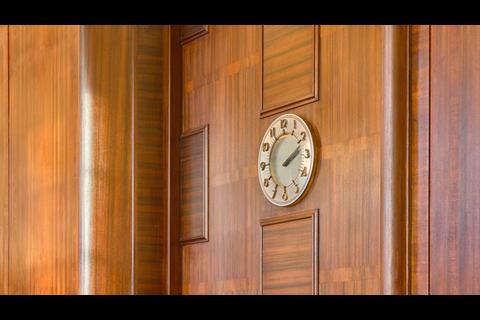
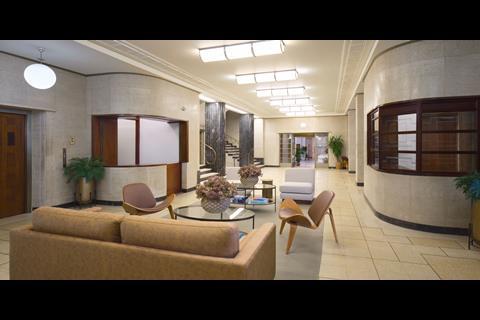
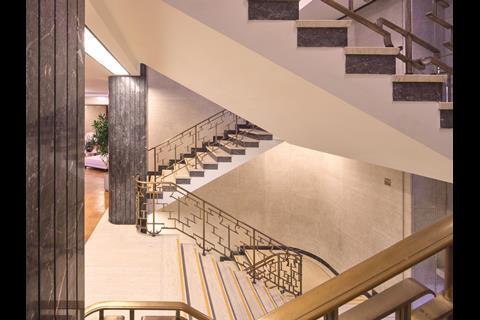
Where original pieces had been lost to time, the architects turned detectives, searching for clues in archive photography and drawings. The council chamber’s full-height wall coverings, commissioned from Heal’s, have been reproduced from a fabric sample, and missing pendant lamps have been replicated by specialist craftsmen. Original furniture was tracked down to a council warehouse, retrieved and re-upholstered.Much of the worst damage had occurred in the assembly hall, a much-treasured local venue that once hosted concerts by the likes of Queen and ELO. Water had leaked in through the slate roof and the guttering, which – unusually for the time – was concealed within the wall cavity.
Many of the geometric wall panels of Australian walnut, teak and Indian laurel had simply rotted and fallen apart. Those that could not be repaired have been replaced by sustainable alternatives, stained and orientated to match the original grain.
The stage’s magnificent walnut proscenium arch – strangely hidden for years behind a dismal panto-style curtain – has been returned to its former glory, ready once again to host music and other events. Unobtrusive secondary glazing has been installed as acoustic protection for the neighbouring flats and hotel rooms.
In bed with the borough engineer
In some spaces, such as the council chamber, main committee room and the (decidedly un-modernist-sounding) mayor’s parlour, the focus has been almost wholly on restoration, with future uses still only vaguely defined – FEC suggests a flexible roster of concerts, exhibitions, weddings and more coworking. Others have required more enterprising reinvention. The counter where people once paid their rates, for example, is now a co-working space (complete with a safe that no one knows how to open).
In one of the few significant structural alterations, a steel-framed wall has been inserted towards the back of the assembly hall, rising up through the full height of the building. This creates three new spaces within the existing fabric: at ground level, a large lobby for the hall, currently being used as a cafe; above this, a small cinema, in place of the hall’s original raked seating; and beneath the roof, a loft-style office with a kitchen, meeting room and access to a roof terrace.
The assembly hall does not suffer for being shortened – the raked seating was so far from the stage that Brian May’s hair must have been a distant blur.
Uren always imagined that it could be extended or reconfigured. We always think that we’re the first people to think about flexibility, but he was already doing that in 1935
Katy Ghahremani, director, Make Architects
In the hotel, which takes over most of the upper floors on the south and east sides of the building, wood-panelled offices once occupied by departmental chiefs have been made over as boutique bedrooms, complete with names such as “The borough engineer’s office”. The panelling had to be taken down, moved around and reassembled like a jigsaw to fit the bedroom layouts, while the bureaucrats’ wood-framed glass cabinets have been repurposed as wardrobes and partitions for kitchenettes.
It is all brilliantly conceived, but also mildly eccentric – one wonders whether bedding down in the office of Hornsey’s chief of education will hold quite the same quirky charm 20 years from now.
The town hall as a whole has proved surprisingly flexible, says Ghahremani. Spaces can be subdivided – the committee room has a remarkable series of 4m-high folding partitions, made from solid wood and integrated into the wall panelling. But the building was also designed to be added to: a sequence of linear blocks with space at the rear for expansion.
“Uren always imagined that it could be extended or reconfigured. We always think that we’re the first people to think about flexibility, but he was already doing that in 1935.”
New buildings, and new routes
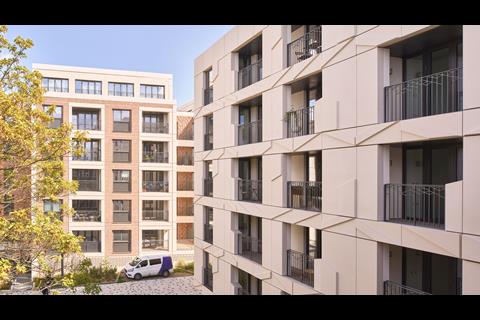
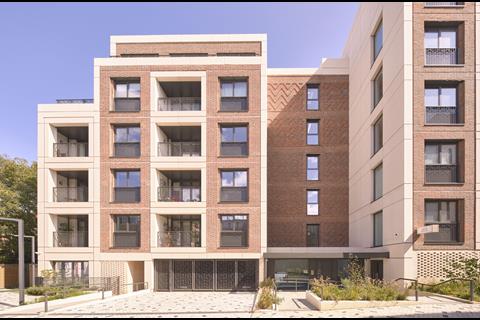
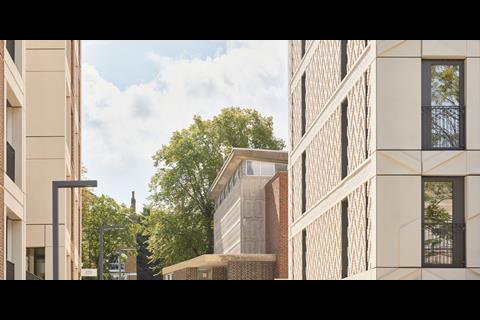
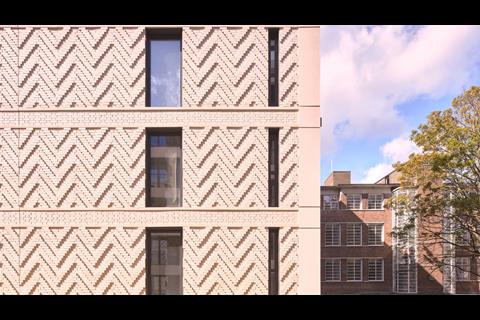
As a result, the new apartment blocks feel relatively unforced. The first, named after Arthur Ayres, the sculptor responsible for much of the town hall stonework, extends from the side of the rear administration block, and is differentiated by the use of light-toned glass-reinforced concrete cladding. This has been cast with a chevron relief pattern – a reference to the herringbone parquet used liberally throughout the town hall.
The chunky, patterned concrete also ties the complex in to the neighbouring Hornsey Library, a bracingly brutal, grade II-listed 1960s building wrapped in precast slabs with a repeating abstract motif. The library and Ayres Building form two sides of Town Hall Gardens, a previously closed-off space that has been remodelled and opened to the public. Crouch Enders approaching from the east can now cut through the gardens and town hall on their way to the high street.
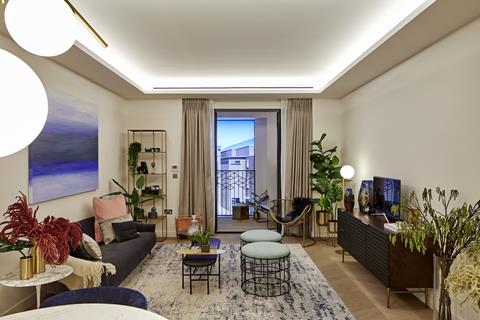
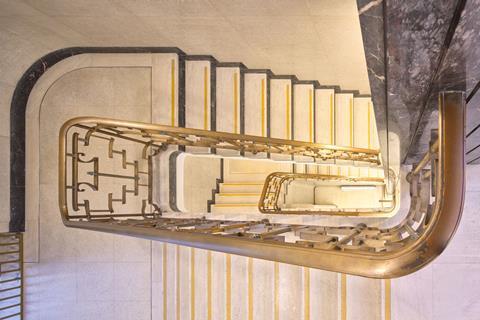
The second apartment block, known as the Uren Building, faces the back of the town hall, opening up previously hidden views of one of its best features – a full-height bow-fronted glass stairwell straight out of an Agatha Christie adaptation. Residents can admire this from their own art deco-inspired metalwork balconies, before retreating into apartments filled with further riffs on the town hall interiors, from retro satin nickel toggle switches to terrazzo kitchen worktops.
Between the two blocks, Make has carved a second new route, publicly accessible during daylight hours. Again, it opens up connections to the library and cuts out one of the high street’s busiest corners.
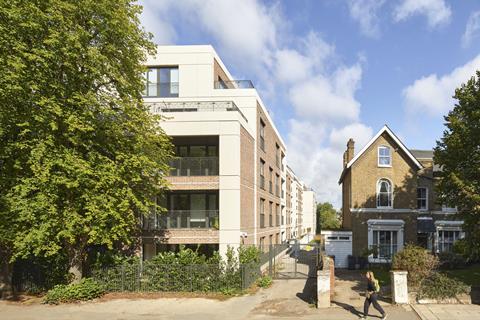
For a densely occupied town-centre development, the buildings slot into the townscape surprisingly efficiently – invisible from the front of the town hall and stepped down to fit with the scale of the streets on either side.
“The local residents were really concerned about that,” says Ghahremani, “but we’ve placed the larger massing at the heart of the site, which works really well with the mass of the town hall.”
In the context of heritage buildings, phrases like new-build residential, aparthotels and co-working hubs tend to make the heart sink. But Hornsey Town Hall wears its new uses relatively lightly. This is partly due to the generosity of Uren’s original design, and partly to its sensitive handling by Make and its army of specialists.
There is irony in the fact that its value as a historic artefact, and by extension as a commercial and community asset, is precisely because of the malaise of municipal Britain. We are drawn to art deco committee rooms and synchronometers as remnants from a lost age – a time when it seemed natural to place a council chamber and a sprung dance floor in the same building.
Starved of local authority largesse, town halls have become exotic. Perhaps the chief of education’s office will still hold the same allure in 2046 – the austerity age equivalent of a berth on the Orient Express.
Project team
Client Far East Consortium
Architect Make Architects
Conservation architect Donald Insall Associates
Structural engineer Heyne Tillett Steel
MEP engineers Sweco; Long + Partners
Employer’s agent / quantity surveyor FulkersBaileyRussell; Certified B Corp
Acoustic design Sandy Brown; TRIUM
Lighting design Pritchard Themis
Landscape architect Outerspace
Main contractor Ardmore Group

Through ongoing analysis and expert commentary, Regen Connect highlights the policies, funding streams and local priorities that matter most to the construction and development sector.
This coverage will culminate in a special report to be published at our Building the Future Live Conference in London on 7 October.
How you can get involved:
Throughout the year, our team will be gathering insight from across the sector to inform editorial features, debates and events. We welcome contributions from practitioners who want to share experience or shine a light on emerging trends.
Click here for more on the campaign
Be part of the conversation – contact us to contribute or get involved by emailing our deputy editor at dave.rogers@building.co.uk and to find the campaign on social media follow #regenconnect
Postscript
Nick Jones is a copywriter and editor specialising in the built environment



2 Readers' comments