


So much heat leaked from Manchester’s grade II listed Pall Mall that it was being used only for storing cardboard boxes. In what is believed to be a first, developer Bruntwood SciTech and architect Sheppard Robson got consent to replace the failing 1960s facade with a thermally upgraded facsimile, demonstrating how detailed analysis and close engagement with planners can secure radical interventions on listed buildings when justified by sustainability and viability concerns. Thomas Lane reports
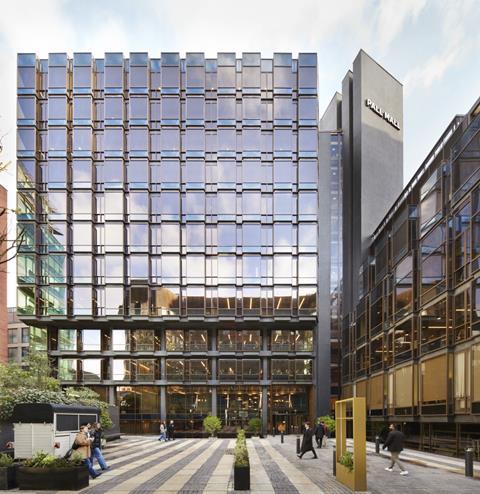
Located on King Street in the heart of Manchester’s central business district, Pall Mall could not be more different from its London namesake. Designed by Harry Teggin of the firm Brett, Pollen & Teggin and completed in 1968, the Manchester building features a distinctive dark bronze-coloured facade characterised by projecting rectangular oriel windows arranged vertically in pairs separated by modest gaps. The glazing to the oriel windows are also bronze-tinted and are a marker of the period from which this building dates.
Pall Mall Court, to use the building’s original name, was considered sufficiently special to warrant grade II listing in 2000. Unfortunately, a key feature behind the listing, the facade, performed so badly that the building had been all but abandoned despite its prime location; being used for storage rather than as a workplace.
The predominantly glass facade was single glazed and, to make matters worse, the sealing tape had failed, resulting in draughts that anecdotally were bad enough to blow papers around on the desks.
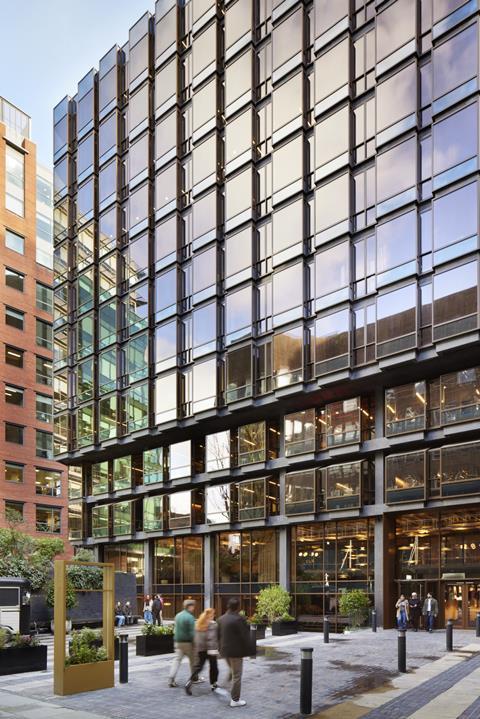
Developer Bruntwood SciTech with architect Sheppard Robson have just completed a full refurbishment of the building, which includes an all new, facsimile of the original facade which the team believe is a first on a commercial listed building. The rarity of an intervention on this scale demonstrates how difficult it is to get listed building consent for such a radical change.
Unsurprisingly, getting consent was a major challenge and risky for Bruntwood SciTech as failure would have left them with an unlettable, EPC G-rated building. Why did Bruntwood SciTech take this project on? And how did they get permission for such a radical move?
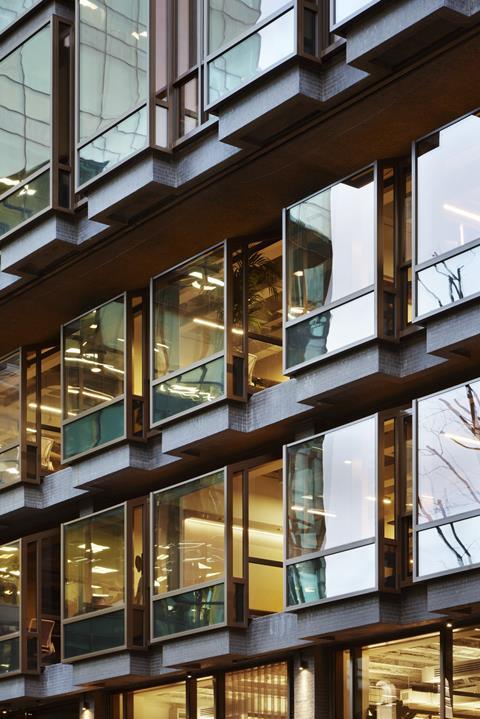
Bruntwood bought the building in 2021 knowing something had to be done about the facade. “It was a significant risk. But what an opportunity to acquire a building in such a prime location,” explains Alex Edwards, the ESG director for Bruntwood SciTech.
Edward says that Bruntwood SciTech’s long experience in Manchester – which includes many successful, low-carbon retrofits and relationship with the planning department at the council – convinced him that taking on the building was worth it. He adds that the timing helped too.
“If we had had this conversation two or three years ago when the sustainability and net zero agenda wasn’t where it is today, we probably would have faced more challenges from the conservation perspective.”
The building’s shortcomings extended beyond the facade. It was designed as a headquarters building for insurer London Assurance but ended up being sublet to individual tenants as the firm merged with Sun Alliance during construction.
Conceived for a single occupier, the building featured a tiny, 25sqm reception on King Street which was grossly inadequate for a multi-tenanted building. The building is arranged as three distinct volumes in a Z-shaped plan. The solitary entrance with its adjacent bank of lifts made it difficult to divide up the floorplates into self-contained spaces for individual tenants.
What’s the building like?
One of the nice surprises about Pall Mall is how the low-rise King Street elevation with its mean main entrance morphs into a much more impressive experience at the back of the building. A pedestrian alley off King Street opens onto a plaza, a rarity in this part of Manchester. Two sides of the Z-shaped Pall Mall plan enclose the plaza with the main block rising to 12 storeys, twice the height of the King Street elevation.
The height and the fact that you are partially enclosed by the building provides a much more powerful architectural experience of the mid-century style of this building, with its unique brown-glazed oriel windows that form most of the facade.
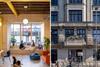
Faced with a tiny main entrance accessed by a flight of steps on King Street, the team took the wise decision to move the main entrance to the back of the building to the lower ground floor. This meant getting permission to shift the external steps inside the entrance and cutting a section out of the ground floor slab to create more headroom – this is a 1960s building after all – and, by opening the reception out to the first floor, giving it a more spacious, airy feel.
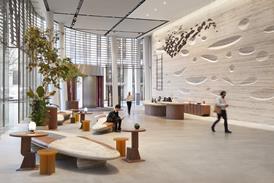
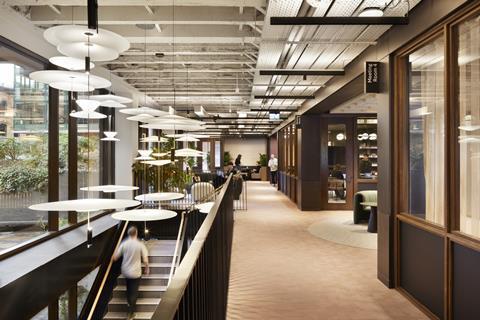
Even so this space is tiny when judged against the cavernous reception areas of many London offices. There is a modest reception desk and a coffee bar complete with seating on the ground floor. Yet it all feels perfectly adequate and is a much more efficient use of space.
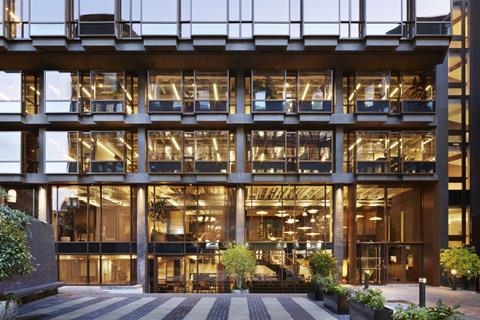
The building layout is configured around what Edwards describes as the Bruntwood SciTech “product stack”. This includes a gym and cycle facilities with showers in the basement, the cafe on the ground floor and pay-as-you-go office space and meeting rooms on the lower ground and ground floors.
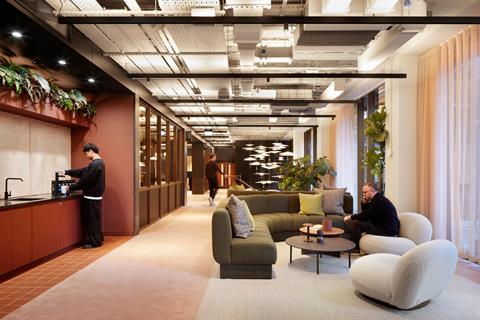
The first, second and third floors are fully fitted out complete with furniture, which Edwards says is increasing in popularity. The floors above are conventional office space.
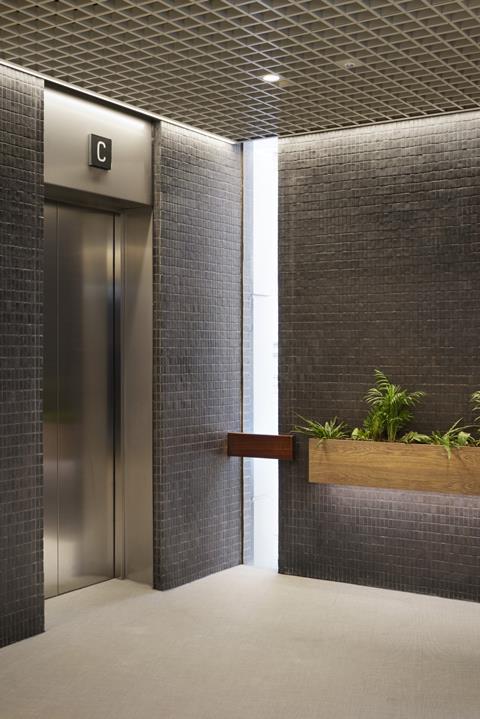
The lift lobbies retain a period feel with mosaic cladding to the walls and sapele veneered fire doors, which are replicas of the originals as these did not meet modern standards. The offices have an intimate feel thanks to the low floor-to-ceiling heights typical of buildings of this period.
Edwards did consider low-profile raised access flooring to increase the headroom, but this would have meant specifying a new system rather than the reclaimed product which helped reduce upfront embodied carbon. The services are exposed to help create a greater sense of space.
The original concrete structure is left exposed, which was a brave move at it is frankly a mess with lots of exposed reinforcing and expanded metal mesh. Edwards says tidying this up would have been too expensive; instead it has been painted a light grey.
This looks fine as it is mostly hidden by the services and, where visible, it is a reminder of this building’s history. Roof terraces have been incorporated to meet the modern desire for outdoor amenity space.
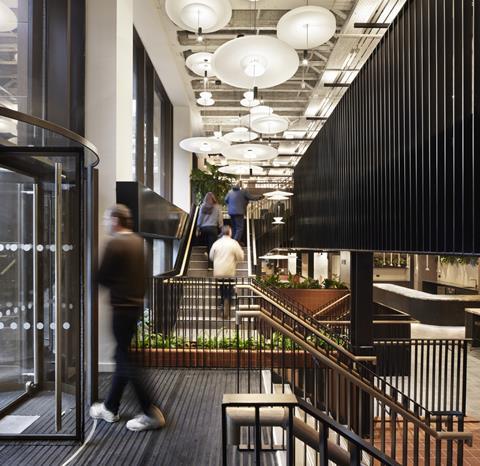
Overall Bruntwood SciTech and Sheppard Robson and the rest of the team have done a fine job on what was a stranded asset, bringing it sustainably back into use and celebrating the unique style of the late 1960s.
The problems with the facade extended beyond the inadequate glazing and failed sealing. The gaskets contained asbestos and the spandrel units had failed. The exterior coating had degraded and been badly recoated in places.
The building was originally naturally ventilated and featured floor-level sliding sashes, which were potentially dangerous. And the facade would not meet modern line-loading standards – the ability of the facade to resist horizontal loads such as a person leaning against it.
Despite these issues, the team considered eight options including doing nothing, fitting double-glazed units into the existing frame, fitting secondary glazing, opting for a new, standardised facade, and the option of replicating the original facade. These were evaluated against 13 criteria which included aesthetics, heritage impact, carbon impact, cost, warranties and buildability.
Edwards and Alex Smith, the Sheppard Robson partner responsible for this project, stress the criticality of the close engagement they had with the city planners. For Edwards, the options matrix was the key factor in getting approval to replace the facade. This showed that a replacement facade was a much lower carbon option than the alternatives.
“The matrix clearly demonstrated for this building to have a long-term, viable future, the full facade replacement was the only credible option. Without that really detailed analysis, I think we would have met much firmer opposition against the proposal to change it.”
Aware of the risks of the facade on the budget and programme, Edwards split procurement into two parts – design and build for the building refurbishment and construction management for the facade and associated scaffolding. A main contractor, Dragonfly Contracts, with whom Bruntwood has a long established relationship, managed both elements.
Construction management meant Bruntwood could engage a cladding specialist, Quest Solutions, early in the process to help with buildability issues, and facade engineer Wintech was also onboard from the beginning. Working up a design that met modern standards and faithfully replicated the original facade was inevitably complex and time consuming and risked delaying the whole programme if procured traditionally.
“If you are waiting to get to the end of the [design development] process before you send it out to tender, then you have lost a significant proportion of time,” Edwards says. Engaging the facade specialist early meant work could start much on manufacturing the new façade more quickly.
For Smith the granting of listed building consent was only the beginning of the long haul to realise the facade. He says the devil was in the detail.
“When you get the first set of drawings from the supply chai,n it looks about right if you were two metres back [from the façcde],” he explains. “But when you start to analyse the number of components that the supply chain were using to get to a warranted system – they were introducing a lot of further horizontals, or two-piece mullions – which on the face of it appear to be like for like but, when you put it up against [the original facade] it didn’t work. We then had to go back and challenge that.”
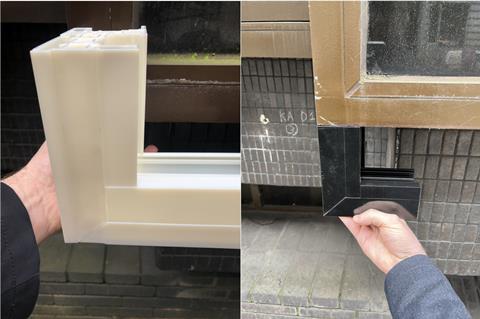
Smith turned to 3D printed facade sections to get a better idea of how closely the proposed design would match the existing façade. “I was offering these up to the facade and we could see if a bead wasn’t right. It is all those little details that wouldn’t have been clear on a 2D drawing, but instantly recognisable from the print,” he explains.
The planners agreed on a plus or minus 10mm deviation from the original dimensions to allow for double glazing and thermally broken framing. “The local authority understood that to go from a single-glazed, uninsulated facade to a double-glazed, insulated one there was going to be a variance,” Smith says.
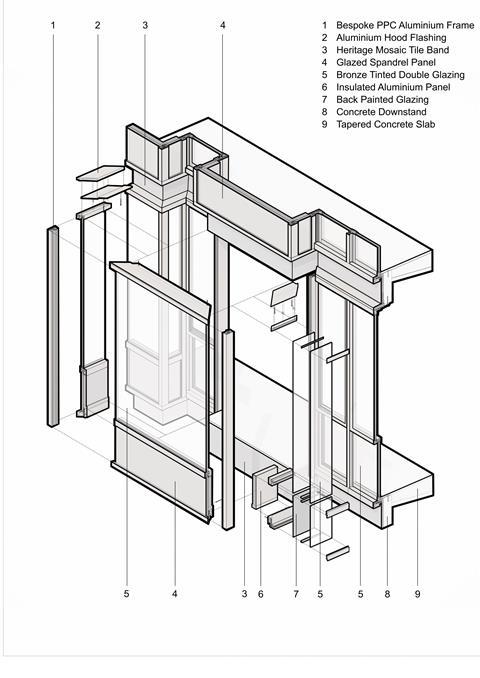
With listed building and planning consent secured, the team were allowed to remove a section of the facade to better understand how it was made and fitted together. This revealed that the facade was similar in construction to ribbon windows as the floor slab edges, which were clad in mosaic tiles, formed part of the facade.
“We did a forensic analysis of what could be incorporated that would make a warranted detail and what elements we would have to change,” says Smith. He adds that there were regular meetings with the planners to resolve these issues.
“The local authority was keen to be part of the process and agreed an engagement schedule before building work started. At that point, we had almost a fortnightly meeting with them.”
There were a few instances where it was not possible to stay within the agreed tolerance of +/- 10mm, for example the spandrel panels needed to be thicker to accommodate insulation, a change that is visible internally. Smith says all the work that went into getting the facade as close as possible to the original and justifying deviations was well received by the planners to give them the confidence that the best possible outcome had been secured.
“Without that dialogue and the enthusiasm of the conservation officer and the local authority, it would have been a more challenging process,” he says.
How to justify replacing a listed building’s envelope
In conservation circles, the wholesale replacement of a listed building’s envelope is a radical move. The presumption is to retain original fabric by repair rather than replacement.
Inevitably, some elements of listed buildings will need to be replaced over time, for example timber windows eventually rot and need replacing. But it is rare for the entirety of a building’s exterior, which is the face it presents to the world, to be replaced.
Smith is a fan of listing, saying the preservation of historic buildings stops cities becoming bland and boring. “If this building wasn’t listed, it would probably be demolished and replaced by something that would have probably less visual interest and amenity to the city,” he says.
But buildings should not be preserved in aspic as, throughout history, these have evolved to meet the changing needs of the people who occupy them. In the case of Pall Mall, excessive energy use in a world that needs to cut carbon emissions, and where people expect a comfortable working environment, the leaky, single glazed facade meant the building had become uninhabitable.
Edwards stresses that a thorough understanding of the building was essential to justify changes.
“Understanding the asset and the impact that potential interventions have on reducing carbon emissions and making the building fit for purpose over a longer period of time is absolutely fundamental to delivering the right interventions,” he explains. “We clearly demonstrated that the facade replacement had to be delivered to maintain this building.
“But, for other buildings, it might not be the facade but something else. Unless you come from a position of knowledge and understanding you cannot then justify the interventions that need to be made.”
To all but the expert eye, it is difficult to tell that the facade is a thermally upgraded facsimile of the original. This maintains the architect’s original aesthetic intent, which is a key reason for listing a building, and ensures its future. As Smith says: “That is a strong offer, because what we have done is prolong the life of this building for another 60 years.”
A facade of this nature was always going to be expensive, and Edwards concedes there were viability challenges to overcome. This included gaining planning for an additional storey on one of the lower-rise elements which increased the amount of net lettable space. This also included space for plant, which freed up space elsewhere.
Most of the facade is a modified Kawneer system. There is a new entrance on the plaza at the back of the building, which necessitated changing the original oriel windows for a more conventional, planar facade. This is a Technal system which was also used for the cladding to the new plantroom.
The main works started in January 2024, with Bruntwood SciTech taking partial completion toward the end of last year. Practical completion will take place this month.
Edwards says the thermal performance of the facade has improved from a U value of 6.5W/m²K to 2.0 - 2.2W/m²K [ck] and is much more airtight. Minimising embodied carbon was a big focus for the team with every element scrutinised for carbon impacts.
A big saving was the use of reclaimed raised access flooring. Edwards says the upfront embodied carbon was a highly commendable 203kg/m2. This equates to a seven-year carbon payback compared to leaving the building unimproved.
The building now boasts an EPC A energy efficiency rating, putting the days of it being a cardboard box repository firmly in the past.
Project team
Client Bruntwood SciTech
Architect Sheppard Robson
Structural engineer Booth King
M&E engineer and sustainability consultant Ramboll
Façade engineer Wintech
Planning consultant Deloitte
Cost consultant Enabl
Fire engineer Bespoke Fire
Main contractor Dragonfly Contracts
Façade specialist Quest Solutions
Mechanical specialist Cubic Works
Electrical specialist Carter Complete Building services

2 Readers' comments