


WA100 International Architect of the Year 2025 finalist Kettle Collective guides us through the unique specification challenges at the Majid Al Futtaim mosque
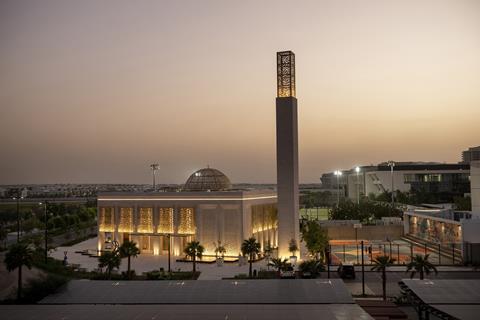
Kettle Collective’s work was shortlisted in two categories at last year’s AYAs, including the WA100 category for International Architect of the Year. Here we take a look at one of the projects in its entry in this category – the Majid Al Futtaim mosque in Dubai – and ask Khairul Khalifah, technical director of the firm, to talk us through the biggest specification challenges involved.
What were the key requirements of the client’s brief? How did you meet these through both design and specification?
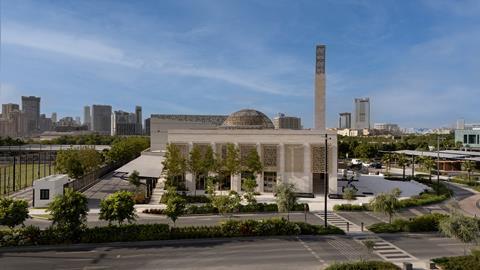
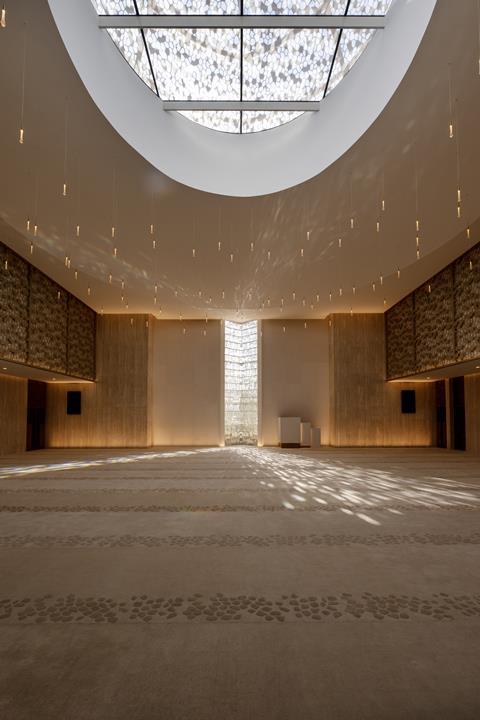
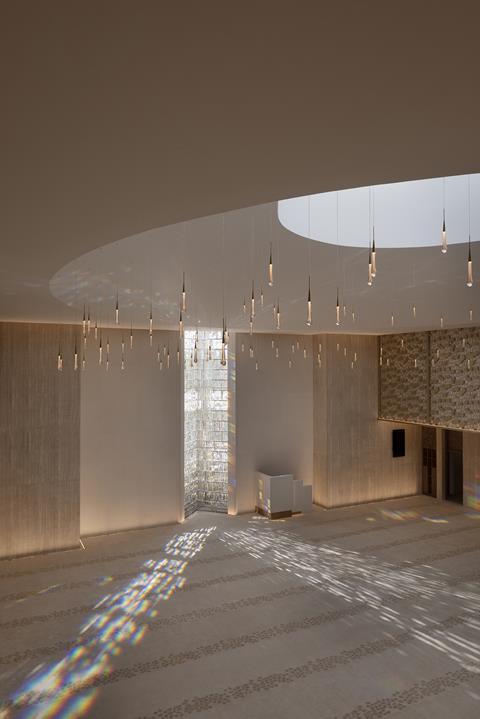
The mosque was envisioned as a new religious landmark that would complement Dubai’s modern urban landscape while reflecting its deep-rooted cultural and spiritual traditions. As the mosque is named in honour of the developer’s late founder, it needed to be an especially memorable building. We carefully thought through and detailed every part of the worshippers’ experience to achieve this – from the beacon minaret calling out to the faithful to the richly detailed and layered facade, the journey through the shaded colonnade all the way to the prayer hall bathed in dappled light from the dome and ethereal glow of the crystalline mihrab.
The client’s brief called for a 13,000ft2 mosque for up to 500 worshippers, with segregated prayer areas, self-contained accommodation for the imam and muezzin and dedicated child-minding facilities. It also needed to act as a social and cultural touch point for the local community while achieving ambitious sustainability targets, creating an environmentally responsible building that could set a new benchmark for religious architecture in the region.
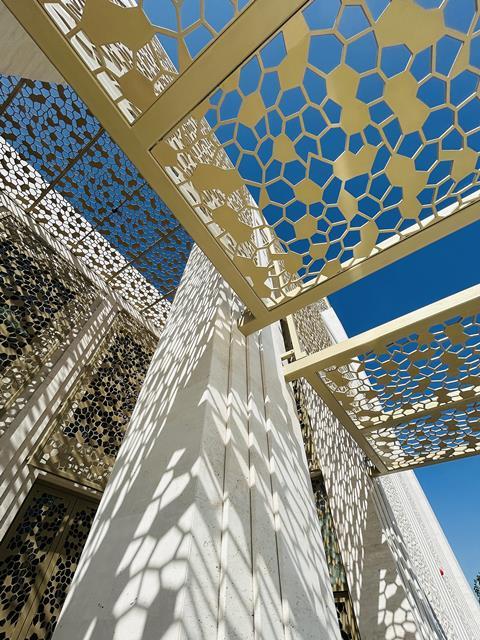
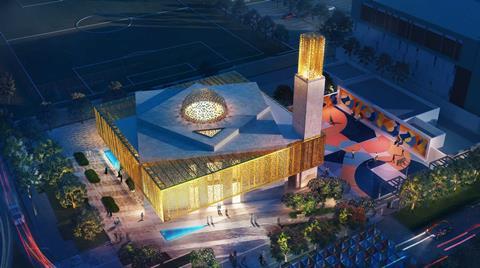
We responded by carefully balancing functionality, spirituality and sustainability through both design and specification. The building’s rotated square plan, inspired by Islamic geometric design, aligns the building to face qibla while creating a dynamic relationship with the surrounding urban context. A welcoming colonnade guides worshippers from the public realm into a tranquil spiritual space, reinforcing the mosque’s dual civic and religious role.
To meet the client’s sustainability goals, we incorporated a thermally efficient building envelope, fully shaded glazing to reduce solar heat gain, and energy-efficient lighting and HVAC systems. Extensive roof-mounted and car-park-shading photovoltaic panels generate clean energy on site, while an advanced grey-water recycling system saves precious water by reusing treated grey water from the wider community for irrigation.
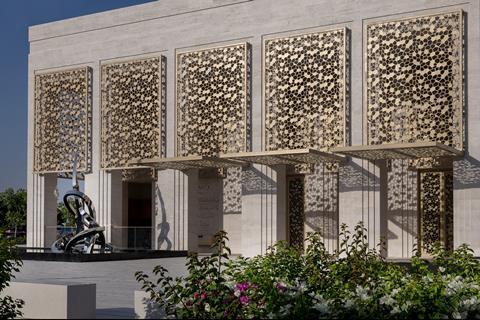
Materials were also selected for durability and cultural resonance. For example, limestone cladding with carved ghaf leaf motifs symbolises both national heritage and environmental resilience.
The result is a beautifully detailed, multifunctional and inclusive space that fulfils the client’s cultural, social and environmental aspirations. The Majid Al Futtaim has become the region’s first net positive religious building, achieving BREEAM excellent certification and setting a new standard for sustainable design in the Middle East.
What were the biggest specification challenges on the project and how were these overcome?
Designing a sustainable and highly energy efficient building in the arid climate of the UAE posed a significant challenge. To meet this challenge, we drew on many years of experience and knowledge, most notably from delivering a net positive energy sales and experience centre building for Majid Al Futtaim – the Tilal Al Ghaf Sales and Experience Centre won a BREEAM regional award (Asia) in 2022
The result is a building that has already achieved exceptional energy efficiency, and assessments show it has exceeded its net zero target of 173,574 kWh/annum by an additional 30,547 kWh/annum. This surplus energy is redirected back to the community, reinforcing the mosque’s dual commitment to environmental and social responsibility.
What are the biggest specification considerations for a project of this type? How did these specifically apply to your project?
As with most prominent public buildings, key drivers in the materials specification were quality, durability and sustainability. This was particularly true of the material that clad the mosque. Limestone fulfils these requirements as its natural beauty lends the mosque an air of timeless elegance. It also offers crisp detail, yet a tactile and warm quality, with durability that only stone can offer. Limestone is also inherently a more sustainable material choice compared with other types of stone, as it takes less energy in its production and is recyclable at the end of its lifecycle.
Do you have a favourite product or material that was specified on the project?
A highlight was the interplay of limestone, pattern and shadow. The mosque has squared arches on all four elevations, which each feature intricate carvings inspired by the leaves of the ghaf tree – the UAE’s national tree that also lends its name to the Tilal al Ghaf community in which the mosque sits. This motif is echoed in the mashrabiya shading screens, which cast dappled shadows reminiscent of light filtering through a tree canopy. Combined with the soft glow of the decorative backlit mihrab, the result is a serene, ethereal atmosphere that enhances the spiritual experience.
Are there any suppliers you collaborated with on the project that contributed significantly? And what was the most valuable service that they offered?
Kettle Collective’s own lighting designer worked closely with local lighting specialists to help achieve a lighting scheme that very successfully enhances the architecture and interiors of the building.
The play of light and shadow across the facade of the building cast by the mashrabiya pattern, as well as the intricate motives carved into the stone facade, reinforce the character of the building at night. Inside the prayer hall, bespoke pendant lighting drops adorn the domed ceiling, creating a constellation of points of light above the worshippers.
What did you think was the biggest success on the project?
Majid Al Futtaim sets a new benchmark for sustainable religious architecture in the Middle East. As the region’s first net positive religious building, it shows how places of worship can lead the response to the climate emergency.
Beyond its environmental credentials, it is a mosque of the future, a powerful symbol of Dubai’s cultural heritage and forward-looking vision. Visually iconic yet warm and welcoming, it honours the traditions of Islamic architecture while embracing innovation.
Project details
Architecture and interior design Kettle Collective
Structural engineer Muamir Design & Engineering Consultancy and Arif & Bintoak Consulting Architects and Engineers
M&E consultant Nottingham Mechanical & Electrical Consulting Engineers and Arif & Bintoak Consulting Architects and Engineers
Landscape design InSite International
AOR Arif & Bintoak Consulting Architects and Engineers
Quantity surveyor Arcadis and Omnium International
Contract administrator Currie & Brown
Main contractor AlGhurair Contracting & Engineering Works
Aluminium and glazing Hisn Al Fahidi Aluminium
MEP works Al Ghurair
Travertine facade Azula Marble
Travertine and mocha cream walls and floor finishes Qasr Al Murjan Bldg. Mat. Trd. LLC
Internal floor tiles RAK Ceramics
Prayer hall carpets The Floorist
Mashrabiya panels and dome Cast Aluminum Industries
Joinery MDC
Lighting supply Istanbul Electricware Trading
Photovoltaic solar panels Yellow door energy
Grey-water recycling Hydraloop
Artwork curator Malorie Fourrier
Sculpture artist eL Seed
Our “What made this project” series highlights the outstanding work of our Architect of the Year finalists. To keep up-to-date with all the latest from the Architect of the Year Awards visit here.



No comments yet