



A £5m refurbishment of a former farm building in Hertfordshire embodies the spirit and life of the artist while radically cutting embodied carbon and operational energy use
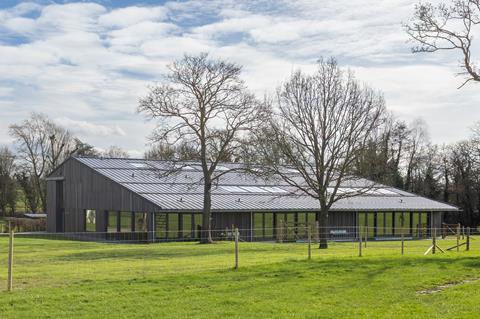
Nestled in the gentle landscape of east Hertfordshire, the Henry Moore Studios and Gardens has added a refurbished gallery and education space that fits both the late artist’s ethos and working practices as well as our current need to minimise environmental impact and upcycling in the built environment.
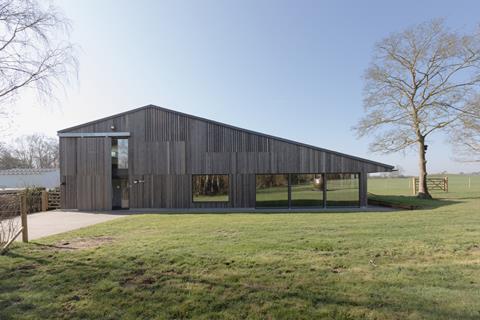
The £5m Sheep Field Barn in the hamlet of Perry Green pulls off quite a trick, blending familiarity and understatement with impressive environmental credentials – the scheme retains the form of the original farm building, doubles its original size but at the same time the team has managed to halve operational energy use and minimise embodied energy.
“If Henry Moore walked around the corner today [to the main side entrance of the building], he would recognise this building,” says Lesley Wake, chief operating officer at client the Henry Moore Foundation.
“We didn’t want a blot on the landscape … [or] a modern steel and glass building. We wanted something that felt very agricultural, that really spoke to the vernacular of the original architecture.”
Elegant frugality: respecting Moore’s legacy
The architect DSDHA has kept very closely to its original competition-winning entry from 2022, which co-founder Deborah Saunt summarises as characterised by “elegant frugality”.
In an interview with Building Design last year, Saunt put the firm’s competition win down to “good research… We spent time getting to ‘know’ Henry Moore really well.” She described him as an “amazing sculptor” who never became pretentious.

The practice’s careful and subtle approach to the design ensures that the building celebrates the landscape and Moore’s work while sitting comfortably with the surrounding studios in which the artist used to sketch and create his distinctive sculptures.
In a neighbouring field an imposing and striking bronze work of Moore’s – Interior/Exterior – stands facing the barn and is visible from the workshops. On the other flank of the barn, sheep are free to wander at will (Moore sketched many of them from one of his studios).
“It feels inevitable that you are part of a bigger landscape which, again, goes back to [Henry Moore’s] work,” Saunt says.
The building, which opened to visitors this month, is now in its third iteration. It began as a steel-framed farm building which Moore used to store his work when he moved from London and bought the grounds in the 1940s; then as a converted gallery designed by Hawkins\Brown. This was opened just before the turn of the century, over a decade after Moore’s death at the age of 88 in 1986.
We didn’t want a blot on the landscape… [or] a modern steel and glass building. We wanted something that felt very agricultural, that really spoke to the vernacular of the original architecture
Lesley Wake, chief operating officer, Henry Moore Foundation
DSDHA’s job, according co-founder David Hills, was to create the “most modest intervention” to the building which is in keeping with the rest of the 70-acre grounds. These consist of 10 buildings, from a variety of studios and Moore’s house – called Hoglands – to a converted main entrance, visitor centre, cafe and educational space designed by Hugh Broughton Architects and completed in 2017. Most of the other buildings in the grounds are “simple buildings that existed here before” Hills says.
Wrapping the barn and cutting embodied carbon
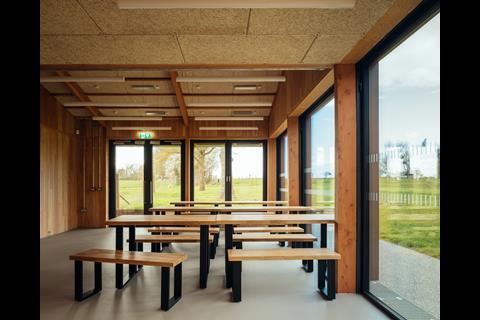
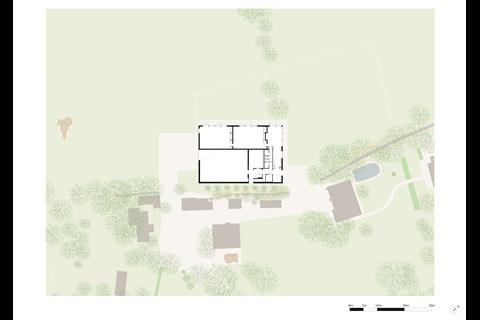
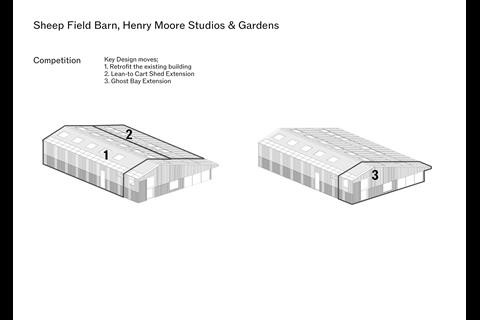
The ingenious design solution that DSDHA came up with was to wrap and extend the existing barn – most of which was made up of a large ground-floor gallery space. The wrap consists primarily of reclaimed, lightweight solid timber for the roof and reclaimed silver spruce cladding with sheeps’ wool insulation for the new facade.
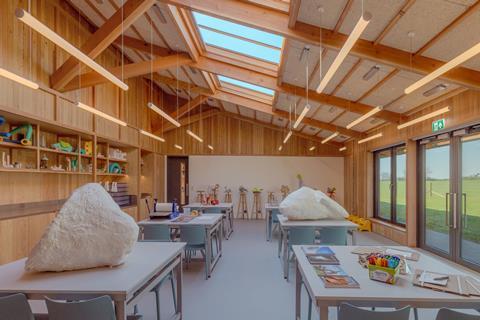
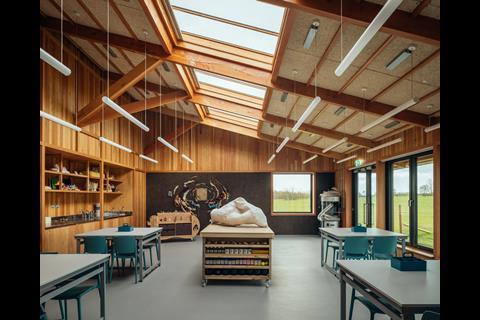
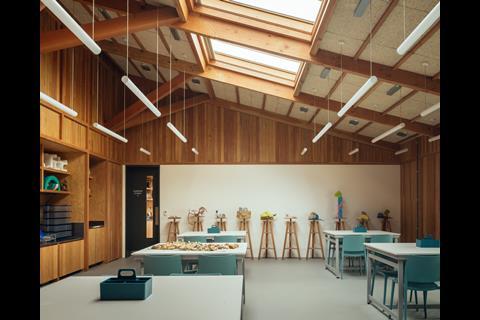
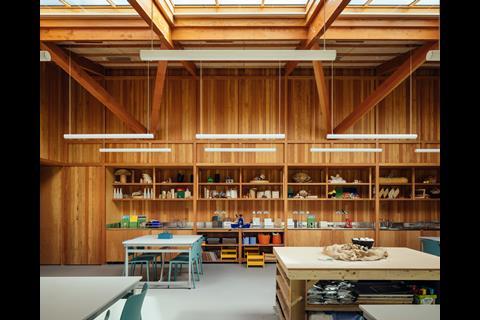
This radically improves the existing building’s air tightness and brings natural light to the extended workshop and education spaces. These sit under a lean-to extended roof and the wrap also incorporates an extended footprint to one side to create a new more welcoming and open entrance area.
The scheme creates a new first floor, which houses a temporary exhibition space and a tightly packed plant room. “The exterior of the building has been wrapped in the same way that some of the [Moore’s] sculptures have an inside and outside form,” says Mills.
In the new spaces, heating and cooling is provided by ground source heat pumps and the roof has integrated PV panels which fit seamlessly within the new structure. The panels are manufactured by UK firm BIPVuk and save around 40% in embodied carbon compared to regular glass-made PV panels due to reduced materials required.
In a rare intervention by the ultimate client – Moore’s daughter Mary – the positioning of the g-value openable rooflights was shifted downwards to make them more consistent with other buildings in the grounds.
The two gallery spaces – on the ground and first floors – have a higher energy demand than the rest of the building, given the need for constant temperature and humidity to protect the artworks, which is supplied by mechanical ventilation.
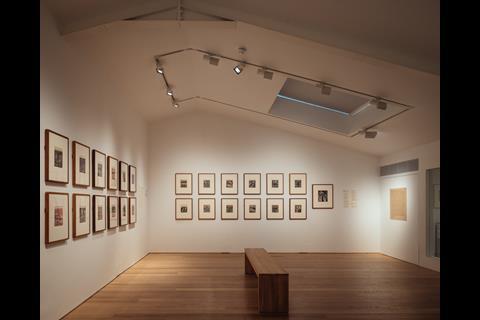
The upstairs gallery kicks off with an exhibition of 30 of Moore’s shelter drawings which he created in the Second World War and which first catapulted him to fame just as he was moving to the rural home in which he spent just over half his life. Moore fans are in for a treat this spring and summer: over in west London, Kew Gardens is showing the largest-ever outdoor exhibition of his sculptures.
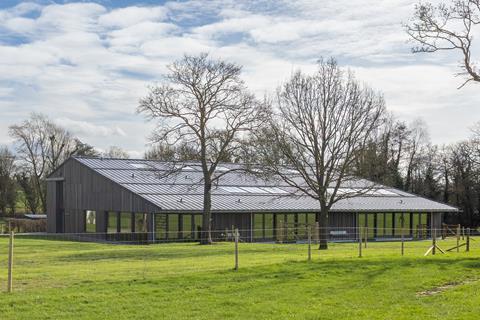
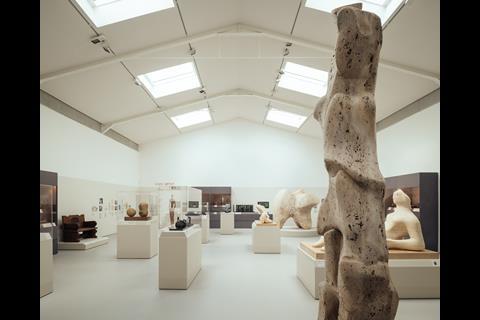
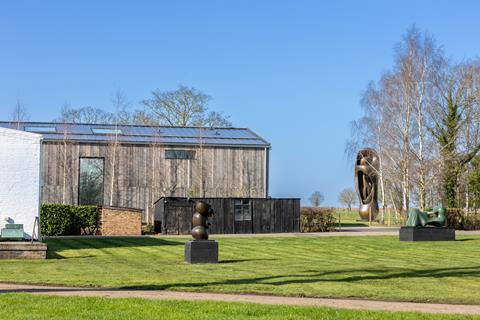

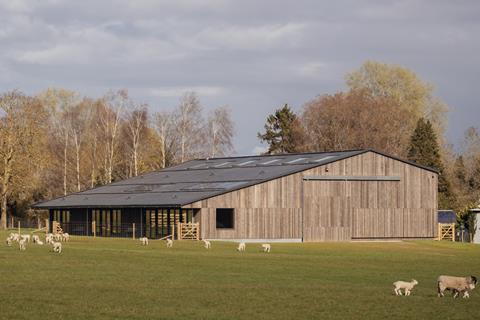
The Hertfordshire retrofit needed to be low/zero noise as well as low carbon, says Hills. This was achieved by removing noisy air-conditioning kit – both internal and external – to make the main gallery “as calm and pure” as possible.
This gallery also houses a permanent exhibition charting the life and work of Moore, which until now has been missing for visitors according to the foundation.
“The gallery goes some way to joining the dots between the different elements of his life and work and giving [visitors] the bigger picture in a more cohesive way,” says Sebastiano Barassi, head of Henry Moore collections and programmes.
Careful choice of materials
As well as minimising ongoing use, the project has strong credentials for embodied energy and choice of materials. “The materials of the building are as circular as possible in terms of using reclaimed material on site,” says DSDHA project architect Guy Mills.
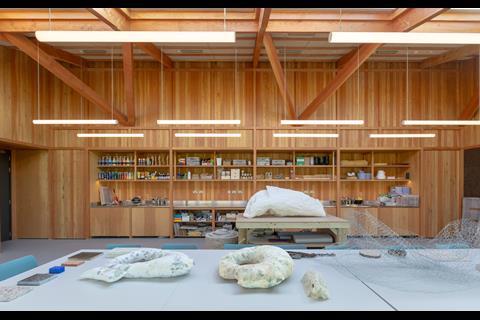
The block work was reused, as was the original external timber cladding which now features in the interior of the two new workshops.
The external sliver spruce timber cladding was recycled from another rural building. Other materials were chosen with the mantra of simplicity, durability and circularity in mind – from sheeps’ wool insulation in the external walls, rubber floors, cork wall and steel screw piles (these can be unscrewed and re-used at the end of the building’s lifetime).
There are a “lot of incremental gains from careful material choices,” says Mills who adds that the client was ambitious but did not want to be a guinea pig for overtly radical choices.
This close attention to circularity fits with Moore the artist and the construction client. Befitting the stereotype of Yorkshire, his county of birth, Moore was frugal and restrained in his development of the grounds. This was despite his considerable spending power – Moore was reported to be second only to the Beatles as the UK’s highest tax-payer in the 1960s.
When adding extra space to the grounds, Moore’s instinct was for retrofit over new build. The Aisled Barn building that introduced new exhibition space for his tapestry works was reconstructed on site in 1980 from an existing building on a separate site. His hotch-potch of studios evolved in tune to the changing nature of his work.
He created multiple different versions of a plastic studio, from a large 15m high version in the 1960s to its current garden-shed like version. Materials for these buildings and his work were often sourced from what was lying around rather than bought in. As Wake quips, he was not a frequenter of B&Q.
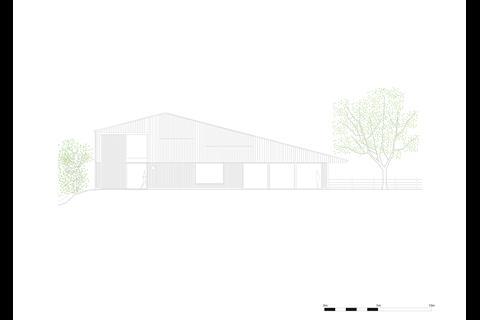

In overall performance metrics the scheme considerably outperforms the closest LETI 2030 targets for schools – by more than half in fact. Upfront carbon was 217kg CO2e/m2 and operational carbon is 24kWh/m2/year (LETI targets are 600kg and 65kWh respectively). The building also has an A7 EPC rating.
Saunt describes the result as “amazing” and praised the “client’s vision to really want to see that performance” delivered by the project team.
Everyone’s dream is that the next Henry Moore or Sarah Lucas will be born from having been inspired by coming to the grounds and having a space to work
David Hills, partner DSDHA
Inspiring future artists
The barn will also allow the foundation to deliver on Moore’s passion for education. He was generous with his time in welcoming fellow and budding artists to Hertfordshire while he was alive and ensured that this would be sustained when the foundation was first created.
Godfrey Worsdale, the foundation director, sees a heightened need for the organisation to lean further into this practice, given the current paucity of arts education available for schoolchildren and the fact that the barn can go some way to proving that arts can be “life enhancing”.
The charity hopes to double the number of schoolchildren who visit the studios and gardens (from the current figure of 2,000) and has created two new workshops in the barn to achieve this. The open and warm spaces allow visitors to get hands on and creative – one space is dedicated for wet and messy activities – and to connect with the landscape and sculptures.
In a nod to its woolly neighbours that the artist welcomed in his grounds and sketched in later life, there are sheep dip sinks positioned just outside the workshops. “Everyone’s [in the team’s] dream is that the next Henry Moore or Sarah Lucas will be born from having been inspired by coming to the grounds and having a space to work,” says Hills.
Project team
Structural engineer: Webb Yates
Mechanical engineer: Harley Haddow
Planning consultant: Turley
Quantity surveyor: Stockdale
Contractor: Rooff
Fire consultant: BWC
Acoustic engineer: Sandy Brown
Ecologist and arboriculturist: TMA
Postscript



No comments yet