




Designed to LETI Net Zero Carbon standards, the Raymond Chandler Library is analysing 12 months of in-use energy data to close a small operational performance gap, while also delivering restoration works to the school’s central Charles Barry building
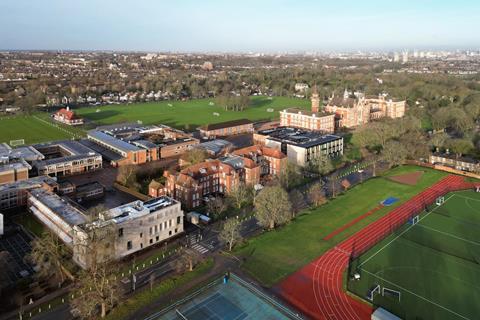
The cultural significance of a new building at an eminent independent school is not what it was 150 years ago. On 21 June 1870, the future King Edward (then Prince of Wales) travelled six miles into south London to open Dulwich College’s new building by Charles Barry Jr. “A fair candidate for the wildest 19th-century building in the whole of London”, as Ian Nairn later put it, with a mishmash of styles “thrown at each other with a kind of nihilistic joy”.
From this cornerstone came a succession of buildings, each reflecting the preoccupations of their day, as the college expanded through contemporary architectural patronage: in 1934, a cricket pavilion by Danby Smith, unveiled by a former England cricketer; in 1969, the great brutalist Christison Hall dining room by Manfred Bresgens and Malcolm Pringle of Austin Vernon & Partners (the practice behind of much of the Dulwich Estate’s mid-century housing), opened by Prince Philip; in 2016, a Grimshaw science block with the James Caird, Sir Ernest Shackleton’s lifeboat, moored in its atrium.
There have been smaller, less trumpeted infill projects on the grade II-listed campus too, but the most significant development in recent years has been the £5.5m Raymond Chandler Library. The building, completed last year and opened in the Michaelmas term of 2024, now provides a full year of in-use energy performance to analyse. Designed to meet LETI net zero carbon standards, it achieved its embodied carbon target and is now being optimised to close a small operational energy gap.
The library was designed by alma-nac, a young south London studio known for retrofit, inventive housing and their Design for All initiative, which offers free architectural services for small charities and community organisations. This summer, they went on to deliver a contemporary restoration of the central Barry building, updating the school’s symbolic centrepiece; the face on every prospectus and the prototype for Dulwich College International’s campuses in China, Singapore and South Korea.
The progressive face of a 400-year-old institution
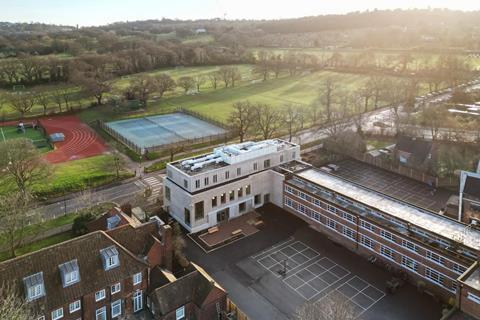
The new lower school library sits by a quiet road leading up to London’s last toll gate, with treetop views over playing fields and the woods, golf course and allotments beyond. Over three floors, it provides a library, computer labs and teaching space, all catering to just two years of boys aged 11-13.
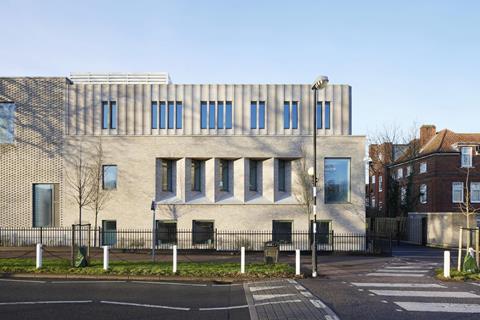
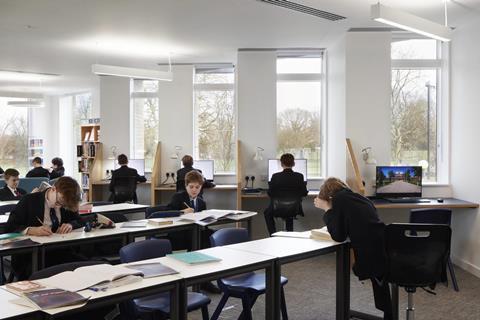
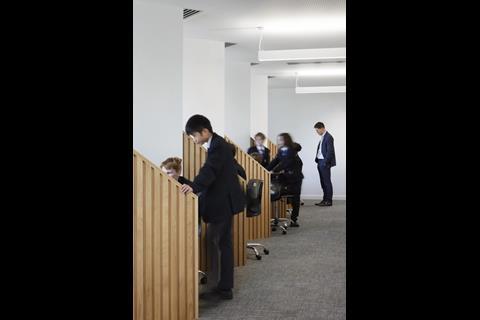
The choice of pale sand-coloured brick is deferential to its more elaborate rusty neighbours, but has enough texture and variation to break down any sense of bulk with style. The circulation core is differentiated by a chequerboard pattern, neatly dividing the building into three parts. The setback at the top, clad in scalloped precast panels, contains a flexible space for robotics experiments and a top-lit ICT lab with exposed glulam beams and an abundance of computers in tidy rows.
What you cannot see from the roadside is how seamlessly this new structure is knitted into the postwar classroom block behind it, which will be retrofitted in a future phase. Internally, the corridors continue as if they were a single building; externally, the L-shape formed by the two blocks now shelters a courtyard play area edged by wildflower planting.
Raymond Chandler studied at Dulwich College in the 1900s, but it is hard to find any traces of his time there in the Los Angeles underworld of his detective, Philip Marlowe. However, conveniently, there is a parallel to draw between Chandler’s precise scene-setting and alma-nac’s choreography of movement and light.
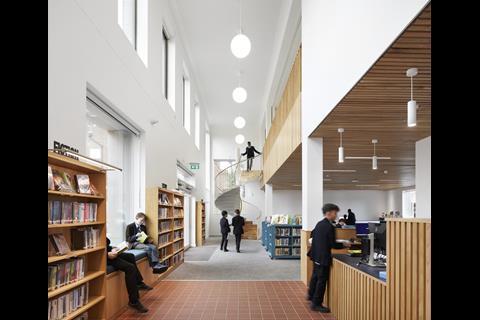
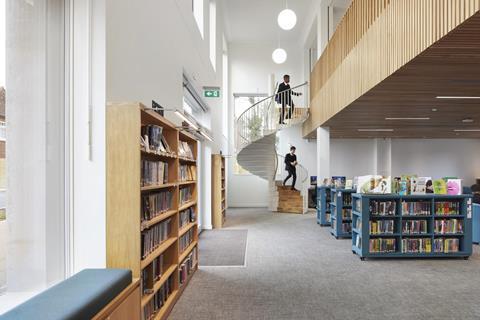
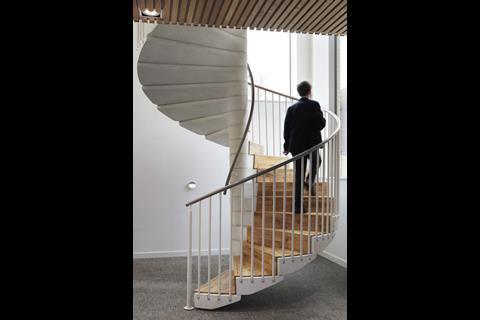
Windows are positioned to reveal glimpses of activity and there’s a flash of drama in the spiral staircase, which is a sweep of oak-topped precast concrete connecting the ground floor library with the gallery-level classroom.
Project data
Start on site: January 2023
Completion: July 2024 (phase 1)
Construction cost: £5.5m
GIA: 870sqm
Co-designed from first principles
Like its predecessors, the architecture is an expression of its time. Today, that means being contextual, designed for flexibility, energy performance and with a more outward-looking social mandate.
Under a community use agreement with Southwark council during planning, the library will host events such as Dulwich Literary Festival and other initiatives through the Southwark Schools’ Learning Partnership.
Alma-nac’s director and a former pupil, Tristan Wigfall explains how the design was a more inclusive process too, inspired by the Baupiloten Method of co-design (named after the Berlin studio where it originated). This wasn’t tokenistic, as the architects’ layout was substantially reconfigured during these interactive workshops with boys and staff.
Where we do have concrete, it’s low embodied carbon – the same with the steel
Tristan Wigfall
The project furthers the school’s net zero ambitions, following a 2011 masterplan developed with John McAslan + Partners. To reduce embodied carbon, the design team worked with engineers Max Fordham to devise a hybrid lightweight steel and concrete structure.
“Where we do have concrete, it’s low embodied carbon – the same with the steel,” adds Wigfall. They initially explored a full CLT structure, but found it “couldn’t meet their operational demands”.
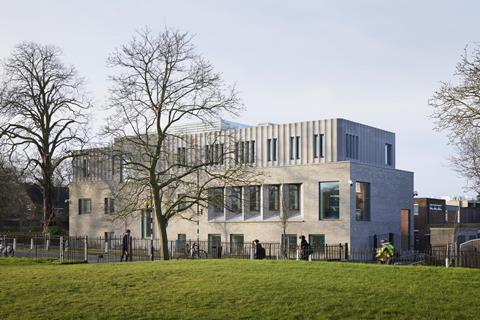
The building’s envelope is based on Passivhaus principles: thermally efficient and airtight, with deep window reveals and automated blinds to keep the space cool in summer. Heating and hot water are powered by air-source heat pumps on the roof, contributing to its BREEAM Excellent.
Having had a year in use, its performance has been analysed. “Carbon calculations have been scrutinised to the nth degree,” explains Wigfall, and it’s ongoing: “It’s a little bit like handing over a car, you have to refine it, tweak it, make sure it’s operating the way it’s supposed to.”
Operational energy use (73 kWh/m²GIA) is currently 13% above target, which is fairly typical for early optimisation, he explains. Working with Max Fordham engineers, the team have developed a plan to improve controls, vary temperatures in different spaces, work with staff on everyday use and fine tune the heat-pump settings. These measures draw on insights from alma-nac’s government-funded Net Zero Accelerator, a project with 25 schools that shows how simple behavioural, design and technical changes can act together to cut energy use.
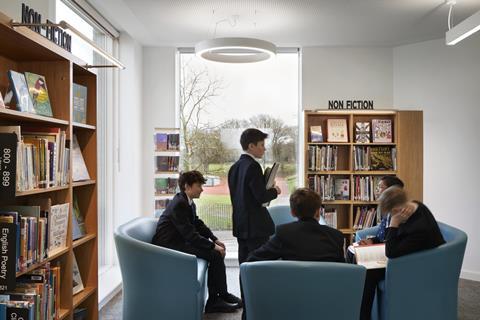
Reading library in use
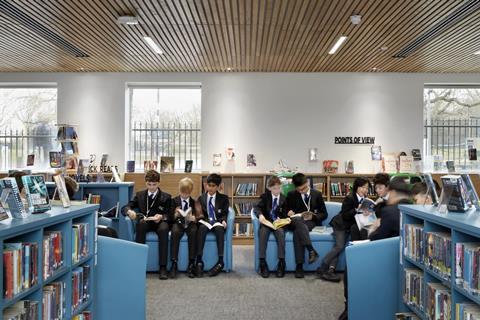
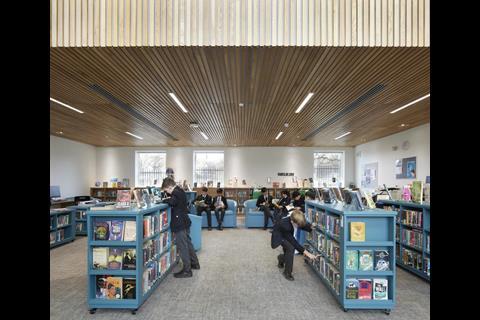
The library’s previous home was a temporary building, in place since 1998. The new building has enabled extended opening hours and it is used “from when we open our doors to the close of the day” the head of lower school, Fran Cooke, tell us. The teaching space is highly adaptable. “In one recent lesson, we were able to clear everything out of the way to lay out eight huge maps of Dulwich Village.”
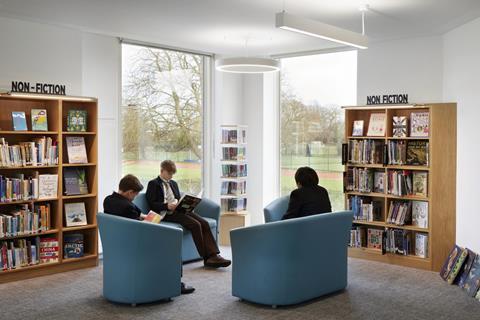
From the road, the angled first floor windows look like they might be reading nooks. Yet inside, they turn out to be filled in by study desks with computers. Freed from the monitors, the bays could be inviting corners to sit with a book and a window on the world. Not criticism of the design, but its interpretation. Hopefully, like the school, this too may soften with time.
You find them reading in all kinds of spaces
Fran Cooke
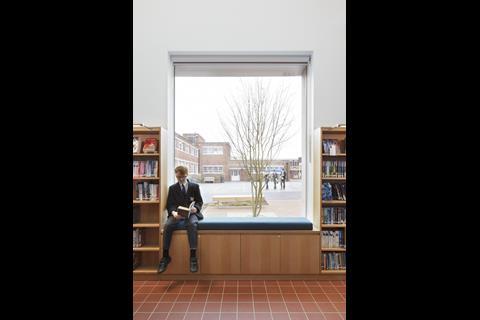
Still, like water, boys find a way. “They contort themselves into niches,” Cooke adds. “You find them reading in all kinds of spaces.”
The building has become “an extension of the playground” and a place to finish conversations, make magazines and play chess (Marlowe would have approved). In its details, the design feels warm, from the window seats and cabinetry to the natural timber battened ceiling, librarian’s desk and earthy tiled floor. The only exception is the circle of blue leather chairs, which seems a slightly corporate choice.
School exchange
Dulwich College has the means and space to stretch out, its only physical constraints being the conservation area and South Circular Road, which roars across its northern boundary. Local schools benefit from the use of its expansive facilities too, but there’s a sense that in a few areas of the design’s interpretation, the college might learn from its underfunded peers.
In one nearby primary school, the library is a converted classroom, made possible by parent fundraising and London’s falling pupil numbers. Its DIY shelves, cushions and bunting suggest a more chaotic, child-led occupation, but a love of reading still thrives.
The chancellor, Rachel Reeves, recently announced plans to invest £10m by the end of this Parliament to ensure that every primary school has a library. Both projects for young students, from the improvised to the designed, offer useful references in terms of how this might be spent.
A contemporary restoration of Charles Barry Jr’s centrepiece block
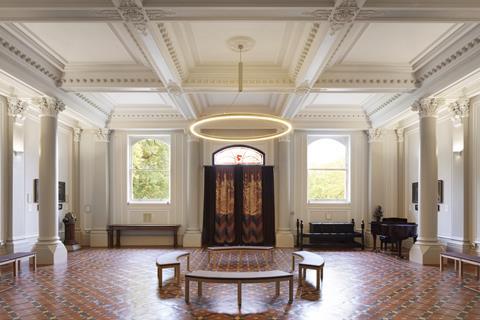
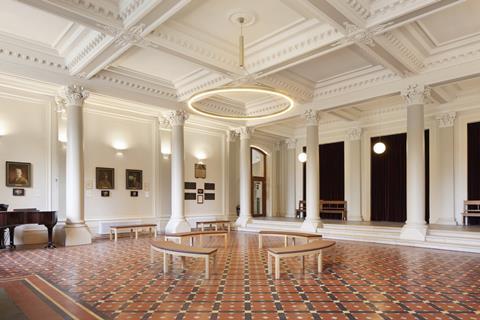
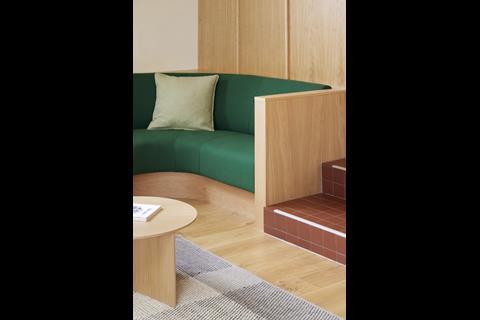
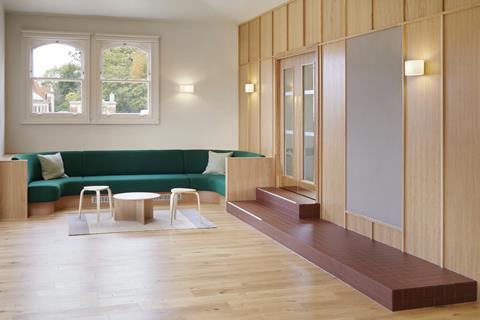
Building on the success of the project, alma-nac has undertaken further discreet commissions across the campus. The college’s new lower school building might be environmentally and socially purposeful, but in the upper school, in the central, emblematic block of Charles Barry’s buildings, the studded Chesterfields still had the feel of a club cigar lounge. The practice’s recent brief involved paring back and lightening the classical Lower Hall, formal staircase and modernising an outdated staff canteen, common room and pigeonhole room.
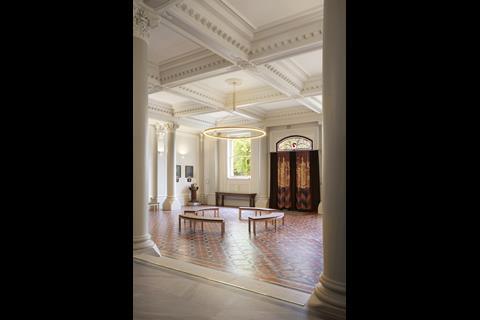
Alongside careful repair works, the Lower Hall’s sofas have been replaced by simple, more adaptable wooden benches and its castle-worthy chandelier swapped for a minimal halo of light. Architectural details, such as the deep red columns and off-pink walls, have been neutralised in shades of white that enhance their finer features. Work in this block was completed in this year’s six-week summer holidays for a budget of around £650k, Wigfall explains.
We had to work very collaboratively with the main contractor, Pall Mall Projects and all the other specialists in art handling and lighting
Tristan Wigfall
“To achieve this tight programme,” he adds, “we had to work very collaboratively with the main contractor, Pall Mall Projects and all the other specialists in art handling and lighting.”
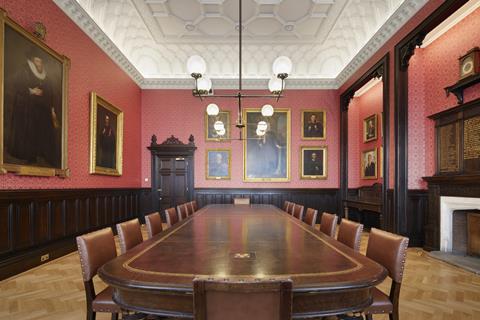
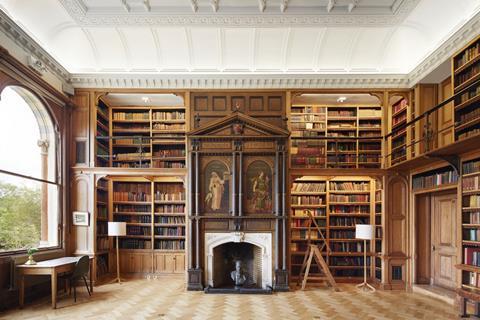
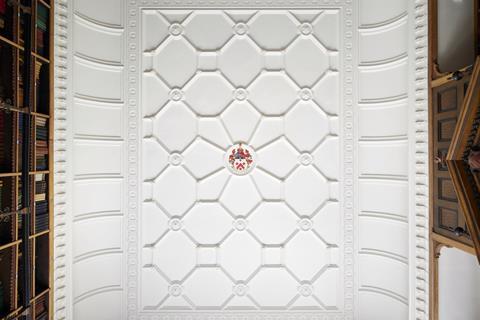
The Boardroom and Master’s Library, with its wall-to-wall hardbacks and ornate plaster ceiling, have been restored too, but without such obvious change. Though still used by some staff, we’re told, these also serve as part of a portfolio of filming and event spaces as the school turns its architectural assets into a source of revenue. You might have spotted it as a location in the BBC’s recent ‘How are you? It’s Alan (Partridge)’.
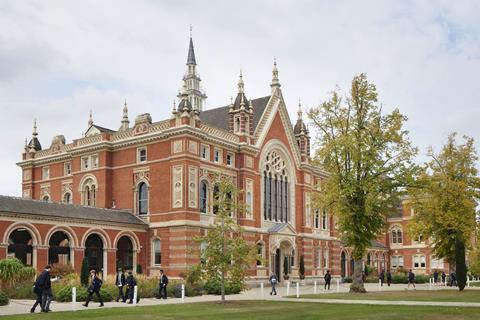
The Raymond Chandler Library fits its setting well; on an autumn morning its mellow bricks glow, the landscaping around it has started to mature, you can see the life in the space. The building, like its forefathers, is of its time, yet politely so. Its restraint is its virtue, as it treads the line between purpose and privilege.
It doesn’t have the Barry Buildings’ “crazy Dostoevskian gleam in its eye”, as Nairn put it. Neither does it give you the sense that “the architect has been driven to this by forces outside.”
With these timely, considered interventions across the campus, alma-nac has evolved from “running workshops and acting as a kind of unofficial architects-in-residence”, as Wigfall put it, to becoming a trusted architect for the institution, much as Austin Vernon & Partners were in their day.
Undoubtedly the library is a positive development for the school, but it’s hard to see the generosity of this new building and its 8,000 or so books without thinking of the intense strain on London’s public library services. All young people deserve a great library. It is a small progressive shift that this one has a new mandate to serve wider local needs.
Architecturally, it represents another generation marking its era on the campus, working within the system to consign a few of its outdated, less welcome associations to history. Most importantly, for the youngest boys making the transition from primary school to the monumental, perhaps overwhelming scale of the college, this space must be a haven.
Project team
Client: Dulwich College
Architect: alma-nac
MEP engineer and net-zero carbon consultant: Max Fordham
Structural engineer: Engineers HRW
Project manager / QS: Quantem Consulting
Landscape consultant: BD Landscape
Main contractor: LifeBuild Solutions Ltd
Energy assessor / BREEAM: Sustainable Construction Services



1 Readers' comment