






It may have become unfashionable and left the modern architectural community unimpressed, but the wider public cefrtainly appreciates the turrets and gables made famous by Sir Walter Scott. Just look at The Traitors, Rab Bennetts writes
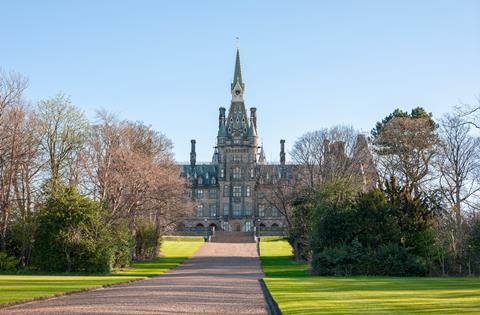
To see how artificial intelligence interprets Scottish architecture, a colleague typed in a few words and his screen spewed out a medley of vertiginous stone structures, turrets and gables, straight out of The Traitors. The Scots (or Scotch) baronial style, as it is known, appears to have a stronger claim to Scottish identity than many would care to admit.

In the 1820s, when the Union was arguably at its strongest, this new, romantic version of Scottishness emerged, thanks largely to Sir Walter Scott, who was not only a hugely popular storyteller of Scottish history but was also an architectural radical, using his own country pile to experiment. Merging forms and imagery derived from the real or imagined Scottish Highlands and the country’s legacy of thick-walled, fortified tower-houses, this was a reaction against the international style of its day – the austere, symmetrical palladian or revivalist Greek architecture best seen in the work of Robert Adam or Thomas Hamilton.
Whereas neo-classical architecture was ubiquitous in Europe, the US and elsewhere, Scott seemed to be questioning in his writings and deeds if Scotland’s identity was being lost. It was Scott himself who said in 1815 that no other country in Europe had changed so much in 50 years, referring to the crushing of Scottish culture and enforced demographic changes after the Jacobite rebellion. It is hard to believe that Scotland was often referred to as North Britain.
It was clear that baronial was deeply unfashionable – an architecture of stage sets and phoney history, so I was told
For most of the next century, with the notable exception of Glasgow, the baronial style became a dominant force across much of the country, with countless buildings in cities, smaller settlements and country estates using similar motifs appropriated from history, applied with an eye for composition that was for the most part asymmetrical. Ambling down Edinburgh’s old town, for example, it is revealing how few genuinely medieval buildings are left, as the general impression of a coherent, ancient townscape is often achieved through Victorian renewal.
One of the high priests of the baronial movement was David Bryce, the 150th anniversary of whose death comes around this year. I remember asking as a student in the 1970s why his monumental Fettes College (Tony Blair’s alma mater) was not more highly regarded as a work of architecture, but it was clear that baronial was deeply unfashionable – an architecture of stage sets and phoney history, so I was told.
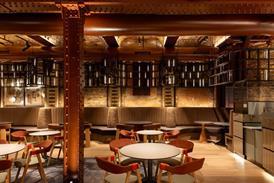
Much more recently, I found myself working (as Bennetts Associates) on the conversion of Bryce’s 1879 Royal Infirmary into the Edinburgh Futures Institute and found that it had been far more than a styling exercise, as it was based on highly functional planning, including 22 “Nightingale” wards and an overlay of engineering that has lessons for us in the 21st century.
In particular, the building’s turrets and spires were the visual expression of a wind-driven, passive ventilation system extending through all floors, with vertical shafts disguised within unnecessary buttresses. In conversation with Roger Emmerson, author of several books about Scottish architecture, I learnt to my surprise that this form of romantic nationalism in Scotland was admired for its functional planning by none other than the German writer Hermann Muthesius. Baronial may have left the modern architectural community unimpressed, but it remains popular with the public, many of whom seem unable to pass the building today without taking photographs.
Glasgow’s urban architecture is resolutely different, with fine ranges of neo-classical buildings that originate from the city’s grid and the demands of staggeringly rapid industrialisation. It is not particularly Scottish in character, though, and has often been used as a film set for movies set in historic Chicago or New York, but the mercantile buildings are among the most impressive in the UK. Sadly, the city also seems to have a problem with spontaneous combustion of listed structures, about which the less said the better.
It was not until after the First World War that the baronial style waned, largely because society – and architecture – had moved on
If baronial was sometimes seen as parochial, it is also in late 19th and early 20th-century Glasgow that we can see how Charles Rennie Mackntosh interpreted the epoch to create several major buildings whose impact travelled far beyond Scotland. Perhaps this was in part because he exploited the freedom in plan and asymmetry demonstrated by the largest baronial mansions, but also because he revelled in its evident mass. Mackintosh’s architecture seems rooted in Scotland’s materiality and climate, although it is regrettable that his Hill House has not kept the elements at bay.
It was not until after the First World War that the baronial style waned, largely because society – and architecture – had moved on. It could be argued that the modern movement has been a barrier to regional identities ever since.
Postscript
Rab Bennetts co-founded Bennetts Associates in 1987 with his partner Denise Bennetts.






No comments yet