




With 2 Finsbury Avenue topped out and shopping mall Broadgate Central open, British Land’s controversial £2bn redevelopment of the iconic 1980s estate is virtually complete. Development head David Lockyer tells Thomas Lane why almost nothing of Peter Foggo’s original scheme remains – and how the strategy has driven rents from £50 to £100 per square foot

With the topping out of 2 Finsbury Avenue at the end of January and the opening of the shopping mall Broadgate Central a couple of months earlier, the shape of British Land’s redeveloped Broadgate is all but complete.
The 36-storey 2 Finsbury Avenue towers above the rest of the development with its angular, snazzy gold cladding typifying the architecture of the all-new scheme. The uniform pink granite of the Peter Foggo-designed original buildings has been banished in favour of a cacophony of gold, raw stainless steel, bright reds and high tech black.
This horrified conservationists, who tried and failed to get the whole scheme listed. Historic England recommended that the first four phases be listed grade II* in 2011, which would have placed Broadgate in the same company as the National Theatre and Battersea Power Station. The heritage body described the development as a critically acclaimed, exemplar of urban place making that was a benchmark for later 20th-century urbanism of this scale.
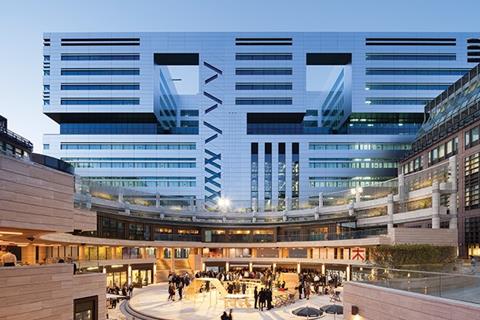
For conservationists the first nail in the coffin was the demolition of 4-6 Broadgate and construction of the Make-designed 5 Broadgate, a vast stainless steel bruiser which looked like it had rudely barged into the group of the more subtle Foggo-designed buildings. Since 2015, when 5 Broadgate was completed, the rest of this part of Broadgate has been redeveloped.
Why did British Land diverge from the unity of original developer Stuart Lipton’s vision? And has the decision been vindicated?
British Land has had an interest in Broadgate for much longer than the redevelopment of 4-6 Broadgate would suggest. The success of the late 1980s development was truncated by the early 1990s recession, with British Land buying a 30% stake in the troubled Stanhope in 1994. By 1995 it had full control of Broadgate.
Since then, British Land has sold 50% of its stake to Blackstone, who subsequently sold this to Singapore’s sovereign wealth fund GIC. Today, British Land is the development manager for this joint venture.
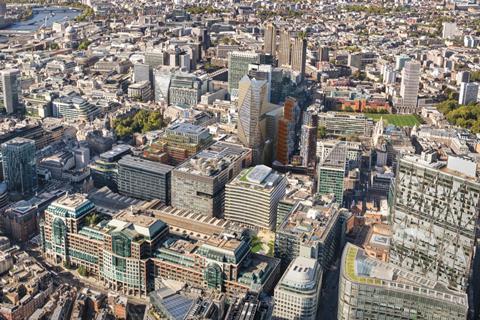
David Lockyer, British Land’s head of development, says that by around 2010 Broadgate was beginning to look tired. He says it was designed to be inward facing because it was surrounded by the semi-dereliction of Shoreditch and the western fringe of Spitalfields, and the fact parts of it were built over railway tracks made negotiating your way round it awkward.
“It was quite difficult to permeate and navigate your way around because of all the level changes,” he explains. “There were a lot of dead spaces where there was no animation and a very limited retail, food and beverage offer. There was just the Corney & Barrow [bar], the ice rink, a golf shop, a post office and a couple of coffee shops – and that was it.”
He adds that most of the buildings were built for single occupiers, with facilities including gyms and cafes available only to those working inside the buildings with very little retail at ground-floor level to animate the streetscape. British Land was achieving rents around £50 per square foot, less than other parts of the City.
To add to the pressure, many of the 25-year leases granted in the 1980s were coming to an end, with the shiny new towers at Canary Wharf ready to tempt existing occupiers away. Lockyer says firms including UBS and Lehmans, who had been at Broadgate from the beginning, were talking about decamping to Canary Wharf.
In response, British Land incentivised UBS to stay at Broadgate by consolidating their workforce from five buildings into one, brand new office on the site of 4 and 6 Broadgate. The move freed up space in 100 Liverpool Street and 2 & 3 Finsbury Avenue.
Around this time, the Royal Bank of Scotland’s lease at 135 Bishopsgate was expiring. “Despite the fact that we were building a 750,000 square foot office building [for UBS], we were getting all these additional buildings back. It gave us the opportunity to think about how we might address Broadgate,” Lockyer explains.
This location has transformed beyond all recognition over those 40 years
David Lockyer, head of development, British Land
The potential offered by the location justified the significant expenditure Lockyer says was needed to make it more appealing to new occupiers. “This location has transformed beyond all recognition over those 40 years,” he says.
“We now sit in the fold in the page between tech and innovation around Shoreditch and Old Street and one of the global capitals of finance on the other side in the City. And we have got a major mainline station and Crossrail was on its way, and 53 acres in single ownership, pedestrianisation and four and a half acres of public realm.”
A brief history of Broadgate
Broadgate was a brave move on the part of developers Stuart Lipton and Godfrey Bradman, who formed a joint venture between their companies Stanhope and Rosehaugh respectively. They turned the former Broad Street station site on the edge of the City next to the abandoned and derelict buildings of Shoreditch and the western fringe of Spitalfields into an exemplar office development.
The first four phases were designed by Peter Foggo of Arup Associates, with Bovis pioneering fast track construction methods imported from the United States to build the first two phases in a record 12 months ready for the Big Bang deregulation of financial services in 1986. Subsequent phases, which were designed by SOM, quickly followed with most of Broadgate completed by 1990.
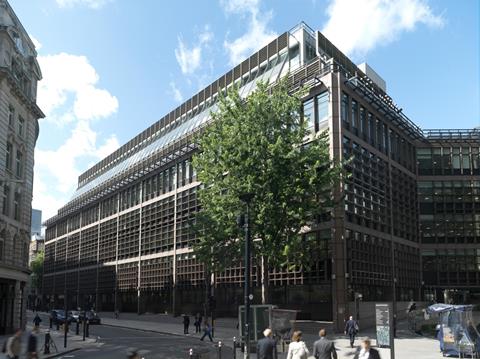
The scheme was praised for its high quality buildings, carefully planned public realm and specially commissioned artworks. In 2010 the Twentieth Century Society started to campaign to get the first four phases listed, with Historic England recommending that it be given a grade II* listing. This was turned down by the culture secretary Jeremy Hunt, which paved the way for the demolition of 4-6 Broadgate.
Historic England then recommended that the remaining elements be considered for grade II listing once it was 30 years old in 2015. But, in 2015, the only building that was listed was 1 Finsbury Avenue.
In 2018 the Twentieth Century Society abandoned its campaign as Historic England recommended that 1-2 Broadgate, the last surviving element of the Foggo scheme, should not be considered for listing, leaving it open for redevelopment.
The plan to rejuvenate Broadgate included widening its appeal beyond the traditional occupier audience of financial services and law firms, and turning it into a more vibrant, mixed-use, 24-hours-a-day, seven-days-a-week destination. This included incorporating more retail, restaurants and bars, including at ground level in the office buildings, and offering a wider variety of office space ranging from traditional leases to fully fitted out and furnished space for small businesses for short term use.
Ultimately the idea was to drive a better return on investment. “If we could drive rents by another £20 to £30 a square foot higher, across four and a half million square feet, it starts to become quite material in terms of the additional value that we can add. That was the hypothesis behind it,” Lockyer says.
Armed with this plan, British Land assessed what buildings should be redeveloped or refurbished, the type of occupiers these were likely to attract and the sequence of work, as there was too much to do in one go. Charles Horne, British Land’s project director, says with so much work going on, the risk was Broadgate would turn into one big construction site.
To provide greater control of the work, certainty and the benefits of a collaborative working environment, British Land signed a 10-year framework deal with Sir Robert McAlpine to execute the work under a series of individual building contracts. “This has been enormously successful,” says Horne. “It gives us a lot of leverage and also ensures that we can continually build and improve from project to project.”
Everyone, from project managers and architects down to the specialists, is co-located in one office to create a one-team ethos. Horne says that some £2bn of work has been completed by McAlpine’s to date – and in all that time he hasn’t received one contractual letter.
The first job was the redevelopment of 100 Liverpool Street, but the 2016 Brexit vote gave cause for pause. “Everyone thought that all the financial services firms – which is our core occupier base – were going to leave and go to Frankfurt,” says Lockyer. “Despite the referendum result, we decided we were going to push ahead.”
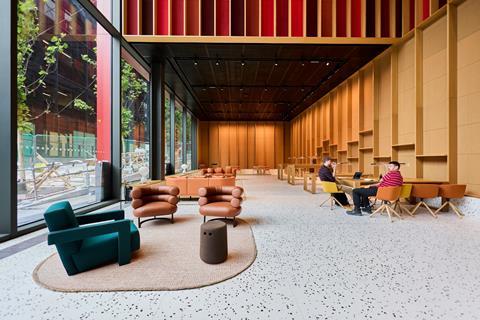
The redevelopment includes the former, conjoined 100 Liverpool Street and 8-12 Broadgate. Designed by Hopkins Architects, half the original structure was retained with half new. Designed to incorporate retail and public access, it was British Land’s first net zero building and achieved BREEAM Outstanding certification.
In what must have been a gratifying moment for British Land after the storm of criticism over 5 Broadgate, it was also shortlisted for the Stirling Prize. It vindicated the developer’s strategy to provide a better return on investment.
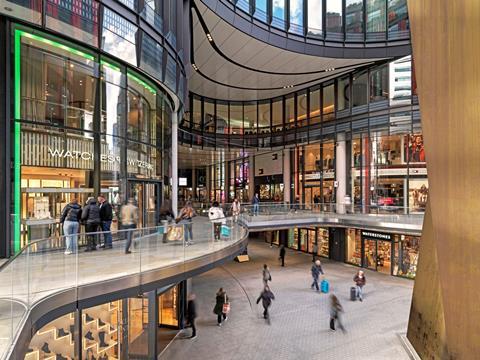
“By the time we got to the top floor in 2020, when we finished the building, we were achieving rents of £100 per square foot,” Lockyer says. The lower ground and ground floor of this building incorporates part of the recently opened shopping mall, which extends from Liverpool Street station to Finsbury Avenue Square and also includes the lower two floors of 1 Broadgate.
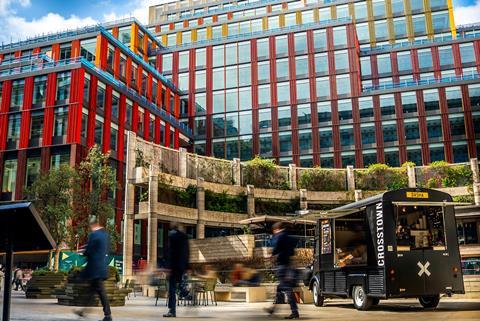
1 Broadgate, which was designed by AHMM and completed in the middle of last year, is all new as, according to Lockye,r the floorplate and structure of the original were not adaptable enough for refurbishment. However, 1 Finsbury Avenue has been refurbished, also designed by AHMM.
This is the only listed building on Broadgate. Lockyer says the facade was the focus of the listing with permission granted to demolish the building behind the facade. He says this would have only added about 10% extra floor area, so the decision was made to retain the structure.
“There’s a bit of compromise on some of the floor-to-ceiling heights – they’re not as generous as you would like them to be – but we felt we could work with this and price it differently from a brand new building and widen the occupier base,” Lockyer says. He adds that the quirky and colourful nature of the refurbishment attracted more tech companies.
It was 100% let on completion at £75 per square foot. The building now includes an Everyman cinema, bars and restaurants and a cafe in the centre of the atrium.
What is the new Broadgate like?
If Peter Foggo were alive today, he would barely recognise the award-winning development that he designed in the 1980s. Virtually all vestiges of the original have been swept away.
The only elements that remain are Broadgate Circus, which has been reworked to fit in more places to eat and drink, and the facade of 1 Finsbury Avenue, as this was listed in 2015.
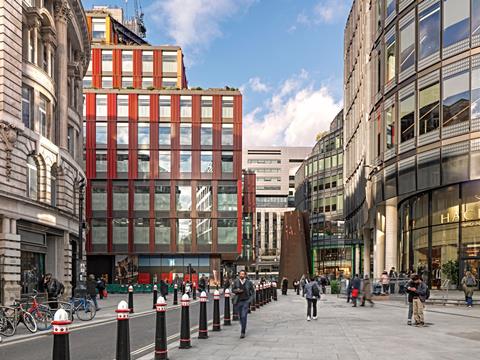
The visual cohesiveness of the original, predominantly granite-clad buildings with their distinctive, set-back fully glazed upper floors has gone. Instead there is a variety of architectural styles ranging from the sinuous black facade of 100 Liverpool Street to the riotous red, yellow and orange facade of 1 Broadgate.
The new buildings, particularly 2 Finsbury Avenue, are much bigger, which makes the whole place feel more hemmed in. On the flip side, when 5 Broadgate was first completed, it seemed very incongruous compared to its Foggo-designed neighbours given its size, rigid orthogonal shape and stainless steel cladding. But it sits much more easily now among the larger new buildings with their multiplicity of facade treatments.
The new buildings are publicly accessible at ground level and internally are high quality and attractive. 100 Liverpool Street includes a distinctive oval-shaped atrium which is directly accessible up escalators from the Broadgate Central concourse, with plenty of colour incorporated into the interiors of the other buildings.
The two-level Broadgate Central mall includes plenty of shops and retains the original Fulcrum sculpture by American artist Richard Serra, although this was lowered from its place up a ramp to ground level, which Horne describes as a big job.
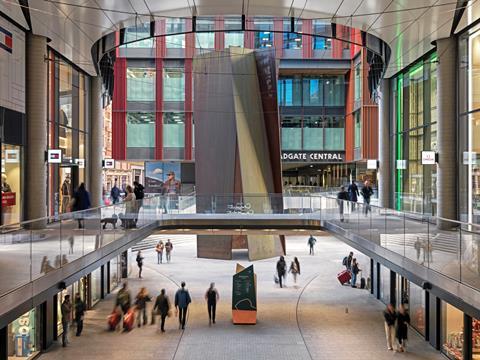
The public realm remains a distinctive part of Broadgate, as this remains pedestrianised with plenty of bars and restaurants to linger in. The northern part of the estate was designed by SOM and was completed later than the Foggo-designed elements. This includes Exchange Square, which has been reworked by DSDHA and, at 1.5 acres, quadruples the amount of green space at Broadgate.
In some respects, Broadgate retains its distinctive self-contained quality, which is unusual for City office development. It feels much fresher than the more sober, traditional street-centred layout of the surrounding area with much better public realm. But now that the cohesiveness of the original scheme has been lost, in other respects it feels like just another piece of new, estate-centered commercial development.
Across the square, 2 Finsbury Avenue was given a very light-touch refurbishment and rented out cheaply until some of the other projects were finished. Hedge fund Citadel agreed a prelet on one third of this building as the main contract was being signed.
Consisting of two towers, the building is topped out and the cladding going on. This will be the tallest building in the development and increases the space from the previous building from 180,000sqft up to 750,000sqft. This will complete in 2027 and will, as Lockyer readily concedes, mean almost nothing of the original scheme remains.
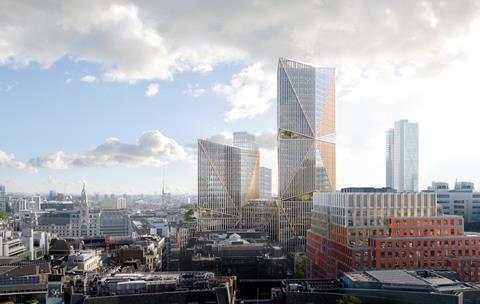
But British Land has achieved what it set out to do. “It is successful, because rents are now significantly at a premium and, as a result of that, we have seen Broadgate perform very well for us over the last few years, and hopefully will continue to do so into the future,” Lockyer says.
In many respects, it is a shame that the original Broadgate could not be repurposed but, given what has happened over the past 15 years, that is now just an academic point. And it is important to remember that the City is a money-making machine with readily disposable buildings in service to that goal.
The original Broadgate was developed to cash in on the financial liberation of the Big Bang and the pressure to redevelop Broadgate and other buildings in this area in response to the changing needs of the firms that inhabit the Square Mile are cut from the same cloth. The difference is that there is an urgent need to reduce carbon emissions, so the current crop of buildings must be made to last longer than those that went before.







2 Readers' comments