









UK regeneration is experiencing a renaissance after more than a decade in the wilderness. With £46bn in new Homes England funding and reformed delivery structures, there is now a renewed focus on transforming our urban centres. As Building Design launches its new Regen Connect campaign, Joey Gardiner finds out why this time around it’s locally-led combined authorities, not central government, driving change


In the first decade of the century, regeneration was the development industry’s biggest buzzword. Renewal of the UK’s cities and most deprived areas was a huge priority of government, with the architect Richard Rogers leading the urban task force that revolutionised policy.
The period saw the centres of Manchester, Liverpool and Birmingham irrevocably changed – and the industry made billions off the back of it. But spending austerity cut the funding and shut the institutions that had supported all this activity. While brownfield development continued to be theoretically promoted by the planning system, the idea of specifically subsidised development programmes at scale designed to achieve social and economic aims was dropped in favour of a simpler ambition.
“For a while, regeneration was a dirty word around government,” says Mary Parsons, regeneration and partnerships director at partnerships housebuilder Lovell. “It was all about housing numbers.”
In the summer of 2024, Labour came into government promising a decade of “national renewal”. Now, whatever you might think about how well that phrase has aged in the 18 months since, there are nevertheless signs that the ambition is resulting in a renewed focus on regeneration. A regeneration of regeneration, if you like.
This time around, however, it is being driven as much by powerful local and combined authorities as big government agencies. To mark the launch of a new editorial initiative, Regen Connect, which over the coming months will explore the regional urban regeneration picture across the UK, Building Design here asks what the landscape looks like for regeneration, and what the prospects are for a revival in the fortunes of the sector.
The death of renewal: decline of UK regeneration funding after 2010
Ben Denton, head of strategic and growth at insurance giant L&G, cut his teeth delivering compulsory purchase for large urban regen schemes. “Regeneration used to be a big proportion of public and private sector involvement in driving growth,” he says, “but, over a period, it has just become removed from the consciousness – it has been removed as part of the growth programme of the nation.”

According to a report by a committee of MPs published at the time, “core” regeneration funding fell by two-thirds in just two years, from £11.2bn in 2009/10, to £3.9bn in 2011/12. While former prime minister Boris Johnson’s levelling up agenda was an attempt to correct the balance back toward investment in deprived areas, the policy’s focus was not primarily on improving the built environment.
In that time, the need for regeneration has not diminished. And funding itself is not the only problem.
“What we have had recently,” says Phil Mayall, UK managing director at regeneration developer Muse, part of construction group Morgan Sindall, “is all this demand and need. But [we’ve had] a far more complicated landscape in which to navigate to pull schemes together.”
For a while regeneration was a dirty word around government. It was all about housing numbers
Mary Parsons, regeneration and partnerships director, Lovell
Currently, he says, organisations looking to deliver a regeneration scheme will need to work with the local authority, often a combined authority above that, and then as well, depending on location, with Homes England, the government’s housing and regeneration agency, or the Greater London Authority. In different areas the different bodies have different powers – with Homes England, for example, controlling affordable housing funding in much of the country, but not in London or Manchester, and having an “in-between” status in other areas.
Stirring the pot: Why regeneration schemes became harder to deliver
Crucially, Mayall says that, while Homes England controls numerous government funding pots – infrastructure funding, gap funding, loans, loan guarantees, affordable housing grant – that might contribute to any given regeneration scheme, it has not acted to co-ordinate them. “The complexity is, there would effectively be several different desks at Homes England, and you have got to speak to each of them and get approval separately.”
Mayall continues: “If you look back to 2010, it was far simpler. You had regional development agencies (RDAs), and you took the scheme to them, they did the work in the background.”
It was known at the time as the “single pot” approach, which ended with the shutting of the RDAs in 2010. “The closure of the RDAs was seismic,” Mayall says.
This complexity is more than just an annoyance – the plate-spinning exercise of getting multiple approvals from multiple different points for multiple different funds, to fulfil multiple different outcomes, blocks schemes going ahead.
Denton says the situation was different under New Labour-era programmes such as the Single Regeneration Budget and Challenge Funding. “Those previous funding approaches were flexible enough to help people to come to the best logical decision around how state investment should come into a project.
“For us to do that nowadays, you would have to put together three or four lumps of funding with different timelines and different criteria, with different approval bodies. And, as a result, you know those schemes just don’t happen.”
In addition, Homes England has also been accused of centralising operations in recent years, making it harder for projects to fund the gap between a local authority’s ambition and commercial viability.
The public bodies review of the agency, published in April 2024, shows this was recognised before Labour came to power, finding that: “Homes England needs to change the way it operates in order to partner effectively with local authorities and respond well to government’s place priorities”.
Push back: estate regeneration - from social cleansing to community renewal
During the 2010s, estate regeneration projects – where former council estates were renewed and redeveloped using significant investment – often became harder to progress, because changing rules meant that too often social housing wasn’t replaced, and residents began see them as gentrification or social cleansing. Paul Hackett, chief executive of housing association Southern Housing, says: “At first residents were really interested in these schemes, but from 2005 onwards it became about mixed tenure and market sale to cross-subsidise the developments.
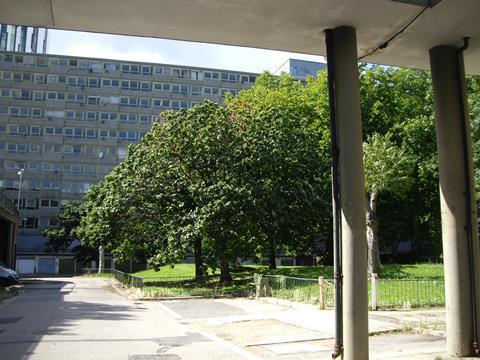
“There was massive push-back, and regeneration got a bad name,” he says. With a positive ballot from residents required, the negative publicity surrounding schemes such as the Heygate Estate in Southwark, he says, made it harder to get estate regeneration projects approved.
The 2,700-home Elephant Park scheme which has replaced the Heygate’s 1,200 council homes in the end provided just 92 homes at the equivalent social rent levels, albeit a total of 541 homes of varying “affordable” tenures were delivered, mostly shared ownership.

Tectonic shift: Homes England’s new approach to regeneration funding
The tectonic plates, however, are shifting, with the government and its agencies now seemingly attempting to apply a few of the lessons of the pre-2010 period to spark the regeneration market.
Firstly, the government has pledged up to £5bn to its 10-year Pride in Place strategy – flexible local funding for neighbourhoods in a form explicitly modelled on regeneration initiatives of the past, with the government’s strategy namechecking the New Deal for Communities programme which ran between 1998 and 2010.
Secondly, Homes England is restructuring the way it works under its new leadership duo – chair Pat Ritchie, a long-time regeneration champion and former local authority and RDA chief executive; and the newly appointed Amy Rees, formerly head of the HM Prison and Probation Service.
The pair published a strategic plan and a separate investment roadmap in December confirming an effective relaunch of the agency from April this year, with a refreshed regional structure and a unified funding approach. The plan put regeneration as a core part of its “mission” and one of six key objectives.

In future, the investment plan says, all funding routed via Homes England that is not affordable housing grant will either be debt, equity and guarantees deployed as part of a new National Housing Bank, or it will be grants available under a new National Housing Delivery Fund. This fund will bring all the remaining streams together into a single place.
Muse’s Mayall is optimistic about the shift, saying he hopes it will start to get towards the “single pot” approach of old. “We’re getting a simplification of all these pots into the national housing delivery fund. It’s got to be welcomed.
”The proof is in the pudding, but I take a lot of comfort from how they have made it. I believe it will be structured in a way that will be accessible and quick.”
It is not just the structure, of course. Part of the optimism comes from the surprisingly generous spending review settlement agreed last year, which has given Homes England £46bn to spend over 10 years across affordable housing, the national housing bank and the housing delivery fund.
We’re going back to what we were able to do years ago. Regeneration wasn’t a dirty word then. It’s very exciting
Paul Hackett, Southern Housing
Lovell’s Parsons says that, while the new funds don’t launch until April, she has already seen a difference in a return to a more regionally-focused operating model, where Homes England is backing the priorities of local leaders, rather than being rigid about policing individual funding pots. “There has been a shift,” she says, while the promise is much greater still.
“They seem to be saying they will stitch together things in the background. If they can do that, it will get away a lot of projects that have been on the blocks for an awfully long time.”
Southern Housing’s Hackett cites another case in point – his organisation’s plan to redevelop four 1960s social housing tower blocks in Hastings, replacing the existing 390 flats with 450 new socially rented homes. A few years ago, he says, Homes England would not have been willing to back a 100% affordable housing scheme such as this, because of the need to demonstrate additional housing provided in every phase. Now he says, it is being more flexible.
“We’re going back to what we were able to do years ago,” he says. “Regeneration wasn’t a dirty word then. It’s very exciting to be able to replace social housing with new decent social homes.”
Homes England funding settlement
Total funding: Up to £46bn
Social and Affordable Housing Programme: “At least” £27bn (figure excludes London) over 10 years from 2026/27
National Housing Bank: Up to £16bn of debt, equity and guarantees (deployment period not specified)
National Housing Delivery Fund: Share of £5bn capital grant to unlock land, tackle viability challenges and support the provision of enabling infrastructure (includes new towns) over four years from 2026/27
Source: Homes England Investment Roadmap, December 2025
Locally led regeneration: combined authorities driving local regeneration
In the 2000s, regeneration may have been all about the RDAs and English Partnerships (another Homes England forerunner). But one area in which Labour is not seeking to turn the clock back is around local devolution. The model is now that Homes England should largely be at the service of the priorities of councils and, where they exist, combined authorities with their mayors and devolved powers.
Mayoral-led combined authorities in Manchester, the West Midlands, West and South Yorkshire and the West of England, among others, have varying powers to marshall funding, and will soon all have strategic planning powers to boot. Michael Lyons, who was chair of the New Towns Task Force, and is chair of regeneration development joint venture the English Cities Fund, says: “The agency’s new focus has taken it closer to the ground, and closer to local government.”
Andy Hill, chief executive at regional housebuilder Hill Group, which delivers partnerships housing and estate regeneration as well as private schemes, says his partnership with Coventry City Council for the £450m redevelopment of its town centre is an example of this local focus: a local authority with a strong plan backed by funding from its mayoral combined authority and Homes England.

The West Midland Combined Authority has put £110m into the scheme, which will deliver 1,575 homes, 8,000sq m of commercial space and 17,000sq m of public space.
“The council is very much leading this. It’s just been down to the quality – they’ve got really good people who are really committed. They’ve made it happen,” Hill says.
Parsons also cites Lovell’s 4,000-home framework deal with the WMCA as a sign of growing confidence in making regeneration work. “Now we’re able to target sites, and have confidence that, if we buy a site, the funding will be there. It’s making things happen quicker.”
Taken together with the changes at Homes England, she says the outlook is positive. “With the new National Housing Bank, there is the ability to look forward over a much longer period and bring in different tools to the armoury,” she says.
“I think for regeneration the policies for the supply side are looking as strong as they have been for some time. I’m not sure there’s an awful lot more the government can do.”
Ground to a halt: Market viability challenges facing regeneration projects
But don’t make the mistake of thinking this is easy. The flip side of her comment, Parsons says is: “Slow demand is holding us back now. We need to think hard about the demand side. Is the demand for home ownership in flats going to come back?”
The fundamentals of the market are, right now, stacked against making any development on brownfield sites viable. Recent years have seen largely stagnant sales prices in the south, allied with low demand, a collapse in housing association development capacity, awkward and delayed new building safety processes, and rampant build cost inflation.
This is the part where we’re all stuck … The market is as poor as it has ever been. It’s very, very difficult
Andy Hill, chief executive, Hill Group
This has made any development hard – let alone regeneration schemes on sites where, by definition, viability is always challenged. An assessment by housing data firm Zoopla in September last year said development was effectively unviable across half of the country.
And, even if funders are being more flexible, the majority of the estate regeneration projects that are being attempted are being done on a classic cross-subsidy model, whereby density is increased and private sale profits are supposed to pay for affordable housing. “Viability for these schemes was always difficult outside of London,” says L&G’s Denton. “Now they are not self-funding in London and they have ground to halt.”
Andy Hill says: “This is the part where we’re all stuck. We’re relying on cross-subsidy, but the market is as poor as it has ever been. It’s very, very difficult.”
But it is not just the viability, or the appetite for development from cash-strapped housing associations that is the problem. Brendan Sarsfield, the new chair of housing association NHG, and former boss of Peabody, says: “I think the skills to carry out estate regeneration have been lost over the last 20 years. Back when we did this at scale, there was a lot of co-production with residents.
“I think that has been lost. We desperately need to redevelop those skills.”
Whether the sector invests in redeveloping the necessary skills and capacity in the coming years will depend on how successful the government and local authorities are at persuading the private sector that they are serious about regeneration again. And whether they do so remains to be seen.

Regional regeneration is transforming communities across the UK - and Regen Connect is our new editorial series, running across Building, Housing Today and Building Design, giving you the insight you need to stay ahead.
Led by the Building the Future Think Tank, our year‑long editorial programme explores how investment in infrastructure, housing and placemaking is shaping the future of our regions.
Through ongoing analysis and expert commentary, we highlight the policies, funding streams and local priorities that matter most to the construction and development sector.
Regen Connect offers clear, practical intelligence on where regeneration activity is happening and why. We track how mayoral funds, government programmes and local authority strategies are influencing development pipelines, and we spotlight the organisations - from clients to consultants to supply chain partners - that are driving progress on the ground.
What we cover:
- Funding priorities: How money is being allocated and the impact on upcoming projects.
- Regional opportunities: Local challenges, strategic ambitions and how industry is responding.
- Market intelligence: Profiles of key players shaping regeneration across the UK.
How you can get involved:
Throughout the year, our team will be gathering insight from across the sector to inform editorial features, debates and events. We welcome contributions from practitioners who want to share experience or shine a light on emerging trends.
Read more about the campaign here
Be part of the conversation – contact us to contribute or get involved by emailing our deputy editor at dave.rogers@building.co.uk and to find the campaign on social media follow #regenconnect







2 Readers' comments