






Devolution is giving Leeds, Bradford and the surrounding local authorities the opportunity to fulfil their potential. But, with key potential transport projects a long way off and the viability of some much-needed schemes still challenging, the question is whether they will be able to grasp it. In the first in our Regen Connect series of deep dives looking at areas where urban regeneration is under way, Joey Gardiner profiles West Yorkshire, its funding streams, community priorities, key clients and active consultants

West Yorkshire could be said to be undergoing a quiet renaissance. While Manchester and its box office mayor Andy Burnham often grab the media spotlight, God’s Own County has been steadily making its own progress.
In Leeds, the region’s de facto capital, more than 11,000 homes have been built in the past three years, making it the biggest building city authority in the country bar Birmingham – which has a far larger population. Last year Leeds didn’t just out build each of the Manchester authorities. It out built them all by a margin of more than 1,000 homes.
No wonder, then, that the government’s new towns taskforce recommended the city’s South Bank regeneration scheme as a potential new town location – and the government looks set to trust it as one of three sites with front-runner status.
Nick Atkin, chief executive at Leeds-based housing association Yorkshire Housing, and vice chair of the 15-strong West Yorkshire Housing Partnership, says: “You can get stuff done and delivered here. You just have to look at the regeneration of Leeds in recent years – it’s unrecognisable from what it was. I’ve never seen it so optimistic and positive and upbeat.”
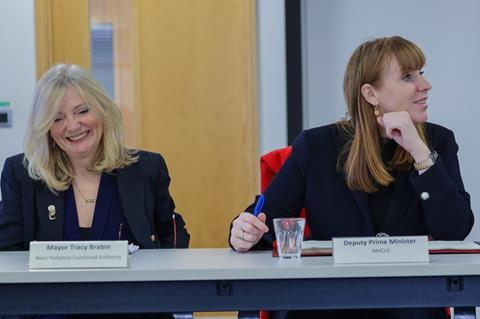
Five councils make up the West Yorkshire Combined Authority (WYCA), which is headed by elected Labour mayor Tracy Brabin, and which will have comparable powers to Greater Manchester from April this year. That month, WYCA will receive its first integrated settlement, of £1.96bn covering the four years from this April, to spend on its priorities for transport, infrastructure, skills, business, planning and housing.
But, despite the optimism, there are concerns about viability challenges, and whether the slow expected pace of infrastructure investment will harm investor confidence. Some also ask whether WYCA is as effective as it could be in creating a strong platform for investment.
West Yorkshire’s infrastructure and housing challenges
Home to two major conurbations in Leeds and Bradford, another city in Wakefield, a host of other large towns and the natural beauty of the Yorkshire Dales, West Yorkshire undeniably has a lot to shout about. Leeds has a fast-growing office market and financial services sector, with employers such as Channel 4, the Bank of England and, now, the National Housing Bank making homes there. Meanwhile Bradford – last year’s UK city of culture – is itself the 10th biggest economy in England at over £11bn and the youngest city in the UK, despite being so often overshadowed by its big brother.
Factfile: West Yorkshire Combined Authority
- Population: 2.4 million
- Region’s economic productivity as GVA (gross value added): Circa £74bn
- Mayor: Tracy Brabin (Labour)
- Constituent councils: City of Bradford Metropolitan District Council; Calderdale Borough Council; Kirklees Borough Council; Leeds City Council; City of Wakefield Council
- Total homes built 2022/25: 22,600
- Integrated settlement: £1.96bn 2026/27 to 2029/30
- Indicative 10-year affordable housing programme funding: £1bn
- City Region Sustainable Transport Settlement: £2.1bn 2027-2032
But the region also has some significant problems holding back its growth. While it is possible to get quick trains into Leeds from London, moving around the region is often painfully slow and unreliable. And, despite significant development in recent years, the provision of housing is insufficient. While its economy is worth a huge £74bn in GVA annually, this actually underperforms the national average per head – by a whopping 16%.
“There’s a desperate need for more affordable homes,” Yorkshire Housing’s Atkin says. “This lack of housing is compounded because the stock we have is ageing and in need of retrofit – it’s coming to the end of its life.”
Mark Mills, chief officer, asset management and regeneration at Leeds City Council is proud of the city’s track record in delivering homes in recent years. But he says that a combination of construction cost increases impacting viability, the on-off nature of the affordable housing programme and the Building Safety Regulator-inspired delays are likely to hit completions going forward.
There is a viability issue with all of the developments across the North
Niall Bourke, Leeds office leader, Arup
“There will be peaks and troughs in different types of accommodation completing,” he says. “So particularly on affordable housing, that will be very lumpy.”
Niall Bourke, Leeds office leader at engineer Arup, agrees that, in terms of urban and brownfield schemes, “there is a viability issue with all of the developments across the North.”
Ben Aspinall, managing director of Leeds-based national planning and property consultant Aspinall Verdi, says the frequency, speed and reliability of public transport is “poor”. He says: “Buses and trains regularly run late and are cancelled. As a business owner, it’s exhausting and disruptive. Improving public transport would make it easier to travel and to recruit and retain, with employees arriving at events and meetings less stressed and more productive.
“I know businesses across the city feel the same”.
The combined authority’s growth strategy
Of course, these are not problems that have gone unnoticed by the WYCA mayor. Brabin has a target to build 5,000 homes in her latest four-year mayoral term, to 2028, plus a longer-term 2040 housing strategy which identifies numerous priority areas.
And WYCA’s local growth plan is effectively a strategy to close the £11bn annual productivity gap with the rest of the country by focusing development along three growth corridors racing out west, south-west and south respectively from Leeds city centre.
WYCA sees improving transport as the main tool for achieving this step change in productivity. Late last month WYCA issued the latest in a series of consultations on its “mass transit” plans – which would deliver a tram system for the West Yorkshire region for the first time. This would see tram lines built down the southern and western growth corridor spokes, through to the Elland Road football ground, and across to Bradford.
WYCA is also backing the transformational changes promised via the £45bn Northern Powerhouse Rail project to link cities across the North – the plans for which are already impacting on development opportunities in Bradford.
The five authorities, who until recently were seen as fierce rivals, appear to be setting aside their natural suspicions to collaborate to back the mayor’s vision. Arup’s Bourke, which is drawing up a masterplan for Bradford’s Southern Gateway scheme says: “The authorities are definitely more aligned. They did a launch ahead of UKREiiF last year, which was the first time we had seen all of them together in a room talking about their shared priorities and […] recognsing that they each have their own growth plans but actually they need to work together to be successful.”
Phil Mayall, MD of regeneration-focused developer Muse, which is building out the City Village development, also in Bradford as part of the English Cities Fund, says: “Leeds has always been strong, but what we’ve got is authorities like Bradford and Wakefield really finding their voice, and understanding what their strengths are.
“Exactly in the way that Stockport woke up to the fact it didn’t need to compete with Manchester, that it could complement Manchester.”
We recognise that there are viability challenges and – certainly in parts of West Yorkshire – that there is a need to blend and layer funding to make things happen
Tamsin Hart Jones, assistant regional director for Yorkshire, Homes England
Meanwhile, Homes England is remodelling how it works to forge closer collaboration, with the body launching a new regional structure from April, plus a suite of new funding tools to coincide with the launch of the National Housing Bank and a unified National Housing Delivery Fund. Tamsin Hart Jones, assistant regional director for Yorkshire for Homes England, says the body is working in a joined-up way with the local authorities and the combined authorities, to help when projects get stuck.
“Rather than thinking in our individual silos,” she says, “we can take a project-based approach to try and work out what the problem is and then identify who might have a solution.”
She adds that: “We recognise that there are viability challenges and – certainly in parts of West Yorkshire – that there is a need to blend and layer funding to make things happen.”

Henri Murison, chief executive of lobby group the Northern Powerhouse Partnership, says the shift in Homes England’s role, accompanied by the agency recently appointing former Leeds council economic development boss Tom Bridges as executive regional director for the North East, Yorkshire and Humber, is good news for the region. “The success of Manchester has largely been about its relationship with Homes England – you haven’t seen the join between it and Homes England.
“[Homes England chair] Pat Ritchie is building a model that will roll out this decentralized approach, coming back to what it should always have been, which is being a joined up partner that works in places.”
Major regeneration projects across the region
Murison says WYCA’s work and the track record of the authorities is already making a difference to investors. For example, in south Leeds, where a tram line is proposed supported by a devolved £2.1bn transport settlement, he says investors are already getting behind the project – despite the project lacking final sign-off.
Last year former Westfield property mogul Peter Lowy, who sits on the board of Leeds Football Club, saw his Lowy Family Group signed up as development partner to expand the stadium as part of a wider regeneration project around the Elland Road stadium, linked to the delivery of the tram line.
Murison says: “I think you always want more certainty to invest as soon as you can. But I think that the examples are there that investment is already starting to get going. That’s the reality on the ground.”
Leeds’ South Bank new town
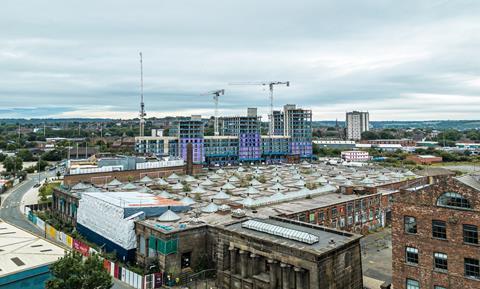
Leeds council has been promoting the comprehensive development of the South Bank area of the city since 2015, when it earmarked 4,000 homes for the area and since when a number of schemes such as Tower Works and Citu’s Climate Innovation District have been built out. However, with the firming up of plans for a tram running through the area, ambition has increased and the site is now favourite for a “new town” designation for 13,000 homes across 258 hectares.
In February 2025 the Ministry of Housing, Communities and Local Government confirmed an additional £10m of funding for Homes England to bring Temple Works, a grade I listed former flax mill, into public ownership with a view to establishing a northern branch of the British Library on the site.
Mark Mills, chief officer, asset management and regeneration at Leeds City Council, says the potential designation is “a real opportunity to prioritise funding to help support unlocking development.”
Meanwhile, in Bradford the prospect of both a tram line terminus and a £2bn redeveloped and re-routed Bradford station as part of the Northern Powerhouse Rail scheme, is triggering that investment. Muse is already signed up to deliver the 1,000-home City Village scheme, designed to re-model the northern part of Bradford’s centre, while Arup is masterplanning a potential 5,000-home redevelopment of the Southern Gateway on the southern side. Murison says this dynamic is well understood by government. “If you look at the business case for the new Bradford station and for the wider Southern Gateway proposal, it’s not a transport focused development.
“From the very beginning that new station has been built on the principle that it will unlock housing growth, and the station itself is being designed in such a way to maximize the benefits in terms of housing growth.”

Bradford City Village
English Cities Fund was appointed to deliver the 1,000-homes Bradford City Village scheme in November 2024, with detailed plans submitted for the city centre regeneration scheme last September. The long-time joint venture between L&G, Muse and Homes England is committed to redevelop two existing run-down shopping centres, Kirkgate and Ostler, into a mix of retail, leisure and business space.
Phil Mayall, MD of Muse, says the scheme works due to funding support from Homes England and the WYCA. “We’re putting in town houses to suit the ambition of people staying in Bradford. We want to make the population proud. The scheme is a blueprint for how to repurpose city centres that are over-supplied with retail space.”
Transport infrastructure delays and the impact on development timelines
This doesn’t mean that everything is rosy in the garden. There are plenty who are concerned that things are not moving quickly enough. In the first place, with so many schemes dependent upon transport infrastructure improvements, the uncertain and slow pace of action here is a big concern.
Last month’s announcement confirming the government’s commitment to the £45bn Northern Powerhouse Rail project was undeniably welcome, but only £1.1bn of funding to develop the project in the current parliament is actually guaranteed. The first phase of the scheme, which will deliver the Bradford station upgrade and electrification east of the Pennines, is only vaguely slated for delivery sometime “in the 2030s”.
Meanwhile, the programme for delivering the tram system seen as so vital for much of WYCA’s plans has just been re-sequenced by the Department for Transport, pushing out delivery of the project from the mid to late-2030s. While the WYCA mayor is still hoping to get “spades in the ground” on preparatory infrastructure works by 2028, progress is now dependent upon a vital review of the project’s business case, to be undertaken this year.
I know that the West Yorkshire Combined Authority and the powers that be are working hard to improve public transport, but the pace of change is slow
Ben Aspinall, managing director, Aspinall Verdi
Richard Jones, northern cities executive at consultant Arcadis, which employs 1,000 staff across the North and has won a role on the NPR design framework, says there is positivity about a “huge opportunity” from devolution. “But it’s early days with the combined authority. The frustration is with the time it takes.”
Aspinall Verdi’s Aspinall says: “A lot of what’s being done is around mass transit. Everyone agrees that more investment to deliver public transport will help the city-region. But it’s difficult to understand when this will be delivered. I know that the West Yorkshire Combined Authority and the powers that be are working hard to improve public transport, but the pace of change is slow.”
‘Years behind’ - the comparison with Greater Manchester’s approach to development
Some lay the blame for slow progress at the door of the combined authority itself, which by these accounts has not been as entrepreneurial and creative in making opportunities as its Lancastrian neighbour across the Pennines. One senior industry figure, speaking on condition of anonymity, says Greater Manchester’s recently launched “good growth fund” was the latest example of where that city had got ahead.
“You’ve got an incredibly driven, well-meaning, positive mayor in Tracy Brabin. But she’s got a team that is incredibly risk-averse when it comes to delivering projects, creating a lot of frustration in the local authorities at the moment.
“Manchester’s new fund is pioneering, it’s needed. But WYCA [is] still thinking in the old way – ‘I’m going to give a grant that is as constrained as it possibly can be’. It’s literally years behind in how it goes about its business.”
WYCA did not agree to answer questions or be interviewed for this piece, something the same figure said was of a piece with its approach. “There is a real frustration at the lack of engagement,” he says.
Arcadis’s Jones says the region is starting to see the benefits of devolution. “But a lot more needs to be done for that to come together. One of the challenges is around the pace of change that we’re seeing.
“The combined authorities need the right skills, capability and resource in order to support that change. We’re still – particularly in West Yorkshire –in the early days of devolution.”
Others, of course, are more positive about the way all bodies are working together. All are agreed that the opportunity right now is huge – the question is whether WYCA will be ready and able to grasp it.

Through ongoing analysis and expert commentary, Regen Connect highlights the policies, funding streams and local priorities that matter most to the construction and development sector.
This coverage will culminate in a special report to be published at our Building the Future Live Conference in London on 7 October.
How you can get involved:
Throughout the year, our team will be gathering insight from across the sector to inform editorial features, debates and events. We welcome contributions from practitioners who want to share experience or shine a light on emerging trends.
Click here for more on the campaign
Be part of the conversation – contact us to contribute or get involved by emailing our deputy editor at dave.rogers@building.co.uk and to find the campaign on social media follow #regenconnect







2 Readers' comments