




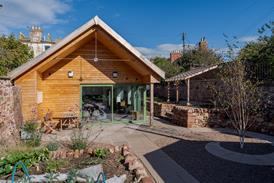




The UK has a rich and eclectic history for the provision of mass housing, but a new book by the former Guardian architect and design editor suggests the reliance on private volume housebuilders has been problematic for a number of reasons, Daniel Stilwell writes
Our homes play important background characters to everyday life – we start and end our days there. We move in and out of them because of a new job, starting university or because we are priced out of them.
In some cases, this can mean moving large distances across the country, to differing towns and cities. As a consequence of this, we might develop a sense of unfamiliarity geographically and socially or be about changing lifestyle habits and physically living in a new space.
On the opposite end of the spectrum is a bigger, more complex web of issues that makes up the current landscape of the housing crisis in Britain. At one end, it is about the houses we already have and, at the other, the need to build more houses for a growing population.
Recent governments have chosen to outsource this issue to private volume housebuilders with ambitions to build 1.5 million houses over a five-year period. Privately-built houses account for approximately 55% of all houses built – with a shortfall of 72,000 houses year on year against the target of 300,000.
A changing prime minister and yet another (albeit recently fired and rehired) housing secretary seems to show signs of this ambitious target becoming part of history all too quickly.
A particular sore point for Glancey is the lack of imagination and ambition of contemporary volume housebuilder architecture
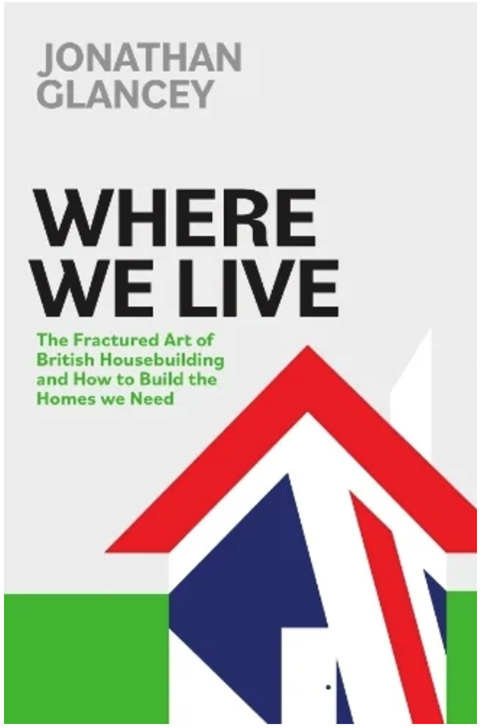
This reliance on private volume housebuilding and their, as Jonathan Glancey describes, ”anywhere housing” in his new book Where We Live is problematic for a number of reasons. Their approach results in the production of housing that is at times undersized, overpriced, of wavering quality, characterless and seems to endlessly fill virgin chunks of the countryside, greenbelt and fringes of villages as well as the sprawling suburbia of Britain in clumsily planned streets and cul de sacs.
They are stitched together by an unrelenting domination of car ownership and can be anywhere and are indeed everywhere.
A particular sore point for Glancey is the lack of imagination and ambition of contemporary volume housebuilder architecture that blights our streets, towns and landscapes. Glancey pines for a renewal of housebuilding in Britain that taps into a recent history of artfulness and homeliness, not just in design and appearance but in their spatial planning, their urban and rural fabric and the way people can and might live.
Where We Live shows that Britain has a rich and eclectic history for the provision of mass housing which stretches back to the 19th century. The book highlights some of the more well-known urban examples in the working class Arts and Crafts-designed Boundary and Millbank Estates of the London County Council to the mid-century partnership of Eric Lyons and Geoffrey Townsend showing what an elevated suburban life could be like through SPAN with an architect and developer combination at its core. We are offered examples of a more radical pedigree through Walter Segal’s methods of self-building in Walter’s Way, Lewisham, on land no which no one wanted to build.
These all offer their own interesting take on the usual architectural tropes of scale and style, but there is a more interesting history being explored from Glancey. This is a little less obvious but retraces British rural or rural adjacent
The issue of rural housing has for a long time been under-addressed in Britain, which seems remarkable given that upwards of 90% of the landmass is rural
Throughout Where We Live, Glancey is concerned with the production of rural housing, showing us that, through history, we have strength in depth and that over the past 150 years, produced meaningful housing bursting with character. Glancey argues that we need more of these qualities to be injected into contemporary rural housing to reflect the nuance and specificity each place. We might find this in form, site planning and materiality – but also in the ways we might then live in these houses.
The issue of rural housing has for a long time been under-addressed in Britain, which seems remarkable given that upwards of 90% of the landmass is rural and that these areas support somewhere in the region of half a million non-farming based businesses. With the rural can come stark social problems around remote living, loneliness and a sense of isolation and ideas of community need to be a serious aspect to contemporary housing.
The emerging rural housing history to which Glancey takes us looks back at the inception of Ebenezer Howard’s garden city movement and the coming together of town and country to imagine a way of life that was walkable and embedded in nature, with Letchworth Garden City the world first, planned by Barry Parker and Raymond Unwin of the Parker and Unwin Partnership in 1903. Their task was translating the concentric circles and magnets of Howard’s diagrams into a liveable place of productive landscapes.
Glancey methodically and chronologically takes us across the 20th century, furthering the eclectic cast of cases studies used to inform and cement his argument
Contemporary garden cities such as Ebbsfleet in Kent share only a timid association, stretching “garden city” to its limit and holding little of the original values of the early 20th- century vision.
Glancey methodically and chronologically takes us across the 20th century, furthering the eclectic cast of cases studies used to inform and cement his argument. A precursor to Walter Segal’s vision for self-build domesticity were the alluring self sufficiency of Plotlands, the most well known and enduring being Jaywick in Essex. Originally, holiday homes, they were made up of anything from caravans to converted railway carriages and single-storey structures.
These alternative domestic set-ups gave people their own slice of land and life. The 1947 Town and Country Planning Act put a stop to these radical ideas in favour of giving local authorities control of planning and the end to these, as Glancey states, “unofficial developments”.
One of the most pleasing examples of rural housing that Glancey gives us is the work of Tayler and Green, who sought to build thoughtful rural council housing for the former Loddon Rural District Council in south Norfolk. Their 1949 project Windmill Green in Ditchingham is an exemplar of modest yet considered council housing that works with its setting.
The Tayler and Green plan, one made up of 30 houses sited around a horseshoe-shaped green, on three sides was thoughtful and honest. Each house had a garden store of sorts, a room built onto the side of the house that allowed inhabitants to traipse muddy boots and store garden equipment without dragging said boots through the house proper. One other notable feature was the positioning of the living room for each house, planned as such to give everyone access to direct sunlight, depending on what side of the horseshoe green you lived on.
While Where We Live suggests to look forward, we might want to look to the past and reflect on where volume housebuilding lost itself. There is also a bigger question that looms at the end, where Glancey offers up one last simple position: Who will build these new houses we need?
The housing crisis is not just about where to build and who will pay for them, but who will build them!
With a huge shortage of construction trade skills, where are the bricklayers, electricians, roofers, plasterers, carpenters and plumbers of tomorrow? Recent rallying cries for a new wave of apprenticeships will begin to address this problem, but it will take time, money and planning to do so.
If we are also thinking about the local as a reference point for materiality, form and craft, how do we manage the many endangered craft skills that are dwindling too? The housing crisis is not just about where to build and who will pay for them, but who will build them!
There is a potential repeating of history on the horizon that takes cues once more from the Arts and Crafts, a constant period of artful excitement for Glancey. We could reflect back on the professional and educational reforms across architecture and the built environment, established by the likes of architect-turned-educator William R Lethaby. Facing similar problems as we do now, Lethaby was tasked with establishing new schools of trade to combat the skills shortages of the late 19th and early 20th centuries.
His vision saw the birth of the Central School of Arts and Crafts in 1896 and, shortly after, the School of Building in 1904 for the LCC. These schools not only allowed those training to do so practically in workshops and studios but gave them opportunities to use those skills and develop core collaborative skills, in what were called practical yards. Architects worked alongside foremen, carpenters and bricklayers as well as with those learning craft skills such as stained glass, furniture and ironmongery.
We are in a moment of confluence socially, culturally, environmentally and professionally where the tackling of ambitious high-quality housing in urban and rural areas could be done alongside a renewed programme of regional schools of building, where we could harness the art of housebuilding holistically but also on a fundamentally local level.
Postscript
Daniel Stilwell is an architect and historian at Charles Holland Architects and teaches at Canterbury School of Art, Architecture and Design & Central Saint Martins. He designs and writes on the history of the home, domestic life and comfort, and specialises in the Arts & Crafts movement.
Where We Live: The Fractured Art of British Housebuilding and How to Build the Homes We Need by Jonathan Glancey is published in hardback by Icon Books







1 Readers' comment