






BDP and MICA also working with Japanese practice on biggest transformation in museum’s history after beating big names including Foster + Partners and Renzo Piano
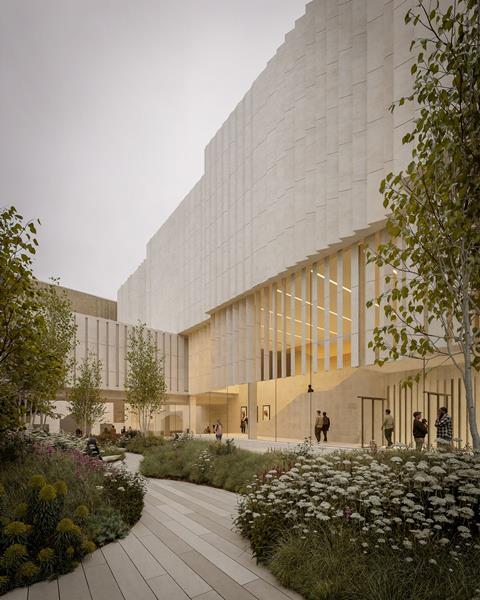
A team led by Kengo Kuma and Associates with BDP and MICA has been unanimously chosen as the winner of the competition to design a £375m new wing for the National Gallery.
The three firms have triumphed over a star-studded shortlist including Foster + Partners and Renzo Piano Building Workshop to secure a commission described by the museum as the most significant expansion in its 200-year history.
The museum’s jury panel awarded Kengo Kuma’s team the highest available score, describing the submission as “both innovative and beautiful, meeting the ambition and sensitivity required for an international gallery commission”.
The new building is set to house artworks loaned from the Tate museums which date to beyond 1900, extending the National Gallery’s collection into the modern era for the first time.
It is part of a wider reinvention of the central London institution called Project Domani, named after the Italian word for “tomorrow”, which is aiming to make the gallery the only place in the world where visitors can view the entire history of painting in the Western tradition.
A total of 65 submissions were received for the job to design the extension, which will replace an existing 1960s hotel building to the rear of the museum’s Sainsbury Wing which the museum acquired around 30 years ago.
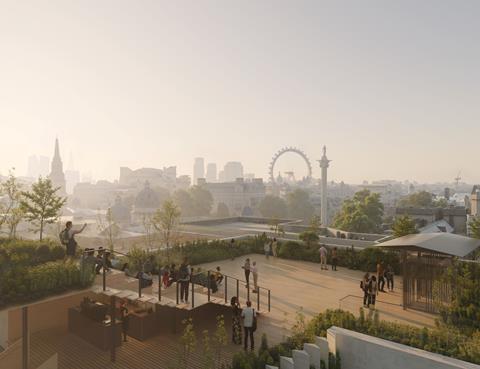
Public realm upgrades around the site will also aim to improve connections between Trafalgar Square and Leicester Square, two of central London’s busiest tourist spots.
Others on the final shortlist included Farshid Moussavi with Piercy & Company, Studio Seilern Architect, a medium-sized UK practice founded by Christina Seilern, the founding director of Rafael Vinoly Architects’ London office, and Selldorf, the US practice which designed the museum’s controversial Sainsbury Wing overhaul.
The panel said Kengo Kuma’s proposal was “an exemplary submission, demonstrating both a strong grasp of the importance of social value for this project, and how social value could be integrated into existing National Gallery initiatives, and future National Gallery schemes”.
It added that the team’s vision for the site was both respectful of Venturi Scott Brown’s grade I-listed Sainsbury Wing while creating a “generous presence” with its proposed public realm and in its approaches to a roof garden with views over Trafalgar Square.
Images of the proposals show a Portland-stone faced building with stepped massing and almost uninterrupted glazing at street level, providing views into the circulation spaces inside.
The jury said: “The style of the galleries is very simple and clean, with a contrast between the main floor that incorporates vaults and arches, while the upper floor has a more geometric design.
“As a result, the main floor of the galleries presents a continuum with the Sainsbury Wing and North Galleries, but the upper floor has its own style, which adds variety and a change of design pace to the overall scheme.”
Jury chair John Booth, who is also the gallery’s chair of trustees, said the winning scheme was a “beautiful design inside and out”.
He added: “The jury’s exciting and challenging task was to assess design submissions from six of the world’s finest architects and their partners. All six were impressive and thoughtful, but in the end Kengo Kuma’s proposal was our unanimous choice.
National Gallery director Gabriele Finaldi added: “Kengo Kuma’s trajectory as an architect demonstrates exceptional design elegance, a keen sensitivity to location and to history, and a supremely beautiful handling of light and of materials.
“The new building will complete the National Gallery’s campus, adding distinction to some already distinguished buildings. We are thrilled to be working with Kengo Kuma and his design partners, BDP and MICA, on this exciting new development for the nation’s gallery and for central London.”
The jury also included RIBA Gold Medal winner and 2025 Building Design Lifetime Achievement Award winner Patty Hopkins, former Imperial War Museum director Diana Lees and artist Céline Condorelli.
The project, one of the most prestigious cultural commissions in recent years, has been funded by two of the largest private donations ever received by a museum or gallery anywhere in the world.
Crankstart, a charity founded by billionaire venture capitalist Michael Moritz and his wife Harriet Heyman, and the Julia Rausing Trust have each donated £150m towards the new wing, with the National Gallery Trust contributing a further £75m.

No comments yet