







Hinsley Lane development is city’s largest passivhaus student accommodation scheme so far


Allies and Morrison has finished eight terraces of passivhaus-certified townhouses at Hinsley Lane in Cambridge, the city’s largest passivhaus student development to date.
The site comprises 39 townhouses with space to accommodate 245 students. Although commissioned by St John’s College, the site will be used by several Cambridge colleges.
The houses themselves range from two-and-a-half to three storeys high, which Allies and Morrison described as “commensurate with their context” in the West Cambridge conservation area.
The area largely comprises red-brick houses dating to the 20th century, many of which were inspired by the Arts & Crafts movement.
Each house in the Hinsley Lane development provides accommodation for between four and seven students. They include private study rooms and “bright” shared living areas with a dining table large enough for everyone to use at once.
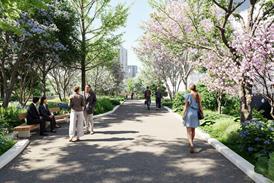
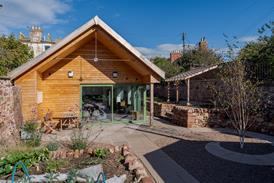
The houses open onto their own private terrace, which then steps down to a shared garden. A neglected orchard was retained and restored under the plans while the landscape traces of a Roman Road were also enhanced, the firm said.
The terraces stick out from Hinsley Lane, a pedestrianised lane running through the centre of the site, which connects Wilberforce Road to the north with Herschel Road to the south.

Max Kettenacker, director at Allies and Morrison, said the project was “quite unusual” for a student project because of its townhouse typology, rather than a corridor model. “The house-share model proved so popular with students,” he noted.
The buildings face north-south, so capture solar gain in the winter, while in summer the architects hope to keep the homes cool through bay windows and openwork screens.
Heat pumps and solar panels provide the homes with additional heading and power. The houses themselves have an all-timber structure, giving them low embodied carbon.
Suzie Wood, head of investment property at St John’s College, said Allies and Morrison had “created a neighbourhood truly embedded in its local context: from the intimate new lane framed by stepping townhouses to the verdant gardens in between, it is a place that feels like it has grown out of West Cambridge, rather than being imposed upon it.”





No comments yet