






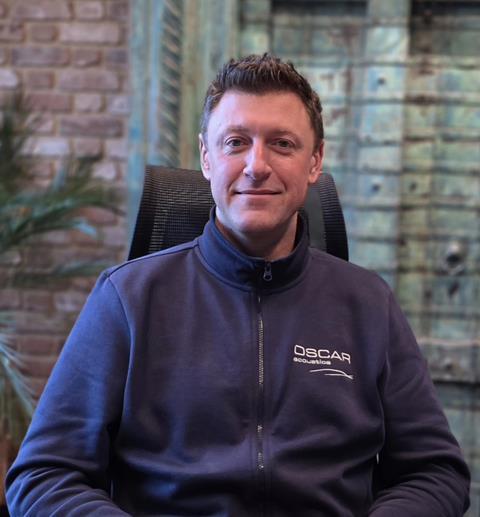
To mark the launch of a new audio-inclusive certification scheme for buildings, we talked to one of its backers, Ben Hancock, managing director of Oscar Acoustics, to learn more about how designers can make spaces more accessible to those who are noise sensitive
The new independent Sownd certification scheme for assessing and recognising audio-inclusive buildings fills what its founders describe as a longstanding gap in the inclusive design framework. Acoustic standards have existed for decades – building regulations and guidance around reverberation times, noise levels and sound insulation are well established – but none have framed these requirements specifically around the needs of people with hearing loss or auditory processing differences. And, until now, there has been no robust way to verify, post-occupation, whether a building actually works for people who are noise sensitive.
Independent certification scheme
Sownd certification, developed by hearing wellbeing specialists Sownd Affects, is the first independent standard for how buildings sound to people using them. The framework has been developed in association with the Institute of Sound and Vibration Research (ISVR) at the University of Southampton. It has three levels, and assessment is based on measured real-world performance rather than design-stage predictions. The scheme’s bronze level aligns with established standards including BS 8233, BB93 and PAS 6463.
At the most basic level, this is about improving acoustics by adding materials that absorb sound rather than reflect it – soft furnishings, acoustic panels and sprays, ceiling baffles – to reduce the echo and reverb that builds up n hard-surfaced rooms. The goal is a cleaner, clearer sound where speech is easier to understand, particularly for people who use hearing aids or struggle to process noisy environments.
The scheme was founded by Marion Marincat, who lost his hearing in his mid-twenties and spent two decades in hearing health before founding Sownd Affects in 2024. “We developed this certification through direct engagement with noise-sensitive communities to ensure it measures what matters to people,” he says. “When these standards are embedded from RIBA Stage 0 onwards, participation and wellbeing improve for everyone.”
Issue that affects many people
Officially, 30 percent of the population is considered to be noise sensitive, but that figure only covers those with diagnosed hearing loss or tinnitus. And, according to Hancock – who has tinnitus himself – when neurodivergent people, who may also be sensitive to loud noise, are included; as well as people with age-related hearing difficulties; and those who are simply noise-intolerant; the true proportion of the population affected by poor acoustic environments may be as high as 80 percent.
At the same time many current interior design trends compound the problem. “What’s fashionable in terms of spatial design at the moment is lots and lots of hard surfaces,” says Hancock.” And those two things don’t add up.”
Productivity probem
The business case is not simply an accessibility argument. Recent research by Hancock’s firm Oscar Acoustics, which has partnered with Sownd Affects on the scheme, found that office workers lose an average of 26 minutes of productive time a day because of noise – which across a 50-person office amounts to 150 weeks of lost productivity each year.
Hancock puts the total cost to the UK economy at £40 billion annually. The same survey also showed that 62% of workers now factor noise into decisions about where to work, with a significant proportion considering leaving jobs specifically because of it – an uncomfortable statistic when many employers are currently encouraging staff to come back to work in the office more regularly.
Health implications extend beyond productivity. Chronic noise exposure is associated with elevated cortisol, stress and higher rates of sickness absence, and the World Health Organisation has identified noise as second only to air pollution as a damaging environmental health factor.
Route to certification
Oscar Acoustics’ innovation centre and HQ in Kent is set to become the first Sownd-certified building. Meanwhile, the company’s spray acoustic finishes – which are made from fire-rated recycled paper and applied to ceilings – have been independently validated by the ISVR so that projects using them can be fast-tracked to achieve the scheme’s bronze certification via a streamlined pathway.
Hancock explains that part of the wider vision behind the scheme is that one day it will enable people to choose which venues to attend – pick a restaurant, say – on the basis that they are audio inclusive. “We want people to be able to filter on review sites and deliberately choose to go to a restaurant where they can actually hear their friends.”
Award-winning film
Hancock and Marincat’s collaboration has also seen them working together on a plan to turn Hackney into what Marincat describes as the world’s first audio-inclusive borough. With support from Arts Council England and funding from Oscar Acoustics, three music venues in Hackney have had their acoustics improved to make them more accessible to people with noise sensitivity. The team’s film about this, Now Hear This, has already won best documentary at film festivals in Berlin and Barcelona and is set for wider release later in the year.
You can learn more about the certification scheme on the Sownd Affects website.







No comments yet