








UK tile manufacturer Johnson Tiles is backing the commercialisation of a new type of tile with a carbon footprint 94 percent lower than conventional ceramic tiles
The kiln-free, low-energy, bio-based alternative to ceramic substrates has been developed by materials technology start-up Dekiln, after founder Dr Aled Roberts invented the new tile formulation in a workshop in his basement during lockdown.
Dekiln’s Eralith tiles are set to be brought to a wider market through the new partnership with Stoke-on-Trent-based ceramic and porcelain tile specialists Johnson Tiles.
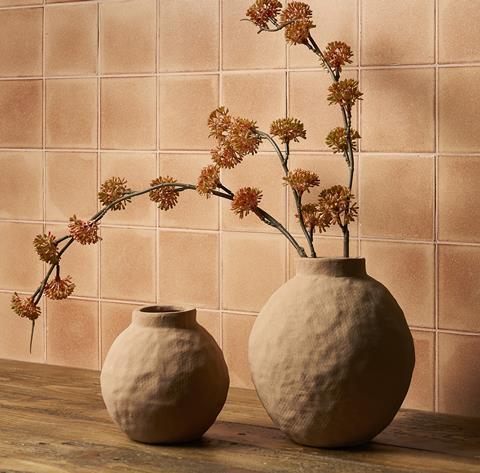
Waste based and low-energy curing
The tiles look, feel and have similar properties to ceramics, but do not need to be fired or glazed at high temperatures. The patented new technology also uses more than 95 percent recycled content. Plant-derived binders are combined with waste mineral powders, such as recycled gypsum plaster, to make a ceramic-like composite. The formed tiles then undergo a low-energy curing process that requires significantly less energy than traditional ceramic firing.
“This marks an important milestone for Dekiln as we transition from the laboratory to industrial scale manufacturing,” says Roberts. “Johnson Tiles’ technical expertise, market reach and sustainability focus makes them an ideal partner to support our ambition to scale-up and commercialise our technology.”
Roberts won a Royal Academy of Engineering’s Green Future Fellowship in 2025, securing £3m funding for his new business. Now the aim is to accelerate the commercialisation of Dekiln’s proprietary processes and materials by leveraging Johnson Tiles’ manufacturing expertise, market access and sector leadership.
“Johnson Tiles are really excited to be forming this partnership with Dekiln and look forward to adding our technical expertise and market knowledge to ensure this unique concept reaches its potential in the marketplace,” says Jason Bridges, procurement director at Johnson Tiles. “Aled’s fresh thinking on solving the recycling of waste alongside removing the sintering process to create a product with all the performance and aesthetic qualities of traditional tiles without anywhere near the embodied carbon is a real gamechanger and a concept that aligns perfectly with Johnson Tiles’ sustainable thinking.”
Decarbonising ceramics
The ceramics industry emits 19 million tonnes of CO2 annually in Europe alone, with firing and drying processes accounting for 80% of emissions. The Dekiln and Johnson Tiles partnership comes within a broader wave of research into low- and no-firing ceramic alternatives. Cold sintering – a process that uses pressure and a small liquid phase to densify ceramic powders at around 150°C rather than the 1,000°C-plus of conventional kilns – has attracted significant academic interest, while geopolymers – which cure at ambient temperature through alkali activation of industrial waste materials like fly ash – are seeing growing adoption in construction. However, cold sintering remains largely at lab stage, and geopolymers tend to be suited to structural rather than finish applications.







No comments yet