

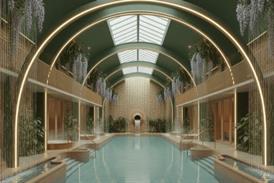
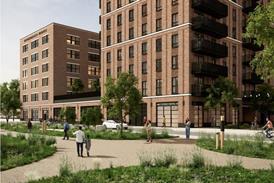
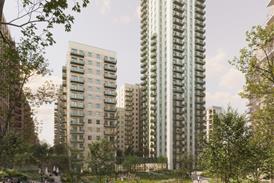
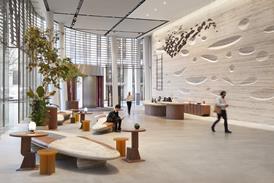

When I met French architect Thomas Coldefy I planned for us to discuss what the UK can learn from France about building with wood – and we did – but we also got distracted discussing some of his practice’s rather wonderful imaginative and biophilic buildings
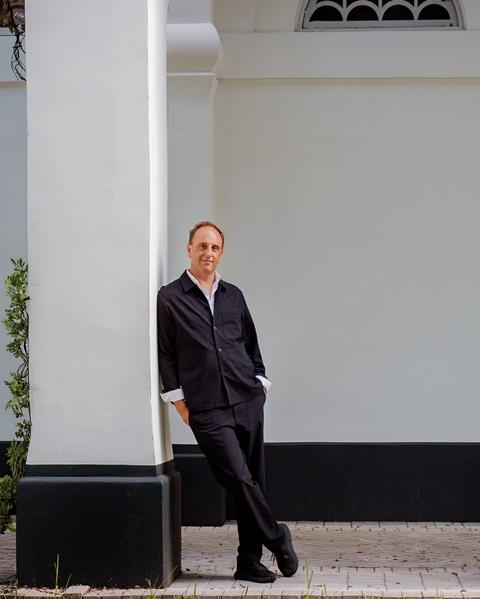
Thomas Coldefy, whose eponymous practice has offices in Lille, Paris, Shanghai and Hong Kong – and a reputation for creative, sustainable design – explained to me how the French are embracing timber so successfully. But our conversation broadened to embrace much more – from the firm’s fascinating “folly” in progress in Montpellier to its involvement in France’s answer to the Eden Project…
Early career – learning from other cultures
Coldefy grew up with architecture. His father ran a practice in Lille, and teenage travels to Chicago and Japan exposed him to different types of architecture and sealed his love for building design. After graduating from the École Spéciale d’Architecture in 2002 he worked at SCAU in Paris on Tadao Ando’s ultimately doomed Pinault Foundation gallery on the Île Seguin. He then moved via London to New York, where he worked for Kohn Pedersen Fox (KPF).
The latter proved to be a formative experience. Coldefy recalls observing for the first time the “Anglo-Saxon way to practice architecture, which is very organised, very professional and very well thought out”, and says he seeks to this day a balance between the Anglo and Latin approaches. “If I had been only raised and educated in France, I would have only known that Beaux-Arts tradition, with the very strong ego of the master architect who thinks he knows everything and everybody just has to follow his idea – that is not really the DNA of our studio,” he says.
Coldefy returned to Lille in 2006, where his father was retiring, and the family name was available. Rather than stepping into the practice, Coldefy Jnr reconstituted it from scratch with Belgian architect Isabel Van Haute, who had also worked at SCAU and at Richard Meier and Partners. Van Haute remains his partner in the firm, which now employs around 50 people across its four offices in France and Asia.
A tale of two regulations
So what of wood? Coldefy says, “Clients are following the trend, but they are also being educated by their kids who say, ‘Hey Dad, you’re driving a Tesla but you’re building with concrete – you’re an asshole.’”
Since January 2022, French construction has been governed by RE2020 (Réglementation Environnementale 2020), which makes embodied carbon a legal requirement rather than a voluntary aspiration, initially via reporting but increasingly through carbon caps.
Each new building must declare its emissions across its entire cradle-to-grave lifecycle, (assessment modules A1 to C4); and the rules are getting progressively more challenging, moving from a carbon-reporting regime to one of embodied carbon caps that are tightened periodically. For example, embodied-carbon thresholds for new apartment buildings tightened in 2025 to around 650kg CO₂e/m², with further reductions planned by 2031. For houses it is already down to 530kg CO₂e/m², which compares with the RIBA 2030 target of 625kg CO₂e/m² for homes. Since the latest tightening of the rules, bio-based materials – of which mass timber is, of course, the most mature and commercially available – are increasingly necessary to comply, with future thresholds expected to make them effectively mandatory for many building types.
French fire regs
At the same time, French fire regs are arguably more flexible and timber friendly than the UK’s post Grenfell regime. Coldefy says, “We have to build hand-in-hand with the fire people, as you do.” France has generally taken a more performance-based approach to timber fire safety than the UK. With sprinkler systems, performance is comparable to concrete, so exposed timber is permitted subject to achieving the required fire rating and the use of appropriate compartmentation and suppression systems. “Timber towers” – such as the 14-storey Wood Up in Paris and the 16-storey Silva Tower in Bordeaux – have already been built, and fire codes continue to be updated to enable the use of timber in more building types, with compliance treated as an engineering challenge that can be met through design.
All of which means the French construction sector is getting timber fluent fast. “There has been, in France, an awakening about the carbon footprint,” Coldefy says. “Many voices raised to encourage everyone to use timber. We were really happy.” The practice has built frequently with timber, but, he explains, “In our studio, the agenda is not focused on wood, it is focused on making nice places, surrounded with nature, with nice materials and that have an impact. We didn’t force clients to do it.”
A hybrid approach
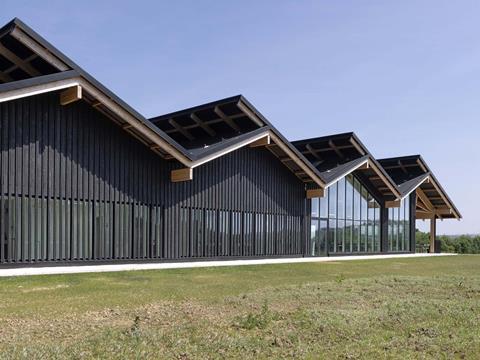
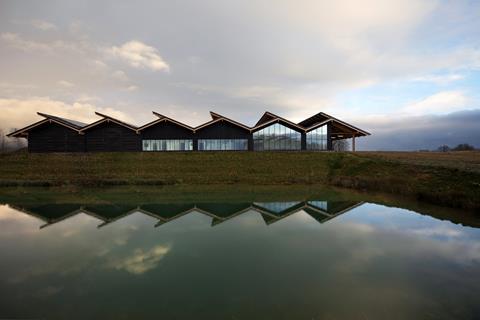
Completed timber projects include the Maroquinerie de la Sormonne, a Hermès leather goods factory in the Ardennes. Here a fully timber structure made sense for a single-storey build near forests used to source the timber. Elsewhere, they have adapted a hybrid approach. At the Robert Badinter secondary school in Cambrai, the first timber school in the north of France, concrete was used for the ground floor and timber above that. He emphasises, “The future is hybrid. And that’s not a compromise – it’s the point.”
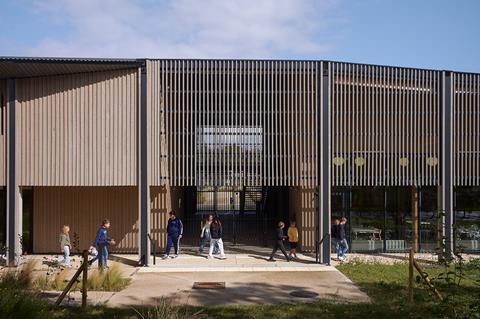
“People are really scared about the cost. So what we do is propose solutions that are not totally timber. We use wood for what it is best for – for dry construction, which it allows to be much faster. Speed is money, so there it is an advantage. Off-site manufacturing is a very important aspect, too. We also use hybrid solutions to reduce the volume of wood.”
Wonder Building – timber at scale
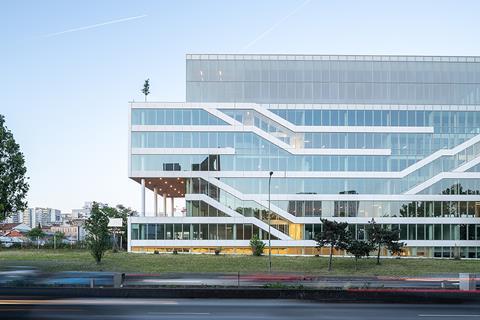
A case in point is the Wonder Building, Coldefy’s largest timber project to date. Completed in 2023 just inside the Paris ring road at Porte de Bagnolet, this is a 27,000m2 office and commercial building on a former industrial site. The client, a major Paris office developer, wanted a building ambitious enough to attract tenants to what was an unfashionable area on outskirts of the capital, while achieving top environmental ratings.
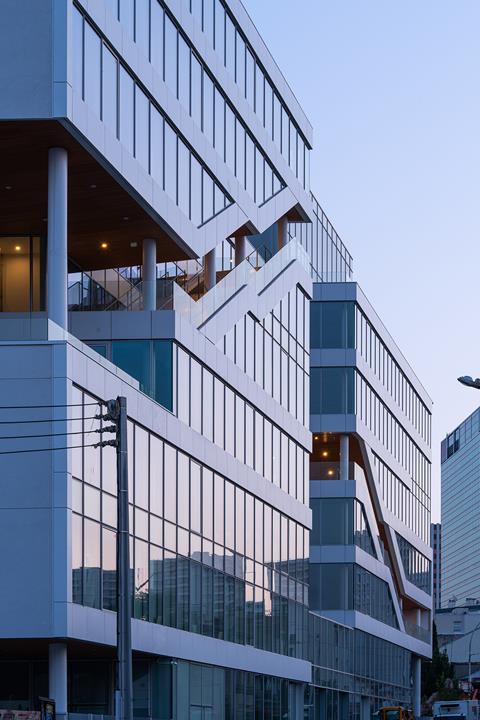
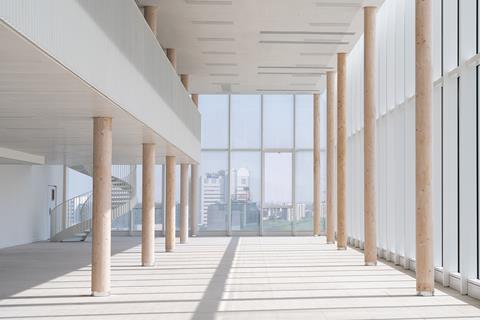
An early ambition for a fully timber structure gave way, on engineering grounds, to a steel-timber hybrid. CLT rib panels by Stora Enso – 11,000m2 of them – form the floor slabs, combined with a steel frame that allows the structural sections to be kept slim enough to maintain the 2.9m floor-to-ceiling heights demanded. “If we had used fully timber construction,” Coldefy states, “we would have lost some quality of the space because the beams would be thicker and everything would have been too much somehow for the scale of building. So, we combined a little bit of steel to allow for thinner slabs, and to allow a better height. Otherwise, we would have to reduce floor heights and have less floors.”
Timber columns were machined off-site, arriving with steel connectors, base plates and head brackets already installed, which meant each 3300m2 floor could be assembled in a fortnight. The 4,450m³ timber structure stores around 2,500 tonnes of CO₂ and, according to the project team, reduces the building’s wholelife carbon footprint by around 60 percent compared with a conventional equivalent.
Dynamism is introduced to the glass facades by running half the building’s staircases across the exterior, which frees up floorplate and makes movement through the building a social and visual event. Connected to a district heating network and carrying 500m2 photovoltaic panels on its roof, the Wonder Building has a whole host of environmental certifications and awards – and is a great exemplar of timber workplace design.
Oasis, Montpellier: bamboo, sunlight, and the new folly
If the Wonder Building represents Coldefy’s sensible case for timber at scale, Oasis, a “folly” under construction in Montpellier, represents something more exploratory: a playful project that pushes boundaries of what can be done with natural materials in modern builds.
Montpellier is a city with a tradition of commissioning major international architects – Bofill, Nouvel, Hadid, Starck – to create public architecture as a means of building civic prestige and attracting investment. It also has an older tradition of follies – 18th century country houses outside the city – and in 2012 these two were combined in a competition to design modern follies. The first results of this were Farshid Moussavi’s Folie Divine and Sou Fujimoto’s celebrated L’Arbre Blanc. In 2022 the programme was relaunched with 13 new sites across the city and a brief now explicitly tied to sustainability, affordable housing and climate resilience. Coldefy’s design is one of the winners from this latest iteration of the folly programme.
The project sits on a site in the Ovalie district on high ground at the edge of the city where summer heat is becoming increasingly difficult to manage. The site contains three umbrella pines, which Coldefy took as inspiration for its design. “We like to refer to trees as the best shading devices… We said we have to design a building that has that capacity of the trees to protect themselves,” he explains.
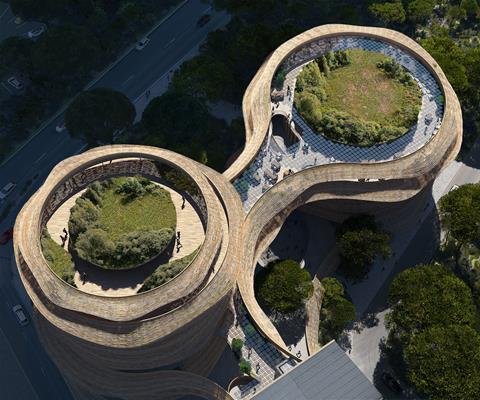
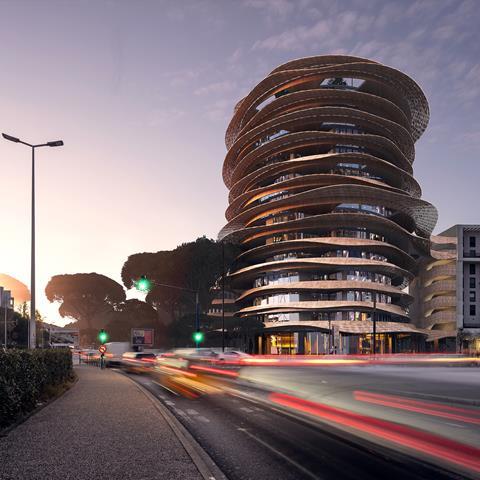
The result is Oasis: two round buildings – one residential with 53 apartments, one offices – facing each other across a shared garden and connected by a footbridge. Each building is draped in what Coldefy calls bamboo “skirts” – hand-woven bamboo panels on metal armatures that encircle every floor like the brim of a straw hat – and the size of these “skirts” is carefully modelled using the sun’s trajectory across the building’s facade, so each face has exactly the shading it needs.
“They are like sunhats or skirts around every floor, with shapes that are undulating and have a different depth according to the solar curve.” What looks like a whimsical architectural gesture is, structurally and thermally, a clever piece of environmental engineering. This is nature as structure, not decoration.
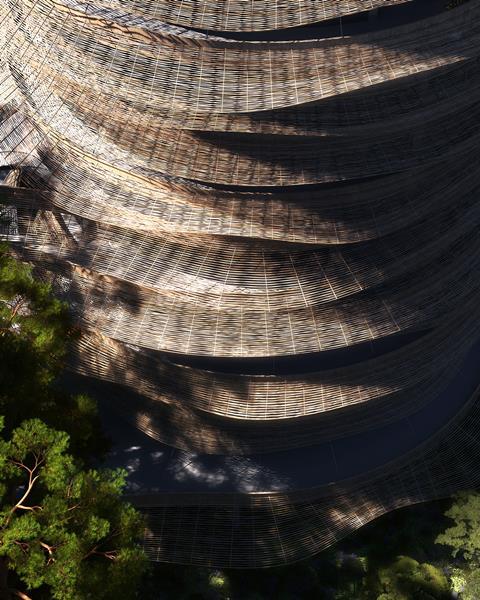
The bamboo is sourced from the Bambouseraie d’Anduze, a historic garden in the Gard département 180 km from Montpellier, where bamboo was first introduced by a 19th century plant collector who brought it back from Asia. Bamboo is not a material that fire officers greet with enthusiasm, but Coldefy’s solution is a concrete curb at each floor level to break the potential fire path between storeys. Completion is expected in 2027, and the rooftop restaurant, with panoramic views to the sea, is set to be run by French rugby international François Trinh-Duc.
This is indeed a wonderful project: creative, fun and making use of sustainable materials in an imaginative and intelligent way. I fell in love with the quirky look of the project when I saw it at Venice last year. Now that I better understand quite what a technical feat it is too, I like it even more. Combining pragmatism and idealism is one of the firm’s strengths: Coldefy dreams big but is ruthlessly practical about execution.
Tropicalia: the dream that keeps going
Talking of dreaming big, no profile of Coldefy would be complete without mentioning Tropicalia, a dream scheme with a rather touching origin story. Still seeking final funding, this is France’s answer to the Eden Project.
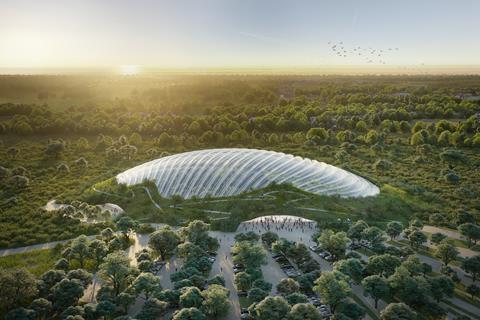
Coldefy smiles affectionately as he tells its story. The client is a vet from the Opal Coast in northern France, a man who grew up as an expat in Africa and South America. Having returned to cold, grey northern Europe, he dreamt up the notion to build the world’s largest tropical dome, with a view to bringing the warmth and colour of the Tropics to his homeland. He found his way to Coldefy’s door about a decade and half ago, arriving with a sketchbook rather than a brief, and shared his vision. Rather than sending him away, the team bought into the dream, worked out how it could be made real, and have been involved ever since.
The idea is the giant dome would house freely roaming birds and butterflies alongside tropical flora grown in situ in an environment designed to inspire and educate children about the natural world. The scheme as Coldefy has designed it involves a 20,000m² double ETFE dome – two layers separated by a three-to-four metre air gap encapsulating the steel structure – that will act as an enormous thermal collector. Solar heat stored in the air cushion will be transferred via a heat-exchanger into a ground-level water tank that will radiate warmth through the entire structure year-round maintaining the constant 25-30°C required for a functioning tropical atmosphere. Surplus heat will feed surrounding buildings, including a nearby hospital.
The dream scheme has survived COVID; attracted enough planning support to obtain a building permit; and survived a campaign by local opponents who objected to its scale. The site near the town of Rang-du-Fliers is ready – and the vet remains determined to make it happen. Funding is the final hurdle to overcome.
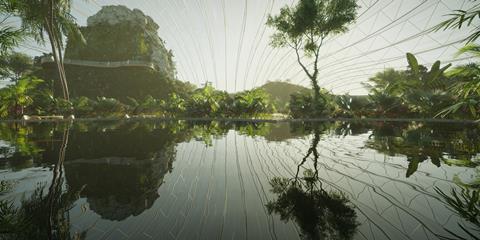
Financial woes troubling our own Eden Project notwithstanding, I rather hope the vet manages to pull off his dream. Tropicalia embodies a kind of unembarrassed, expansionist confidence that is out of step with the times. Certainly in the UK, ours is an age that is cautious about grand projets, grand gestures, grand anything; suspicious of human interventions in nature; and uncomfortable with the idea of transplanting one part of the world’s ecology into another. Who are we to bring the tropics to northern France? The Victorians had no such qualms (too busy collecting palms) – they built pleasure gardens, collected the world’s wonders, moved species around with total confidence in their right to do so. We have lost that confidence, which is, no doubt for the best in many ways. But, I am sure there has been an over course correction and when I see a scheme like this – a project that has the audacity – I find it hard to resist.
It is also a project powered by one man’s dogged pursuit of his dream. “Architects are here to make dreams happen, using the best solutions available,” says Coldefy. Sticking with Tropicalia through years of planning battles and funding difficulties and bringing technical ingenuity to what could be seen as a fantastical scheme, makes me warm to the Coldefy team even more.
Learning to love the challenges
Coldefy himself regards the challenges that have to be overcome in bringing projects to fruition as the spice that keeps things interesting. “We have to turn every opportunity into a positive. I always try to see the difficulties as part of the game,” he says. For him, fire-safety rules, cost questions, technical challenges, regulations are not obstacles to good architecture, rather they are constraints that help sharpen good design. And that is probably a more profound takeaway from our conversation than anything more specific about French rules for mass timber construction.
International embodied carbon regs
France is not the only European country taking a lead on embodied carbon regulations. The Netherlands was the pioneer, introducing mandatory wholelife carbon assessment through its MPG (Milieu Prestatie Gebouwen) system as far back as 2018 for new homes and offices, with thresholds tightening progressively and set to halve by 2030.
France followed in 2022 with what is perceived to be the most comprehensive framework to date, with RE2020 mandating full A1–C4 lifecycle assessment with progressively tightening carbon thresholds.
In 2023 Denmark was the first country to set a hard CO₂e per m² limit that buildings over 1,000m² must meet. Again, limits are tightening over time.
Finland’s new Construction Act has brought mandatory wholelife carbon climate declarations into force from January 2026 for new buildings, covering a 50-year lifecycle aligned with EN 15978.
At EU level, member states have been required to adopt their own versions of the Energy Performance of Buildings Directive (EPBD) which mandates wholelife carbon LCA for new public buildings over 1,000m² from 2028, and all new buildings by 2030. Also by 2030 member states must introduce limiting values, not just reporting. The EU has also published a common calculation framework so that methodology is consistent across all members.


No comments yet