Landmark ‘stump’ reaches its intended height - more than a century after it was completed

Brighton College

Source: Will Pryce

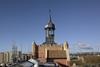
The cupola viewed from below

Project Cairns Tower, Brighton College
Architect Richard Griffiths Architects
Location Brighton, East Sussex
Completion November 2014

Architects know only too well that feeling of frustration when the funds run dry before a project is complete. It’s an emotion that the eminent Victorian architect Thomas Graham Jackson must have felt when the design for his bell tower, the centrepiece of Brighton College, could only be built to less than half its proposed height.

Brighton College

Source: Will Pryce

The two-storey tower, built in 1887, didn’t really live up to its lofty name. It looked more like a sawn off stump, albeit a beautifully detailed one, capped with an unfortunate tiled pitched roof, chimney stacks and no bell. The octagonal buttresses, which were meant to serve as a base for the tower, were terminated in an unsympathetic manner and sheltered by an over-sailing roof.

However, 127 years later, a substantial donation to the school has enabled Jackson’s vision for the city landmark to be finally realised. Two extra storeys and a cupola have been added to the grade II-listed tower in a £3 million scheme executed by Richard Griffiths Architects (RGA) and completed in late November. The tower, which has been renamed after Richard Cairns, the school’s head, closely follows Jackson’s design, but takes advantage of 21st-century building techniques and tools.

“We are not purists, we’re building in the 21st century,” says Jorge Moreira, project architect at RGA. “We are respecting Jackson’s principles, but we’re not pretending to be Mozart composing Mozart’s music. We use our tools and make it fit. Our work is an interpretation of the proposed tower based on Jackson’s original drawings and we have closely followed Jackson’s suggested form and materials. But the detailing is simplified and has a more contemporary feel that acknowledges that this is a 21st-century addition to an incomplete entrance range.”

Jackson, who had been a pupil at Brighton College from 1850 to 1853, was heavily influenced by the architecture of George Gilbert Scott. An unsurprising fact given that Jackson would have seen Scott’s main school building (1849) most days at school. He also worked in Scott’s office as a young apprentice. So when Jackson was appointed in 1883 to design a range of boarding houses along the south boundary with the tower entrance in the middle, he chose an ornate Victorian gothic style for the design.

But a lack of funds meant that just half of Jackson’s proposals were built, including only two floors of the tower. The eastern range was eventually completed in 1929-30 by TF Cawthorn, but the tower remained incomplete, until now.

Brighton College plans

The Cairns Tower, which looks out towards the sea from its main (south) elevation, forms the central entrance to the independent school. It features a main carriageway entrance and pedestrian arch, both of which are vaulted, and is accessed off the busy Eastern Road. The south elevation is in red brick with terracotta dressings while the north elevation, which faces on to the school’s quadrangle, is of flint with terracotta dressings.

RGA’s brief when it was appointed in September 2011 was to complete the tower, which involved looking in detail at the treatment of each element, including the tower’s design, its structure and the most appropriate materials.

When considering how the structure of the tower’s new additions should be built, RGA felt strongly that to be consistent with the tower’s original solid masonry walls they should be of solid construction. At second floor, the tower’s unembellished east and west walls were completed in solid three-brick-thick brick above the existing gables to match their construction. At third floor, the walls were built in one-brick-thick brick external leaf with an insulated cavity and a blockwork inner leaf.

For the richly decorated north and south walls, combining window openings with flint, brick, lead and terracotta, the new second and third floors are of solid construction with the facing brick and flint tied to an inner block leaf. The walls are insulated internally with a Ty-Mawr breathable internal wall insulation system, which is cork-based. The tiled pitched roof was demolished to make way for the new additions.

However, the architects made an exception for the structure’s new roof. Where Jackson may have used timber, the structural engineer recommended a steel frame structure that employed steel ring beams bolted on to the base of the roof and cupola. The cupola steel frame was assembled offsite and craned into place and finished in lead. The cupola features eight fixed bronze-framed windows and is crowned with a copper weather vane, depicting a pelican, the school’s symbol.

“The purpose of the cupola is pure Victorian gothic show,” says Moreira. “There is no access to the top. The windows in the cupola are there to draw in daylight into the top floor.”

RGA are well aware of how historic glass influences the appearance of old buildings. Therefore all new windows in the tower and adjacent stone staircase are double glazed with historic glass. Instead of leaded lights, as on the existing first floor, all new windows are contained in bronze casements of slender frame with unleaded and undivided lights and are set into a terracotta frame. Bronze is an expensive material but it was chosen for its durability. In addition, given the tower’s close proximity to the sea, bronze won’t need the same level of maintenance that timber- or aluminium-framed windows would have required.

“The quality of the materials used on the tower throughout had to be very high; the bronze, the lead work, the terracotta, the flint and the brickwork had to be of a quality construction,” says Sam Holden, project manager at Brighton College. “We are dealing with an old building and this is something that will be here for a long time.”

A welcome addition to the north side of the tower at third-floor level is a new clock made by Smith of Derby who also made the sundial for the south side positioned at the same level.

Moving inside the tower, RGA made no alterations to the ground floor, which houses the entrance gateways, and adjacent porter’s lodge and spiral staircase, which provides access to the tower. Changes also weren’t made to the grand timber-panelled first floor, which still contains the head’s room and the PA’s office, which is located above the porter’s lodge to the side of the tower.

The new second floor is a wonderful tall space lined in oak panelling that will be used as an events and conference room. Oak window seats have been installed at the north and south ends, providing views of the sea on one side as well as opportunities to look out at the school grounds on the other. In the area to the side of the tower, which houses the stair, a new shower area and small kitchen have been provided, located immediately above the PA’s office.

Brighton College

Source: Will Pryce

Moving up to the new third floor, which will be used by the deputy head, is another impressive room, its spaciousness heightened by the cupola that is clad internally in copper sheets with a bronze finish.

One of the more technically challenging elements of the scheme, and a geometric exercise for the architects, was the extension of the existing spiral stair adjacent to the tower which serves the new floors. In spite of the existing stone stair having a central solid drum, the architects were convinced that a new stone “cantilevered” stair was more appropriate.

The decision to employ a “flying” stair using York stone built into the wall, seemingly without any visible support, and not to extend the central drum, was the right one, says Moreira. “I didn’t want to carry the drum all the way up because it would have killed the space and the enjoyment of the route,” he says. “The headroom in places was very tight and a cantilevered stair resolves this and co-ordinates the different levels of the building.”

The staircase may have presented its own set of challenges. But for Moreira the most complex aspect of the project was marrying the old with the new and making sure that the new elements didn’t modify or damage the existing ones.

Thankfully, the completed tower no longer resembles a squat stump. The sensitive design skilfully executed by RGA, coupled with the employment of quality materials and excellent craftsmanship, means that the Cairns Tower is now truly deserving of its name.

Client Brighton College
Architect Richard Griffiths Architects
Structural engineer Hockley and Dawson
Services engineer Thornton Reynolds
Quantity surveyor Quantem Consulting
Main contractor Virtus Contracts
Terracotta contractor Hathern Terra Cotta
Brick and flint contractor The Flint Wall Company
York stone stair contractor Stonewest
Steel contractor Littlehampton Welding
Cupola lantern bronze cladding CDC
Lead contractor Bridgehill Specialist Roofing
Bronze windows Vale Garden Houses
Specialist joinery Edward Williams Furniture
Tower clock and sundial Smith of Derby
Weathervane Greens Weathervanes