








Timothy Brittain-Catlin reviews an accessible and lively compendium that represents a wonderful tribute to a much-missed mentor
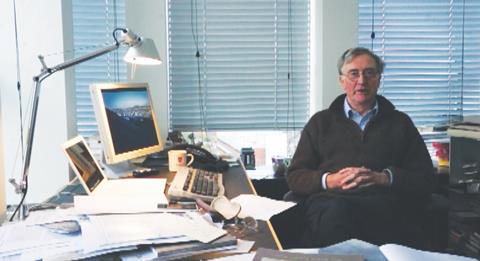
This is an important book that celebrates and continues the work of Peter Blundell Jones, who died in 2016, one of the most important architectural teachers, historians and writers of his generation.
His monographs on the German expressionist architects Hugo Häring, Hans Scharoun and Peter Hübner, and on Erik Gunnar Asplund, are still acknowledged as authoritative accounts of their work; as a regular guest editor and contributor to the Architectural Review during the peak of that magazine’s international influence from the 1990s, he was also the person who set the agenda for much of what was to come in the world of organic and environmentally aware architecture.
Unfailingly supportive of former students, he must take a great deal of credit too for the rise of the reputation of the Sheffield School of Architecture and Landscape, which recently celebrated his life’s work with a substantial exhibition that ran for the second half of last year. The centrepiece of this was one of his most astonishing creations, the immaculate 1:500 carboard model of the centre of Sheffield as it was around 1900, created with graduate students.
Towards the end of his life he began to lay out a theory of understanding buildings through the experience of using and living in them
This map was, he said, an “educational vehicle”, and so was much else of Blundell Jones’s legacy. Towards the end of his life he began to lay out a theory of understanding buildings through the experience of using and living in them: this was in contrast to the idea that the architecture of high modernism should be interpreted either as works of conceptual art or as theoretical “texts”, the latter a particular bugbear of the authors and editors of the Architectural Review.

His first book to pursue this was Modern Architecture through Case Studies of 2002; a second collection was published five years later. He followed these with Architecture and Movement and then Architecture and Ritual, published in the last year of his life. This latter begins with an interpretation of the state opening of the British parliament and was inspired by one of his earliest interests, the work of A.W.N. Pugin and the early gothic revival. Together, these books lay out a coherent theory of analysis of continuing value.
This new compilation has been created in continuation of that sequence by two of Blundell Jones’ collaborators, the architect Xiang Ren and the landscape historian Jan Woudstra, both teachers at the Sheffield school. Many of the chapters are by researchers who at some point worked there too, in some cases directly with Blundell Jones as doctoral supervisor.
The format is that of the short case study that the original author pioneered, so the chapters as a collection cover a great deal of ground and the casual reader is likely to find at least a couple of subjects accessible and engaging.
The 16 chapters are well illustrated and shorter than academic journal articles, making them easily negotiable on, for, example a journey to work. Thus Jo Lintonbon, writing about Saltaire, is followed by Hyon-Sob Kim on buildings in Seoul.
Then, towards the end, via the master planning of Gaberone, the churches of Rome, the sanctified spaces within Thai homes and much else, come the veterans Jeremy Till and Stephen Parnell: the former on a demountable/remountable timber pavilion called the Floating University Berlin – Till, who presents the structure as a form of engagement with climate breakdown, might perhaps describe himself as an architect) – and the latter on the “fascinating and risible” Neom project in Saudi Arabia.
A beautiful endpiece on living in Padley Mill, the home that Blundell Jones designed for his family, concludes an excellent and lively compendium, a wonderful tribute to a much-missed mentor.
Postscript
Timothy Brittain-Catlin is a professor of architecture at the University of Cambridge.
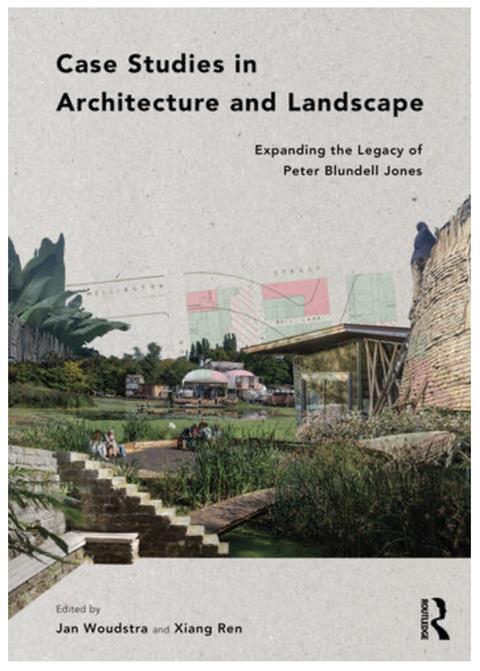
Case Studies in Architecture and Landscape: expanding the legacy of Peter Blundell Jones, edited by Jan Woudstra and Xiang Ren, was published by Routledge in September 2025.







1 Readers' comment