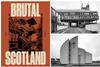
Brutal Scotland is a book and exhibition by photographer Simon Phipps documenting 160 buildings across the country. The exhibition is at Street Level Photoworks in Glasgow until 16 May, Bobby Jewell writes

Glasgow has a serious problem with its historic and cultural buildings. Even before the Union Street fire last month, the city had a reputation for being beset by problems of arson, alleged incompetence from leadership and needless demolition.
Furthermore this year has been disastrous for the city’s cultural spaces, with the Contemporary Centre for Arts closing and multiple occupants of thriving arts venue 103 Trongate facing “unsustainable” rent increases.
It is important to bring up this context of how these buildings and spaces are being let down as the exhibition and book Brutal Scotland by photographer Simon Phipps really shows how much incredible architecture is in the country, and presents his work at Street Level Photoworks, a venue that is part of the contested 103 Trongate site.
Working for over 25 years, Phipps has been documenting the brutalist buildings of the UK since 2015, with his much lauded Brutal London and Brutal North books and now Brutal Scotland, published by Duckworth Books in 2025 and designed by Glasgow-based Graphical House.
Put on by Phipps with “a desire to make it the biggest it can be”, the exhibition is a fantastic series of large photographs and collages filled with arresting, bold images of Scottish brutalism: there are iconic behemoths like St Peter’s Seminary and Cumbernauld Centre, civic and healthcare projects from Aberdeen and Edinburgh, Glasgow locals like Kentigern House and the McCance building, the Gala Fairydean Football Stadium in Galashiels restored by Reiach and Hall Architects and the recently saved Bernat Klein Studio.
More than just a snapshot of these buildings as they stand today, the exhibition also reflects on the architectural and photographic culture that existed at the time these buildings were designed, especially the use of black and white film and the 1969-70 Manplan magazines.
Influenced by photographers such as Henk Snook, Jim Donat and Sam Lambert, who used black and white out of necessity, Phipps chose to echo this style with his choice of monochrome film to give the exhibition a timeless feel and admiration for these architectural designs. He writes: “It allows you to photograph a building without fixing the dates, and removes the distractions from its sculptural form and materiality.”
It is something immediately felt on entering the exhibition as you see the buildings in frame as the sculptural objects Phipps intended: with the dramatic lines, curves and facades of buildings at a wide range of scales with seldom instances of people, street furniture, cars and lighting interfering with them. It is a choice that was also made by Glasgow artist Nebo Peklo and her brutalism show at Glasgow City Heritage in 2023.
An honesty of materiality can be seen throughout the photographs and also highlighted in a text written for the exhibition by Glasgow Georgian architect Paul Stallan in an accompanying minigraph and poster of Dundee’s Medical Sciences Building. Phipps writes: “Everyone thinks brutalism is about concrete, but it’s about using the materials as they are and not hiding that expression of structure and legibility of form.”
A rare treat for audiences in Brutal Scotland is the exhibition of the influential Manplan magazines. A series of eight issues of the Architectural Review published from 1969-70, the magazines were a radical challenge to the status quo that covered themes such as health and wellbeing, frustration and religion.
The striking visuals of Manplan magazines, with their bright use of simple colour contrasting with the black and white photographs, were “foundational” for Phipps, who presents the exhibition as “an exploded magazine within the space”. The Manplans were used to guide the flow of the exhibition, with the rockwell typeface, colourscheme of the series replicated across Phipps’ photographs and even some vintage adverts thrown in to tie you back to the era.
At a worrying time for the built environment and the arts in gneeral, especially in Glasgow, Brutal Scotland shows how much there is and equally how much can be lost if we don’t work to preserve and celebrate this era of architecture
Brutal Scotland is one or two architectural photography shows this year to showcase the work of the Manplan magazines – the other being Wide-Angle View: Architecture as social space in the Manplan series 1969 to 1970 opening at the RIBA Liverpool in July – and its sharp, critical eye feels so relevant to questions of how we see and think about the current state of the UK’s built environment.
There is always some discussion when it comes to brutalism about its resurgence in relative popularity over the past two decades with younger generations, especially given the ongoing housing crisis. For Phipps, “it’s about responsible and sociable architecture, as much as it is about the muscular concrete forms” and the legacy that brutalism has on contemporary architecture, with Peter Barber’s housing singled out as work that resonates with contemporary audiences due to its matching ambition and respect for form and materiality.
At a worrying time for the built environment and the arts in general, especially in Glasgow, Brutal Scotland shows how much there is and equally how much can be lost if we don’t work to preserve and celebrate this era of architecture. And what Phipps has done so well here, with both exhibition and book, is present his photography in an engaging and popular way – certainly the gallery was busy with audiences of all ages each time I visited.
As Phipps states in Brutal Scotland: “These buildings were never just about concrete and form – they were about ideas, about society, about a future that people believed they could shape. Scotland’s postwar architecture still tells that story, but you have to be willing to look past the neglect.”
Postscript
Brutal Scotland is a book and exhibition by photographer Simon Phipps documenting 160 buildings across the country. The book is published by Duckworth. The exhibition is at Street Level Photoworks in Glasgow until 16 May


No comments yet