






Finalist for Individual House Architect of the Year Award 2025, Wilkinson King Architects guides us through the specification challenges present at Field House
Wilkinson King Architects’ work was shortlisted at last year’s AYAs, as the practice was named a finalist for Individual House Architect of the Year.
In this series, we take a look at the team’s entry project and ask the firm’s principal, Chantal Wilkinson, to break down some of the biggest specification challenges that needed to be overcome.
What were the key requirements of the client’s brief? How did you meet these both through design and specification?
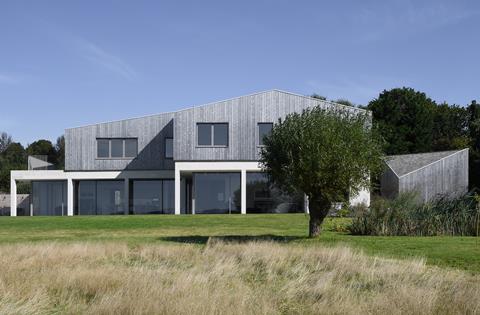
The clients wanted a four-bedroom family home set in agricultural land just outside the South Downs National Park AONB. Their brief emphasised comfort, the use of natural materials, a highly sustainable approach, and a sensitive relationship with the rural context, while celebrating the site’s sweeping views and enhancing its biodiversity.
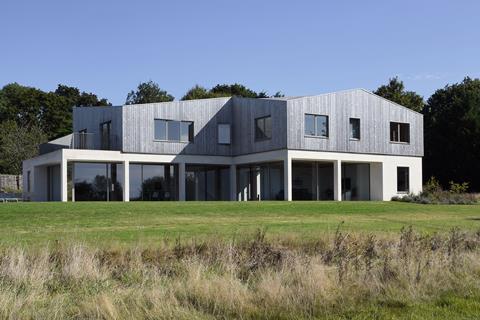
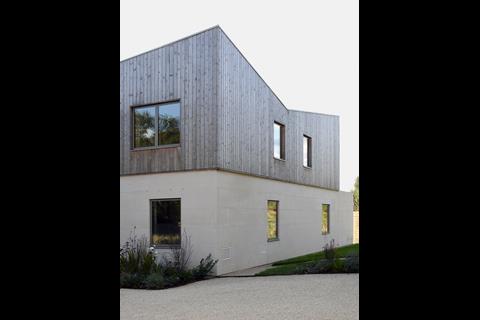
We responded with a design that is both grounded and innovative. A palette of French limestone and Douglas fir was chosen to embrace low-carbon natural materials and construction. The stone base supports the upper storey formed in CLT and clad in homegrown Western red cedar, while the roof form takes cues from the old, dilapidated barns that once stood on the site.
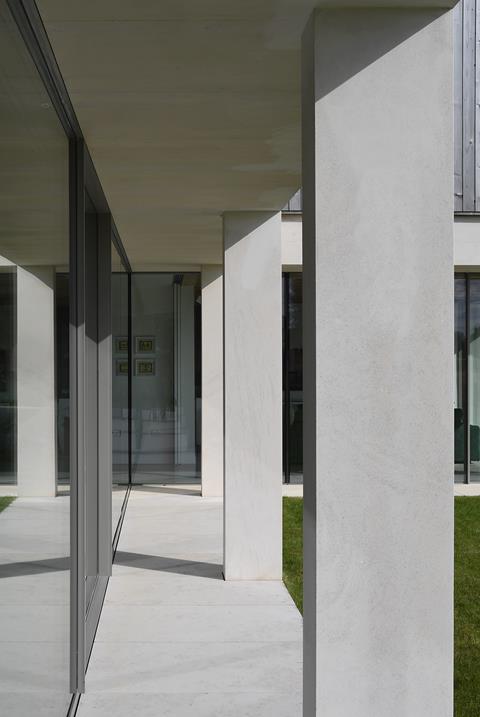
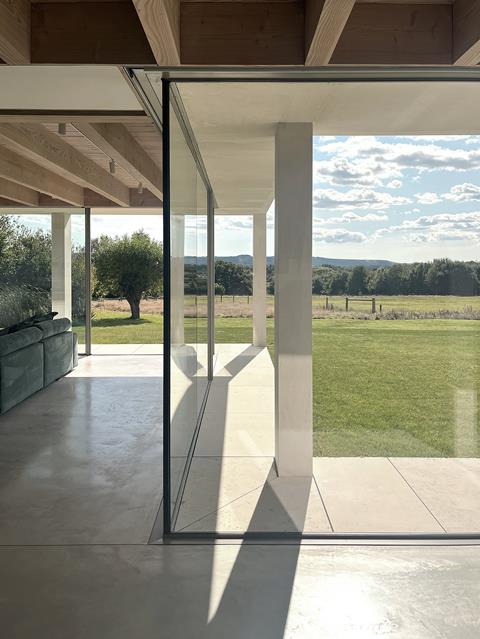
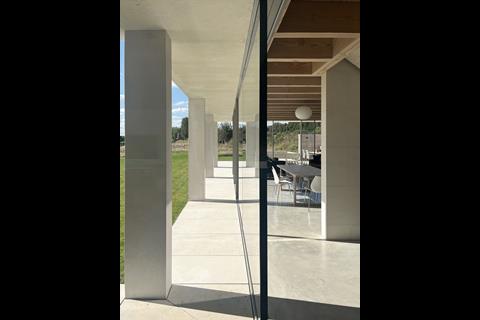
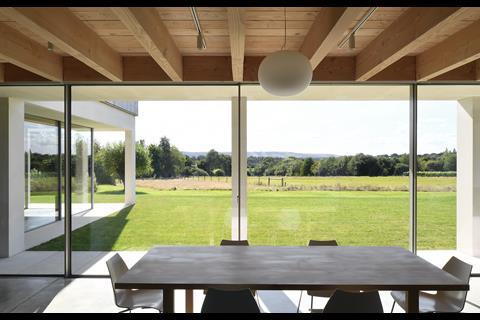
The family spaces are organised around a double height entrance hall and gallery with its solid stone stair. The continuous stone loggia, spanning across the south elevation, frames panoramic views across the meadows to the Downs. Mediating the threshold between inside and out, it shades the glazing in summer while capturing solar gain form the low winter sun. Beyond the house, the wider site was transformed into wildflower meadows with ponds, reed beds and bat roosts, ensuring the project delivers for both people and wildlife.
What were the biggest specification challenges on the project and how were these overcome?
The central challenge was how to use stone. The clients initially imagined a stone-clad house, but we felt this would be superficial. Instead, we worked with Webb Yates Engineers and The Stone Masonry Company to develop a system that used the stone structurally. This required precision in sourcing, cutting, and assembling large limestone blocks from the Valanges quarry in France, with the columns formed from single pieces of stone. By treating stone as a primary structural material rather than a finish, we created a building that is both environmentally advanced and architecturally expressive.
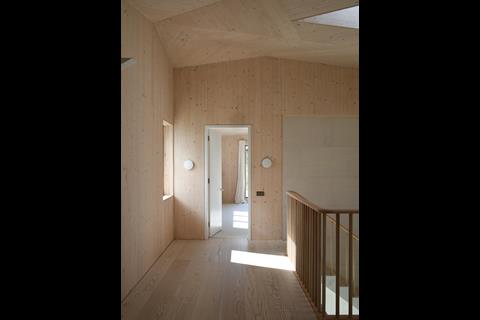
The limestone columns and spanning beams of the loggia support the upper storey and carry the timber frame. Large Douglas fir joists, left exposed internally, establish a strong rhythmic quality across the ceilings, evoking the surrounding fields and vineyard rows while reinforcing the warm, tactile character of the home.
What are the three biggest specification considerations for the project type? How did these specifically apply to your project?
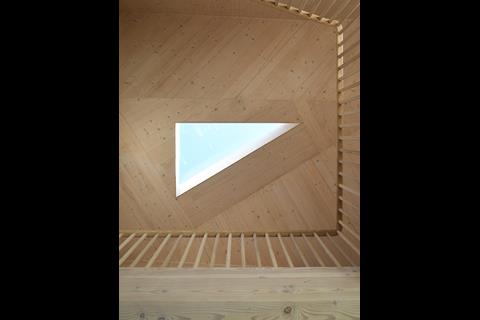
Environmental strategies are at the core of the overall orientation, massing and design. The project achieved –85 kgCO₂e/m² in construction and 737 kgCO₂e/m² over whole life, thanks to low-carbon materials, high insulation values and a focus on exposed structural finishes. The interiors are flooded with natural light, with a large skylight at the heart of the plan. Full-height glazing is carefully shaded in summer while capturing solar gain from the low winter sun and opening windows allow the house to remain highly passive and permeable. A thick mineral wool envelope and airtight detailing ensure energy efficiency, supported by an air-source heat pump providing hot water for underfloor heating and a low-energy MVHR system. Together, the use of low carbon construction materials and technologies establishes both high performance and comfort.
Located within an Area of Outstanding Natural Beauty, the house needed to integrate sensitively with its rural setting while addressing strict planning limitations. The domestic curtilage was carefully negotiated westward to optimise views, while the roof form and material palette draw on the agricultural barns that once stood on the site, ensuring the house feels embedded within its landscape.
Enhancing ecology was integral to the project. Wildflower meadows, reed beds, a large swale and bat roosts were designed into the site, creating rich habitats and supporting biodiversity. The stone loggia and full-height glazing ensure daily life remains constantly connected to nature, while the meadow planted right up to the house allows the landscape to be experienced directly at all scales. Internally, a large skylight at the heart of the plan floods the spaces with daylight, while the layout encourages family interaction and provides calm moments for repose.
Do you have a favourite product or material that was specified on the project?
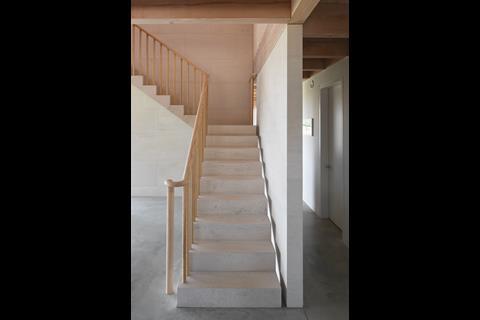
Yes, the structural limestone. Unlike concrete, which requires multiple energy-intensive processes, limestone blocks are simply cut at the quarry and assembled on site. At Field House they form columns, beams and soffits, working structurally while also providing a tactile and timeless exterior. Beyond the stone loggia, the material continues into the heart of the plan with a beautifully carved limestone staircase. Its quarter landing is cantilevered from the central structural stone wall that rises to the upper storey, creating a striking architectural moment which carries the stone seamlessly into the interior. It is both beautiful and sustainable, and gives the house its distinctive architectural identity. The Douglas fir with its characterful grain works really well with the stone.
Are there any suppliers you collaborated with on the project that contributed significantly? And what was the most valuable service that they offered?
This was a project built on close collaboration. Webb Yates Engineers provided the structural ingenuity that enabled stone and timber to work together in a composite system, while The Stone Masonry Company brought exceptional expertise in working with large limestone blocks, helping to pioneer the post-tensioned stone beam system.
KLH delivered the CLT superstructure and undulating roof with precision. The team collaborated on design to ensure that panel dimensions were efficient with minimal joints, carefully set out and oriented to achieve correct direction of the grain of the visual timber. IQ Glass supplied the specialist glazing that frames uninterrupted views while maintaining high performance.
Each contributed critical knowledge and craftsmanship, but above all it was their willingness to innovate that made the project possible, ensuring the design ambition was fully realised.
What did you think was the biggest success on the project?
The greatest success was proving that structural stone can play a central role in sustainable, contemporary housing. Field House is carbon-negative in construction, warm and comfortable in use, and deeply rooted in its landscape.
The project demonstrates that environmental performance, architectural innovation, and domestic delight are not mutually exclusive, but can work together to create a home of lasting value for both its inhabitants and the wider environment.
Project details
Architect Wilkinson King Architects
Structural engineer Webb Yates Engineers
Main contractor Excalibur Building Contractors Ltd
Quantities surveyor Wilkinson King Architects
Landscape consultant Guillaume Baltz
Stonework The Stone Masonry Company
Structural engineer Webb Yates Engineers
CLT superstructure and roof KLH
Glazing IQ Glass
Timber frame iWood
Our “What made this project” series highlights the outstanding work of our Architect of the Year finalists. To keep up-to-date with all the latest from the Architect of the Year Awards visit here.


1 Readers' comment