







Finalist for Young Architect of the Year Award 2025, Trewhela Williams guides us through the specification challenges present at Elizabeth Mews
Trewhela Williams’ work has been shortlisted for this year’s AYAs, as the practice was named a finalist for Young Architect of the Year.
In this series, we take a look at one of the team’s entry projects and ask the firm’s principal, Joseph Williams, to break down some of the biggest specification challenges that needed to be overcome.
What were the key requirements of the client’s brief? How did you meet these both through design and specification?
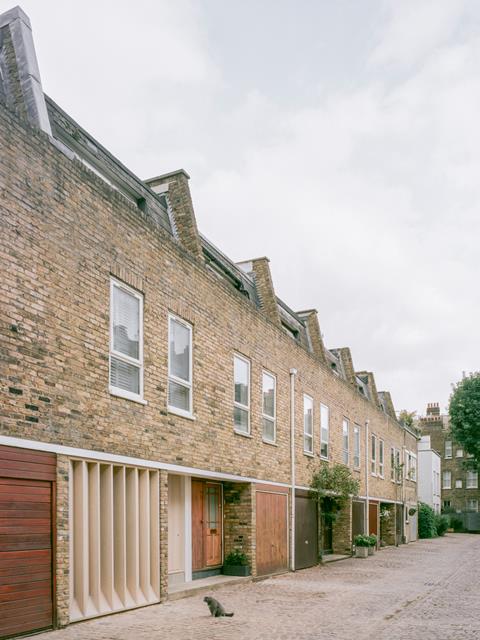
The client’s brief for her house on Elizabeth Mews was to convert the under-utilised and uninsulated garage at the front of the property into liveable space, allowing her family to live across one level with improved light, ventilation and a stronger connection to the courtyard.
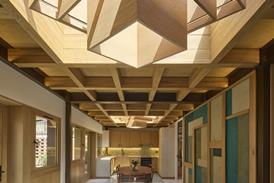
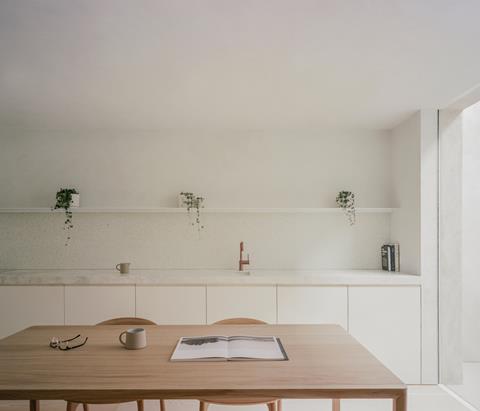
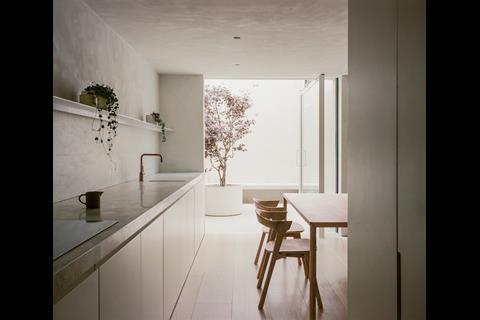
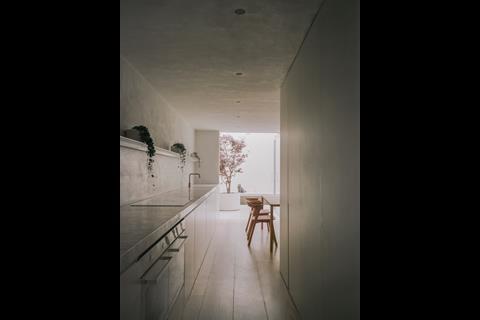
This was achieved by reorganising the floor plan into a linear open-plan arrangement, with a galley kitchen running the length of the property to maximise daylight and create dual-aspect ventilation.
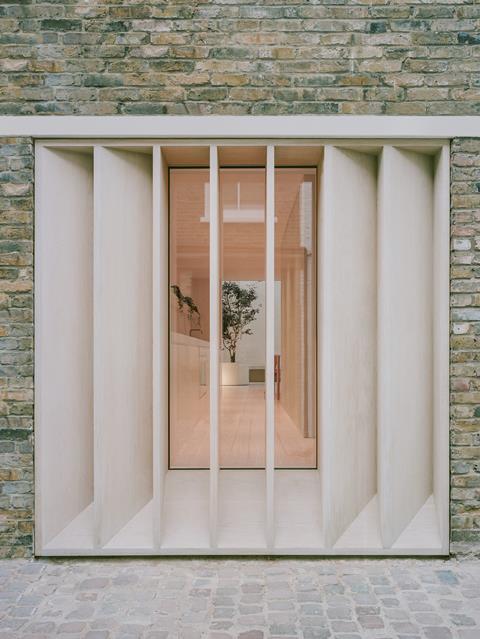
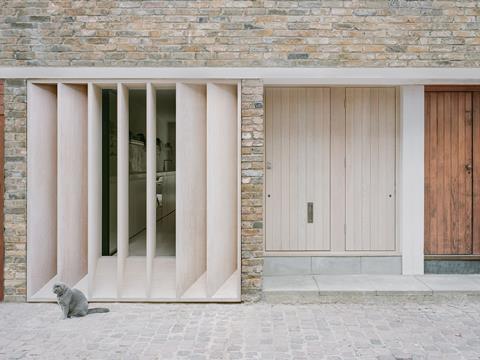
Thoughtful interventions, such as replacing the garage door with an oak-finned frontage balanced functional requirements of daylight admission, solar shading and privacy screening with contextual sensitivity.
Material and finish specifications were carefully chosen to unify the interiors, ensure longevity and deliver a calm, practical home.
What were the biggest specification challenges on the project and how were these overcome?
Elizabeth Mews falls within the Belsize Park Conservation Area, which meant that the proposed street-facing alteration to the garage door needed to be carefully considered and specified so as to not harm the existing character of the street.
The repeating wood panelled garage doors are a legacy from the mews’ origins as stabling and coach accommodation, and remain a key contributor to its overall character. Therefore from the outset it was felt most appropriate to sensitively repurpose the existing door opening.
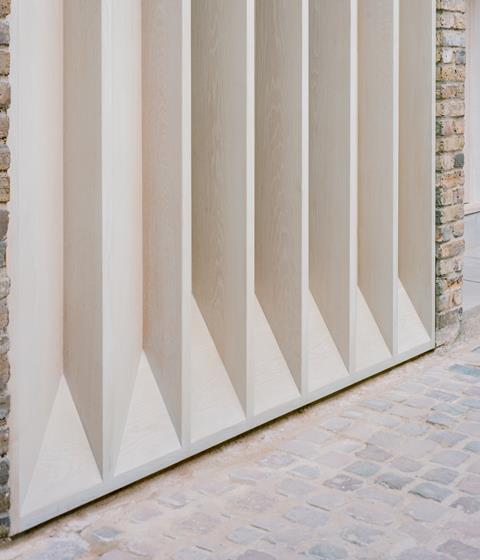
The garage door was reimagined as a rhythmic finned screen of matching overall proportions inset within the retained opening. This approach respects the established fenestration order of the mews, whilst offering a quietly dignified evolution of its character.
The use of oak construction was a nod to the timber of the panelled garage doors. An exterior grade oil was required to protect the oak from mould/fungus, and a white finish was desired to helps soften the grain’s contrast and lend a hazy homogeneity to the overall surface. Having reviewed samples of several oil product options, two coats of WOCA exterior wood oil was ultimately specified as it provided the best balance of textural softening and tonal harmony with the surrounding London stock brick.
What are the three biggest specification considerations for the project type? How did these specifically apply to your project?
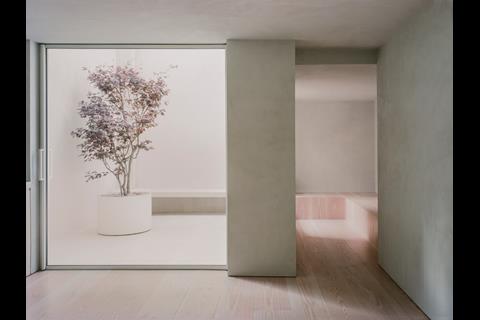
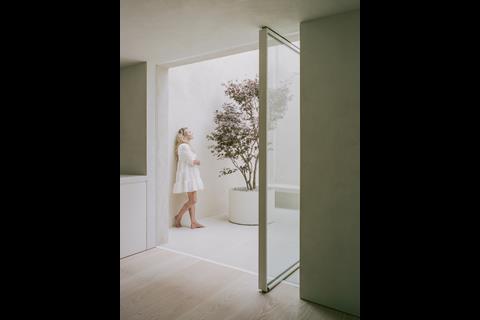
For this type of small-scale retrofit project in a conservation area, heritage sensitivity and interior cohesion were important specification considerations but environmental performance remained at the forefront of our decision making. This steered the selection of high-performance glazing such as IQ Glass’s Vitra Pivot (which achieves a u-value of 1.37W/m2K) to the rear courtyard.
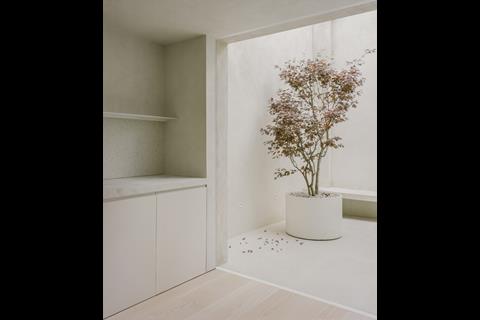
This carried through into the selection of finishes: the clay plaster is 100% natural, recyclable and compostable with zero VOC emissions or synthetic additives. The Torc Pots’ plant pot was handmade from Ecocrete, a recycled cementitious based material made from 60% recycled material. Chauncey Timber Flooring’s engineered timber floor is FSC certified ensuring that all composite parts are sourced responsibly. The terrazzo is an agglomerate material produced from the offcut waste of other natural stone processing.
Water usage is reduced through dual-flush WC’s and low-flow taps. Underfloor heating provides a more energy-efficient mechanism to gently warm the inhabitants. Dimmable LED’s, a 5amp circuit and A+ appliances helps to optimise energy efficiency, whilst a smart meter allows the easy monitoring of usage and helps active engagement in shaping better energy habits.
The property’s estimated primary energy use is now 165kWh/m2 (down from 369kWh/m2).
Do you have a favourite product or material that was specified on the project?
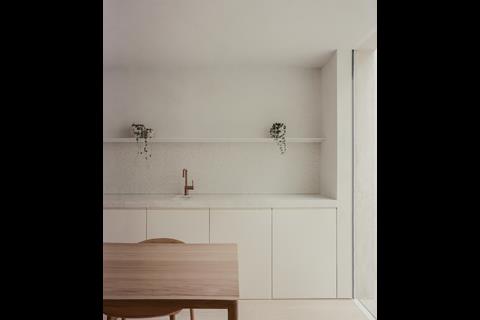
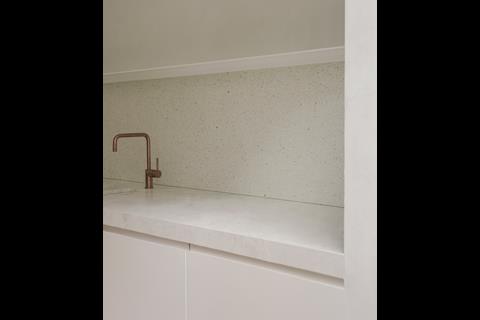
I think it has to be the Grey Cloud marble that forms the eight metre long kitchen worktop. The Mugla stone’s soft veining and cloudy surface lend a quiet elegance that grounds the interiors. The weighty edge profile establishes a strong visual anchor within the galley kitchen, balancing the delicateness of the pressed metal shelf above. The marble’s light grey clouding formations include faint hints of pinkish tones that help unite the finishes palette by complementing both the pale plastered walls and the rosy warmth of the Douglas Fir flooring.
Are there any suppliers you collaborated with on the project that contributed significantly? And what was the most valuable service that they offered?
GD Stones supplied, templated and installed the grey cloud marble worktop. Of particular value was their stone specification assistance, technical expertise and care taken in slab selection, detailing and jointing. Their attention to detail helped to ensure a strong visual continuity between the assembled pieces of the worktop, which reinforces the singularity of the element and the generosity of its length spanning from mews to courtyard.
As part of the review process GD Stones provided a visualisation of the worktop slab arrangement prior to cutting and install so as to ensure all parties were clear with the proposed approach.
What did you think was the biggest success on the project?
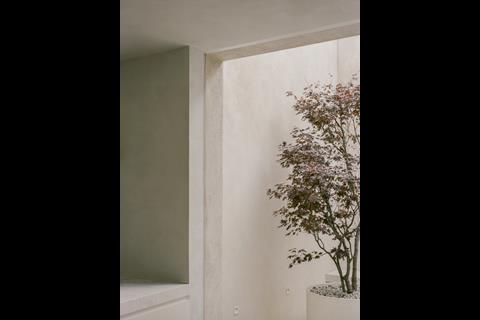
We are particularly proud of the calm, contemplative character of the interior. Its subtle play of tonal and textural nuances helps the space to read as a uniform whole and allows the focus to shift to the purposeful moments of celebration such as the Acer Palmatum Fireglow. The species was specified for its suitability to the sheltered courtyard, sculptural multi-stem trunk and the year round interest provided by its foliage transformation from a burgundy-red in Summer turning to a vibrant scarlet in Autumn.
Project details
Architect and interior design Trewhela Williams
Client Private
Location Hampstead, London, NW3, United Kingdom
Completion date August 2022
Project size 43sqm
Total cost £160,000
CO2 emissions 28.72kg/m2/year
Structural engineer Peter Dann Consulting Engineers
Main contractor Woodland London Ltd
Building control Stroma Building Control
Suppliers GD Stones, IQ Glass, Chauncey Timber Flooring, Torc Pots, Clifton Nurseries, Clayworks
Our “What made this project” series highlights the outstanding work of our Architect of the Year finalists. To keep up-to-date with all the latest from the Architect of the Year Awards visit here.




No comments yet