




Finalist for Office Architect of the Year Award 2025, Fletcher Priest Architects guides us through the specification challenges present at 100 Fetter Lane
Fletcher Priest Architects’ body of work was shortlisted for last year’s AYAs, as the practice was named a finalist for two awards, including Office Architect of the Year.
In this series, we take a look at one of the team’s entry projects and ask the firm’s senior associate, Mark Sutton, to break down some of the biggest specification challenges that needed to be overcome.
What were the key requirements of the client’s brief? How did you meet these both through design and specification?
The client required a high-quality, flexible commercial office space that responded to evolving workplace needs and embedded sustainability at its core. These were met and exceeded by designing a dynamic workplace that is attractive to tenants, future-proofed and based on circular economy principles.
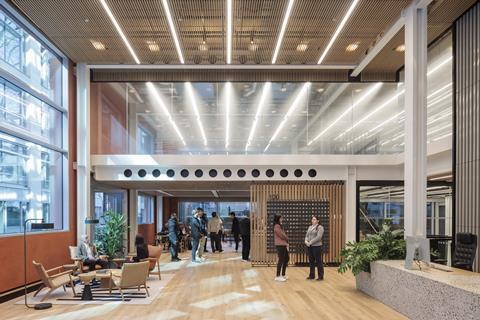
The project includes flexible floorplates, high floor-to-ceiling heights (3.4m), mixed-mode ventilation, generous daylight and landscaped terraces. Environmental strategies were embedded from the outset, including a pioneering standardised material passport framework, and the building is on track for BREEAM Outstanding and NABERS 5*.
The civic contribution was extended through a new café, reinstated pub, accessible public routes and a pocket park.
What were the biggest specification challenges on the project and how were these overcome?
Implementing the UK’s first detailed, standardised material passport framework was a significant challenge. This required assigning source, composition and wider design data to 4,817 individual building elements. The framework was developed by Watermans and the consultant team collaborated closely with Mace and others in the supply chain to feed information into the central data base. This approach was standardised during construction and provided a comprehensive digital asset for the building in operation and facilitates accurate carbon measuring through the life of the building and traceability for reuse and a reduction in waste.
What are the three biggest specification considerations for the project type? How did these specifically apply to your project?
Sustainability: Addressed through an industry-leading approach to embodied carbon, use of recycled materials, and achieving BREEAM Outstanding, NABERS 5* predicted and EPC A ratings.
Flexibility and adaptability: Delivered through exposed concrete soffits, underfloor air supply, and modular systems that allow for Cat A fitout flexibility and future layout changes.
Circular economy and material traceability: Achieved through the implementation of a detailed materials passport system covering most building components to support future reuse.
Do you have a favourite product or material that was specified on the project?
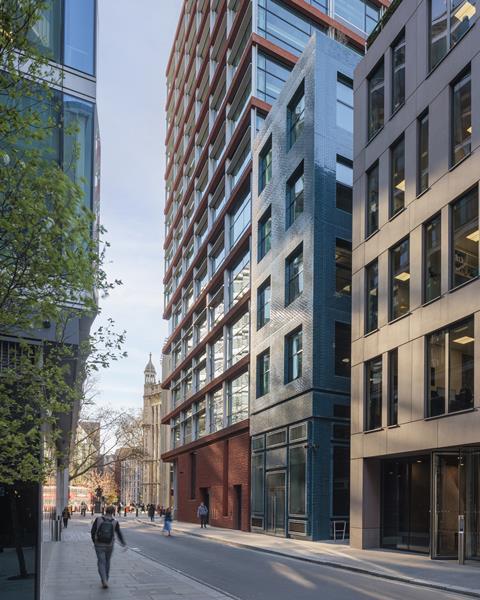
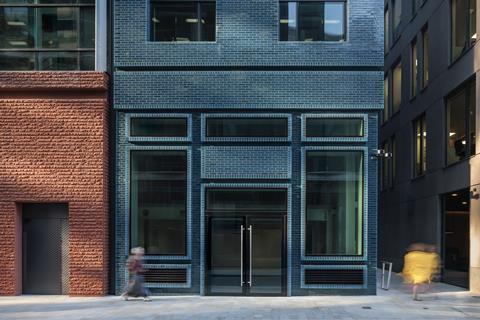
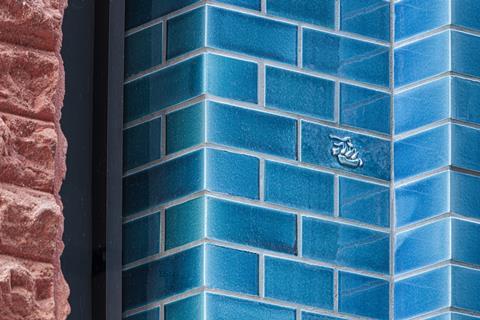
The vivid blue glazed bricks used for the pub exterior are a highlight. They were specially cast with relief motifs referencing the printing history of the area and crystalising the prominent public houses of the past associated with the printing industry. These were used to create a distinctive identity for the pub and to celebrate the heritage of the site.
Are there any suppliers you collaborated with on the project that contributed significantly? And what was the most valuable service that they offered?
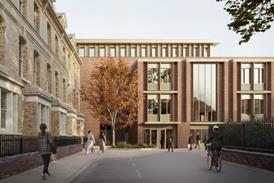
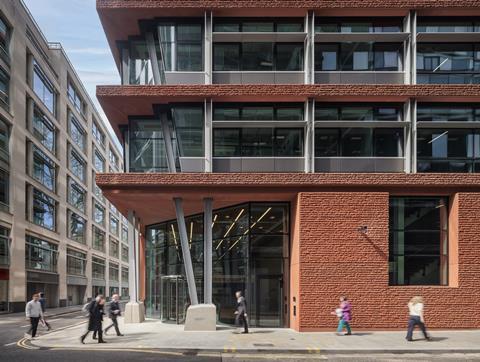
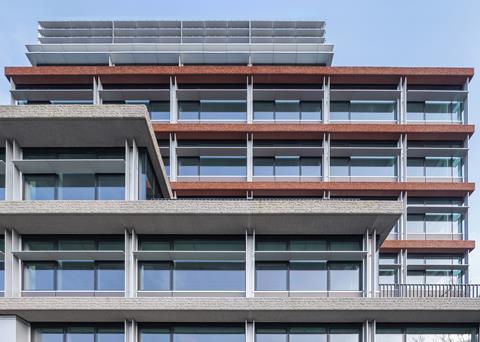
100 Fetter Lane has a distinctive facade, through the carefully specified pre-cast cladding manufactured by Techrete at their Balbriggan Facility in Dublin. The use of colour involved an extensive sampling process to achieve the specified red and grey tones in a series of finishes. The pre-cast concrete components of the facade are designed for longevity, with a life of over 100 years. The casting of the cladding panels included a textured finish of the horizontal round profiles, which was achieved via an efficient mould process.
What did you think was the biggest success on the project?
This is a pioneering scheme, using the building as a material bank for the future re-use of materials. The project is a testbed, designed to take the theory to reality and its implementation across the supply chain resulted in specialist contractors adopting new and related methodologies.
80% of the building by mass has a material passport (including structure, facade and raised access floor). QR codes are applied to components and information is logged on a dedicated platform developed by Circuland.
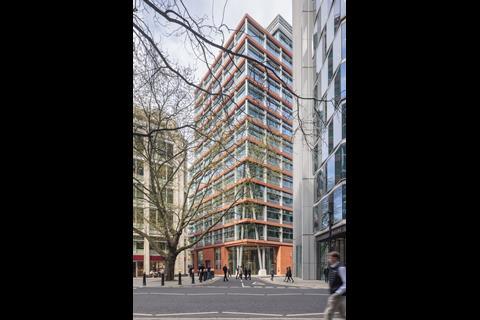
Materially, the building responds harmoniously with its context, with the pre-cast panels in a distinctive red that recalls the historic brick and terracotta of Fleet Street and Holborn.
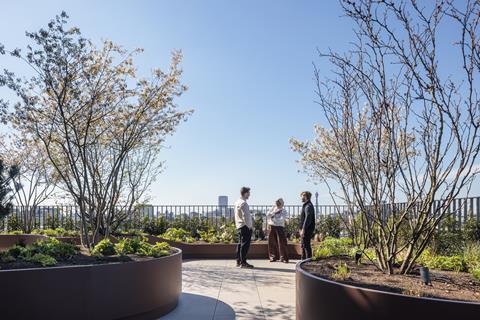
It also contributes generously to its setting, opening onto existing public spaces, maintaining and improving the streets and passages in the locality, and reinstating the pub that brings life to the neighbourhood. On the upper floors, occupants enjoy landscaped private terraces at six different levels with exceptional views across the city.

Project details
Architect Fletcher Priest Architects
Main contractor Mace
Facades Techrete, Skonto Plan
Structure Bourne Steel, Keltbray
MEP Essex Services Group
Lifts KONE
Dry lining BDL
Blockwork Lesterose
Joinery/fit-out JJ Sweeney
Reception wall Putney and Wood and NBK
Roof waterproofing Tilbury
Landscape Willerby’s
Photography Dirk Lindner
Our “What made this project” series highlights the outstanding work of our Architect of the Year finalists. To keep up-to-date with all the latest from the Architect of the Year Awards visit here.

4 Readers' comments