




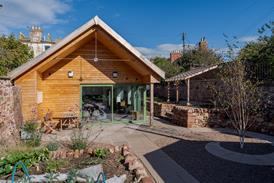




A Teesside transporter bridge, an abandoned mausoleum in a Welsh woodland and a Hackney disinfecting station among ten at-risk buildings
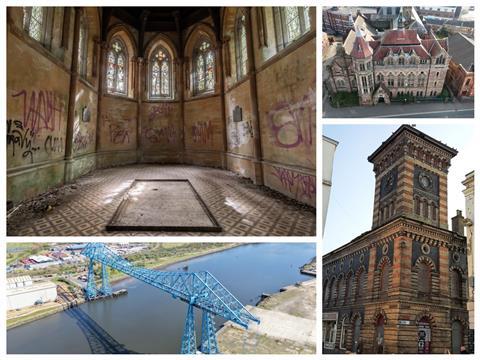
A secluded mausoleum, a former school of art and a towering transporter bridge are among the Victorian Society’s 2026 list of England and Wales’ top ten endangered buildings.
Selected from nominations made by the public, the annual list highlights architecturally significant Victorian and Edwardian buildings which have fallen into disrepair and face an uncertain future.
From a disinfecting station in Hackney to a former library in Devonport, the ten “extraordinary survivals” from the 19th and early 20th centuries “exemplify Victorian ideals”, the society’s president Griff Rhys Jones said.
But despite all benefitting from protected status, two at grade II* and eight at grade II, many have been vacant for years and now face “irreversible decline” without intervention.
“There is no building here that cannot be recycled,” Rhys Jones said. “All are great buildings, executed on demand and with care and foresight. They not only tell the story of our country, they were usually constructed with such strength and integrity that they can continue in service today.”
The list aims to draw national attention to heritage at risk, both encouraging debate and galvanising efforts to find sustainable new uses for vulnerable buildings and structures.
The Victorian Society’s Top Ten Endangered Buildings 2026
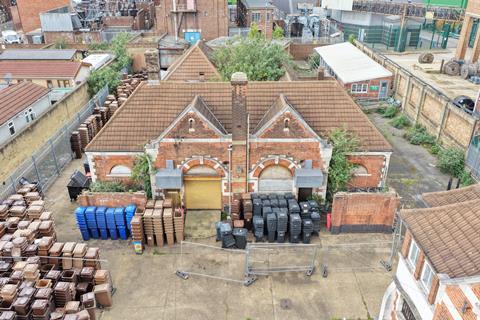
Hackney Borough Disinfecting Station, Millfields Road, Hackney, London
Grade II, Gordon and Gunton, 1901
What the Victorian Society said:
On the eastern edge of Hackney, in Clapton, stands a remarkable and little-known survivor: the only purpose-built municipal disinfecting station still standing in England. Tucked between a waste depot and an electricity substation, it is a rare and powerful reminder of the Victorian response to infectious disease. It now faces an uncertain future.
Under the Local Government Act of 1899, Hackney Borough Council was empowered to enter homes, remove contaminated belongings, and disinfect them using steam cleaning. The Millfields Road site was designed to support this work at scale. It included not only the disinfecting station itself, but also a Shelter House providing temporary accommodation for displaced families, and a caretaker’s lodge. In its first full year of operation, more than 24,000 items were disinfected and over 2,800 rooms treated.
Despite its utilitarian purpose, the complex was carefully designed, incorporating quality materials such as Portland stone and decorative leadwork. It stands as a testament to a period when civic investment in public health was both ambitious and architecturally expressive.
The station closed in 1984 and has stood unused for decades. Although the Shelter House and caretaker’s lodge remain occupied, the main building has been mothballed since 2020 and now appears on Historic England’s Heritage at Risk Register. Basic repairs have been undertaken, but the site remains vulnerable, with no clear long-term plan in place.
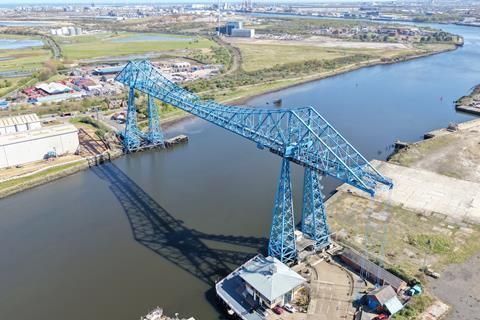
Tees Transporter Bridge, Stockton-on-Tees/Middlesbrough
Grade II*, Engineer: G.C. Imbault, construction: Sir William Arrol & Co Ltd, 1911
What the Victorian Society said:
The Tees Transporter Bridge - an iconic symbol of Teesside’s industrial heritage - has been closed since 2019 due to serious structural concerns. Spanning the River Tees between Middlesbrough and Port Clarence, it is one of the most recognisable engineering landmarks in the UK. Its future, however, now hangs in the balance.
Built by Sir William Arrol & Co, the firm responsible for the Forth Bridge, it stretches 260 metres (850 feet) and rises 69 metres (225 feet) above the water. Its distinctive gondola, suspended from the overhead structure, once transported vehicles and pedestrians across the river, a rare and ingenious solution that made it one of the largest transporter bridges of its kind in the world.
Responsibility for its ownership and operation is shared between Stockton-on-Tees and Middlesbrough Councils, and the estimated £60 million required for repair and restoration is beyond their means alone. A central challenge remains unresolved: whether the bridge is to be treated primarily as transport infrastructure or as heritage.
The Victorian Society is calling for a co-ordinated national response to secure the bridge’s future. Whether as a functioning crossing or as a conserved monument, this extraordinary structure must not be allowed to fall into permanent disuse.
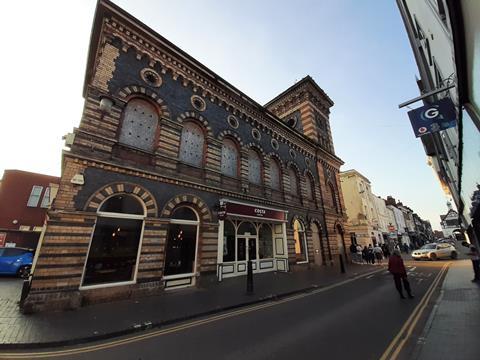
The New Market Hall, Postern Gate, Bridgnorth, Shropshire
Grade II, Robert Griffiths of Quatford, 1855 -1859
What the Victorian Society said:
Prominently positioned on Bridgnorth’s High Street, the New Market Hall is a striking polychromatic Italianate building and a rare survival of a high-status Victorian commercial structure. While comparable market halls in nearby towns such as Shrewsbury and Ludlow have been lost, Bridgnorth’s example endures, though does so now in a perilous condition.
The building was repurposed multiple times over its history, serving as offices, stores, workshops, and later retail and community uses. In the 20th century it housed, among other things, a supermarket and a Museum of Childhood.
Today, the building is in very poor condition. Although the ground floor remains partially occupied, the upper levels are vacant and deteriorating. The rear wing is particularly at risk, and emergency scaffolding installed by the local authority in 2022 remains in place, imposing an ongoing financial burden on the council.
Local concern is growing. Community groups have called for stronger action, including the possibility of compulsory purchase, and there is clear appetite to see the building brought back into active use, potentially as a cultural or community space. Without decisive intervention, however, this important landmark faces continued deterioration.
Former Strand Railway Station and Railway Men’s Club, Barrow-in-Furness
Grade II, Architect, E. G. Paley, 1863
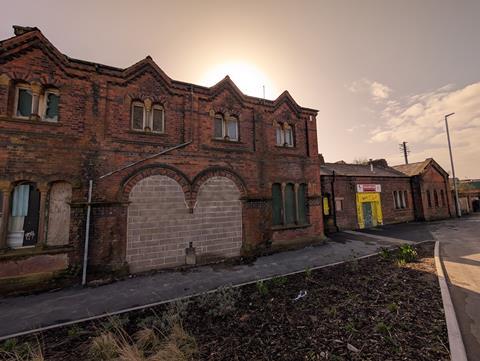
The former Strand Railway Station in Barrow-in-Furness is a significant survivor from the earliest phase of the town’s rapid industrial growth. Once at the heart of a transforming settlement, it now stands vacant and deteriorating, its future uncertain.
By the early 20th century, the site had become the Railwaymen’s Club, aligned with the ethos of the Mechanics’ Institute movement. It provided educational and social facilities and remained a focal point for the community for over a century. Its later history reflected changing social habits: alcohol was only introduced in 1947, and by the 1990s the club faced financial pressures, narrowly avoiding closure. It finally closed in 2008 after 101 years of operation.
Once part of the bustling centre of Barrow’s industrial and civic life, it now stands neglected, with no clear plan for its future. Without intervention, further deterioration is inevitable.
Faenol (Vaynol) Mausoleum, Pentir, Near Bangor
Grade II, Henry Kennedy of Bangor, late 1870s
What the Victorian Society said:
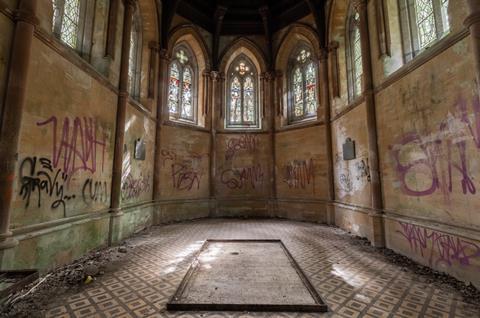
Set within woodland just off the Wales Coast Path, the Faenol Mausoleum appears at first glance to be a romantic folly. In fact, it is a substantial and architecturally significant funerary building, now in a state of visible decay and at risk of further deterioration.
Listed as a rare and important Welsh example of its type, the mausoleum stands within an octagonal enclosure surrounded by iron railings. The building has suffered vandalism, with graffiti and damage to its stained glass, and its condition continues to decline.
The mausoleum was constructed in the late 19th century for the Assheton-Smith family, owners of the vast Faenol Estate, which once extended to some 36,000 acres. Designed by Henry Kennedy, a leading architect in north-west Wales, the mausoleum reflects his extensive ecclesiastical work across the region. The building incorporates French Gothic elements, including a bell tower, and features a striking interior with a hammerbeam roof. Decorative carving was carried out by Robert Evans of Menai Bridge, and the stained glass is believed to be by James Powell & Sons. At least four members of the Assheton-Smith were interred here.
With a well-used national trail passing close by, the mausoleum has clear potential to be appreciated once again as part of the historic environment. The Victorian Society is calling for action to address its condition and secure a future in which it can be conserved and, where appropriate, made accessible.
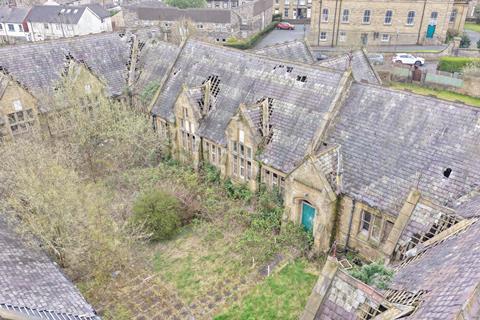
Former Oakes School, Oakes Road, Huddersfield.
Grade II, Charles Fowler, 1873; extended by Ben Stocks, 1885
What the Victorian Society said:
The long empty and seriously decaying buildings of Oakes School are in an otherwise well-looked-after district of surviving Victorian commercial, domestic and community buildings from the 1860s and 1870s. Closing soon after 1970, the former school was in residential use and then utilised as the Wellington Court Residential Care Home for some years until that in turn closed. For many years since it has been decaying with spasmodic attempts by its owners to place and replace covers over windows and door spaces, and across holes in walls and roofing as these appear and enlarge.
Practically all the nearby Victorian housing is of good quality and remains in use today. This remains a popular urban area with good access to local shops, eateries, buses, schools, surgery and hospital. By contrast, nearby former industrial buildings and once vacant sites have quickly found new uses. Oakes School sticks out.
Oakes School can and should find re-use. Kirklees Council need to take enforcement action now. The owner should sell this re-usable building rather than continue a course of action that will lead to the building eventually falling down or having to be demolished.
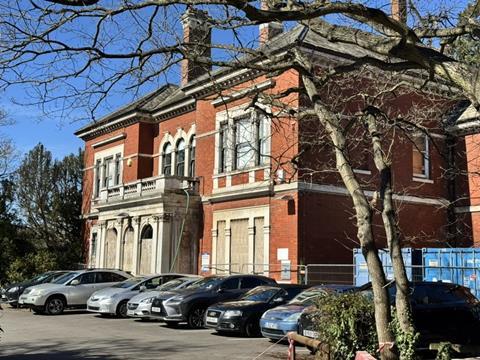
Parndon Hall, Hamstel Road, Harlow.
Grade II, possibly Joseph Clarke, 1867
What the Victorian Society said:
Parndon Hall is a remarkable Victorian house now standing neglected within the grounds of a modern hospital site in Harlow. Once a family home of distinction, it contains an extraordinary and little-known artistic legacy, yet today both the building and its interiors are at risk.
The true significance of Parndon Hall lies within its interiors. The house is decorated with a remarkable series of paintings by Elizabeth Arkwright, Loftus’s wife, which adorn ceilings, doors and wall panels throughout the building. Elizabeth is thought to have received formal training, possibly connected to the artist Sir Edwin Landseer, and her work makes Parndon Hall a rare example of a Victorian house with a substantial decorative scheme by a female artist.
The paintings have had a precarious history. Some were whitewashed over in the late 19th century, possibly reflecting changing tastes or sensitivities, and were only rediscovered and restored after the Second World War. Others remain concealed beneath later overpainting. More recently, works attributed to Elizabeth Arkwright have appeared at major international auction houses, underlining their significance.
Despite this, the building is now at risk. Following flooding in 2024, repairs were made to the roof and chimney stacks, but the decision was subsequently taken to vacate the building. It is currently used only for storage, and there are no clear plans for its future. The internal environment is a growing concern: fluctuations in temperature and humidity, potentially exacerbated by a recently installed heating system, may be contributing to the deterioration and fading of the paintings.
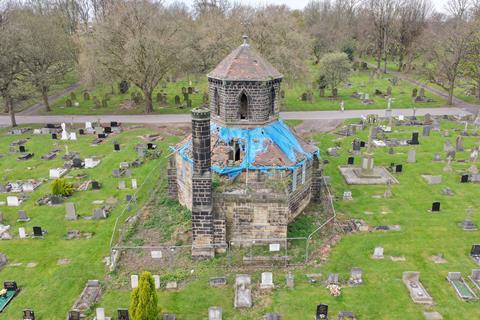
St Michael’s RC Cemetery Chapel, City Road, Sheffield
Grade II, Charles Hadfield, 1898
What the Victorian Society said:
St Michael’s Roman Catholic Cemetery Chapel in Sheffield’s City Road Cemetery is a striking example of a once-common building type now in steep decline. Long unused and increasingly unstable, it stands at serious risk, part of a wider national pattern of neglect affecting Victorian cemetery chapels.
A specialist report in 2018 identified serious structural concerns, noting that the roof was in extremely poor condition, with missing tiles, vegetation growth and likely compromised structural integrity. Although limited repairs have been carried out to sections of the stonework, there is no clear plan for the building’s future.
The situation is particularly concerning given the wider pressures on the cemetery itself. Sheffield is expected to run out of burial space within the next decade, yet this historic structure, designed to support the rituals and dignity of burial, remains unused and neglected.
St Michael’s is not an isolated case. Cemetery chapels across England and Wales are falling into disrepair, with increasing numbers now redundant and without clear custodianship.
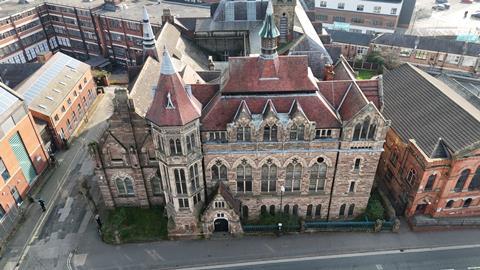
Former Derby School of Art, Derby
Grade II*, F.W. Waller, 1876 with additions 1899
What the Victorian Society said:
The former Derby School of Art is one of the city’s most striking Victorian buildings, an ambitious and architecturally confident statement of the cultural importance then placed on art and design. Today, however, the building stands empty and uncertain, its future unresolved.
Described by Historic England as “a notable essay in Gothic style”, the building is constructed in distinctive pink granite from Matlock. It was designed as a purpose-built centre for art education at a time when such institutions were seen as essential to civic life and industrial success.
The building has had a varied recent history. After its original educational use, it became part of the University of Derby, before serving as the Metro Cinema from 1981 to 2006. Following a period of vacancy, it reopened in 2012 as a rehearsal space for Derby Theatre. In 2021 it was sold to New Vision University, based in Georgia (South Caucasus), with proposals to establish a medical school. However, the building appears never to have been brought back into active use.
As a result, this important Grade II* listed building now stands empty once again, with no clear timetable for its reuse. Its continued vacancy places it at risk of deterioration and represents a significant missed opportunity for the city.
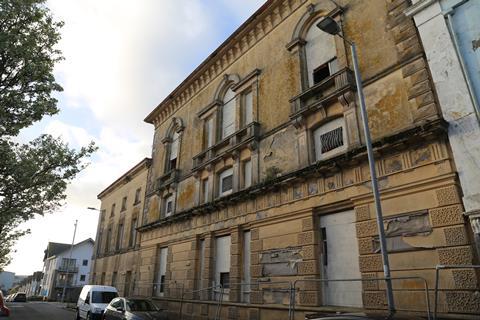
Former Library and Mechanics Institute, Devonport. Grade II, A. Norman, 1843-44
What the Victorian Society said:
The former Library and Mechanics’ Institute in Devonport is a significant early Victorian civic building, now standing vacant and at risk, with no clear plan for its future.
Built in 1843–44, the Institute was established at a time when Devonport was a major naval and industrial centre. Mechanics’ Institutes played a vital role in 19th-century society, providing education, reading rooms and cultural opportunities for working people. They were founded on the principle that access to knowledge and self-improvement could drive both individual advancement and wider social progress.
The Devonport Institute reflects these ambitions. As both a library and a place of learning, it formed part of a wider movement that spread rapidly across Britain, particularly in industrial and dockyard towns. These institutions were often among the earliest examples of publicly accessible education and cultural provision, predating the expansion of state-funded systems.
Despite its historical importance, the building’s more recent history has been uncertain. Like many Mechanics’ Institutes, it has struggled to find a sustainable role in the modern era. Changes in patterns of education, leisure and public provision have left buildings of this type particularly vulnerable.
Now vacant, the Devonport Institute faces an uncertain future. Its continued disuse risks further deterioration and the gradual loss of its historic fabric. As a distinguished essay in Victorian Classicism, however, and as a prominent and adaptable building, it retains clear potential for reuse.





No comments yet