





Sponsored by ROCKWOOL®, this module explains the regulatory framework on fire safety, clarifies the responsibilities of different design and construction roles, and examines how material performance, compartmentation and fire stopping can work together to limit risk
Deadline for completion Friday 1 January 2027
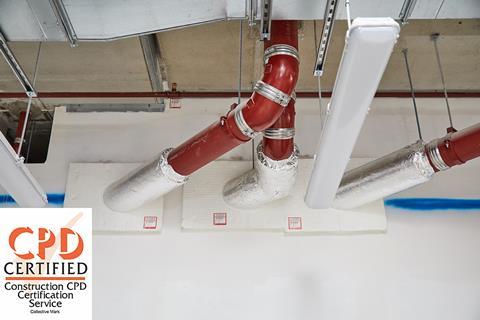
Fire safety is a fundamental aspect of building design, but its effectiveness is often only scrutinised after serious failures occur.
New legislation, clearer statutory roles and a stronger emphasis on accountability mean that designers, specifiers and contractors are expected to demonstrate not only compliance with the Building Regulations but also competence, transparency and sound decision-making (within the scope of their role and stage of involvement).
We will look first at fire safety regulations and legislation, before examining the responsibilities in relation to fire safety of those involved in design and construction in the built environment. Next, we will look at fire behaviour and how materials are tested and classified for combustibility. Finally, we will cover compartmentation and fire stopping.
Learning objectives
- Know the key elements of fire safety legislation and regulations.
- Identify the roles, responsibilities and potential liabilities of different parties involved in the design and construction of buildings, in relation to fire safety.
- Learn how fire behaviour, material performance and reaction to fire classifications influence design decisions and compliance routes.
- Understand how compartmentation and fire stopping work together to limit fire and smoke spread.
- Recognise the importance of tested systems, competent installation and third-party certification.
Fire safety regulations
In the UK, there is a layered framework of primary legislation, secondary legislation and guidance, intended to embed fire safety in every stage of a building’s lifecycle.
In England, the statutory fire safety requirements are set out in Part B of Schedule 1 to the Building Regulations 2010 (as amended). These are functional requirements that define the fire safety outcomes buildings must achieve, including means of escape, limitation of internal and external fire spread, and access and facilities for fire and rescue services. Approved Document B (ADB) provides statutory guidance on how compliance with these functional requirements may be demonstrated, but it is not mandatory. Alternative solutions may be used where they can be shown to meet the requirements of Part B.
The Building Act 1984 underpinned the Building Regulations, while the Building Safety Act 2022 (BSA) has introduced a more rigorous regime for all buildings, with additional oversight for higher-risk buildings (HRBs). The BSA enshrines the concept of the golden thread, first championed in Judith Hackitt’s post-Grenfell review, Building a Safer Future. Its purpose is to make sure the right people have the right information at the right time, ensuring buildings can be managed safely both now and in the future.
This emphasis on transparent, well-maintained information is seen in other recent secondary legislation, including the Building Regulations 2010 (SI 2010/2214), which require buildings to be designed and constructed to resist the spread of fire and smoke internally and externally. Achieving this relies on clearly defined and correctly implemented measures, such as compartmentation and fire stopping (where required by the building’s use, size and height).
The Construction (Design and Management) Regulations 2015 (CDM) are the UK’s primary health and safety regulations for construction projects. They place legal duties on those who commission, design and carry out construction work, introducing defined statutory roles including the client, principal designer, principal contractor, designers and contractors. The BSA built on the dutyholder-based approach already established by the CDM, introducing additional building safety-specific duties, stronger accountability mechanisms and enhanced regulatory oversight for HRBs.
Further key secondary legislation includes the Regulatory Reform (Fire Safety) Order 2005. This applies primarily in the occupation phase, and places duties on a responsible person to assess, manage and mitigate fire safety risks innon-domestic buildings and the communal parts of residential buildings categorised as houses in multiple occupation (HMOs).
Additional non-statutory, sector-specific guidance is available to support compliance with the Building Regulations, such as Building Bulletin 100 for schools and Health Technical Memorandum 05-02 for healthcare premises. These documents provide extra, context-specific guidance on how fire safety requirements may be met in particular building types.
Standards
British and European standards also play a vital supporting role in ensuring fire safety. They provide recognised methods for testing, classification and performance assessment of materials, products and systems – helping designers and regulators demonstrate compliance with the requirements of the Building Regulations.
The legal framework for fire safety has become progressively more demanding as lessons from past failures have been incorporated into legislation and practice. For practitioners, this means that technical knowledge alone is no longer sufficient. Understanding how legislation and guidance interact, and how they translate into day-to-day decision-making, is now central to professional competence.
How the law has changed
In the late 20th century, facade fires focused attention on the performance of external walls in fire – particularly that of cladding systems. In the early 2000s, standard BS 8414 introduced full-scale fire tests for cladding systems, and BRE’s BR 135 set out performance criteria against which the results of the BS 8414 fire tests were measured. BR 135 sets maximum temperature thresholds at defined points on the test rig. If these thresholds are exceeded, the external wall system is considered to have failed to adequately limit fire spread.
From the mid 2000s, guidance in Approved Document B (ADB) of the Building Regulations recognised two ways to demonstrate facade fire performance:
- Using materials of limited combustibility
- Demonstrating whole-system performance via the BS 8414 system test assessed to BR 135.
The latter testing route permitted the use of combustible components if the assembly passed BR 135. This approach was later found to have enabled unsafe facade designs. Although BS 8414 testing assessed to BR 135 remains a recognised assessment method, experience has shown that systems incorporating combustible materials may still present unacceptable fire risk. As a result, its use as a compliance route is limited and, in many cases, no longer considered appropriate without additional justification.
Fire safety responsibilities of different roles in design and construction
Note: UK fire safety legislation does not generally impose duties on named professions (such as “architect” or “engineer”). Legal responsibility arises from statutory roles, dutyholder appointments, and the functions actually performed under Building Regulations, the BSA and CDM Regulations. Professional titles are used here for clarity only.
| Role (typical professional title) | Legal basis for responsibility | Project stage | Fire safety responsibilities (within scope and appointment) |
|---|---|---|---|
|
Client/developer |
Yes – statutory dutyholder under Building Regulations dutyholder regime; duties also arise under CDM Regulations and, for HRBs, Higher-Risk Buildings Procedures Regulations |
All stages |
Appoint competent dutyholders; provide adequate time, resources and information; ensure arrangements in place for compliance with Building Regulations from project inception; for HRBs, ensure gateway processes are followed and golden-thread information is created and maintained during design and construction |
|
Principal designer (Building Regulations dutyholder) |
Yes – statutory dutyholder under Building Regulations dutyholder regime (may also hold CDM principal designer role by separate appointment) |
Design stage |
Plan, manage and monitor design work so that, so far as reasonably practicable, the design complies with Building Regulations (including fire safety requirements); co-ordinate fire-related design information between designers; take reasonable steps to ensure designers comply with their duties; manage and communicate design changes affecting fire safety |
|
Designers (all disciplines) |
Yes – where acting as “designers” under Building Regulations dutyholder regime and/or CDM, within their design scope |
Design stage |
Prepare and modify designs so that the work they carry out complies with Building Regulations (including Part B where relevant); avoid introducing fire risks through design decisions; co-ordinate interfaces with other designers; provide accurate fire safety information, drawings and specifications; respond to changes without undermining the agreed fire strategy |
|
Architect |
Where acting as a “designer” under Building Regulations dutyholder regime and/or where appointed to a dutyholder role |
Design stage |
Integrate fire safety into spatial planning, means of escape, compartmentation, facade design and material selection where these matters fall within the architect’s design scope; co-ordinate with other designers to support compliance with the fire strategy |
|
Structural engineer |
Where acting as a “designer” under Building Regulations dutyholder regime |
Design stage |
Design structural elements to achieve required fire resistance; address robustness and disproportionate collapse where relevant to fire safety; specify structural fire protection within the engineer’s design scope |
|
Building services engineer (M&E) |
Where acting as a “designer” under Building Regulations dutyholder regime |
Design stage |
Design fire-related building services (eg fire detection and alarm systems, smoke control, emergency lighting); co-ordinate service routes and penetrations to maintain compartmentation within the services design scope |
|
Facade/envelope designer |
Where acting as a “designer” under Building Regulations dutyholder regime |
Design stage |
Design facade systems to meet external fire spread requirements; specify compliant materials and system build-ups; co-ordinate interfaces with structure, cavity barriers and fire stopping within the facade design scope |
|
Fire engineer / fire safety engineer |
Not a statutory dutyholder by default; duties arise where acting as a “designer” under Building Regulations dutyholder regime or where specific responsibilities are defined by appointment |
Design stage |
Develop and document the fire strategy; carry out fire engineering analyses; advise on compliance routes; support building control and (for HRBs) gateway submissions. Statutory dutyholders retain their own non-delegable duties, while the fire engineer remains responsible for the services and design work they undertake within their appointment |
|
Building control body |
Yes – regulatory authority under Building Regulations |
Design and construction |
Check applications and assess proposals for compliance with Building Regulations; review fire strategies and technical submissions; inspect works; issue relevant approvals and completion certification. Building control approval does not transfer legal responsibility for compliance away from dutyholders |
|
Principal contractor |
Yes – statutory dutyholder under Building Regulations dutyholder regime (and under CDM by separate legal basis) |
Construction stage |
Plan, manage and monitor construction work so that, so far as reasonably practicable, it complies with Building Regulations; ensure works are built in accordance with approved fire design and specifications; manage changes; co-ordinate contractors and specialists; contribute to golden-thread information for HRBs |
|
Contractor / subcontractor |
Yes – where carrying out work subject to Building Regulations |
Construction stage |
Construct and install works in accordance with the approved fire strategy, specifications and method statements; provide accurate installation records and as-built fire safety information within their scope of work |
The Grenfell Tower fire in 2017 was a watershed, exposing systemic failings in product testing, regulation and competence. The tragedy catalysed a vast programme of reform and remediation, and subsequent government action restricted riskier facade designs. In late 2018, amendments to the Building Regulations in England introduced a ban on combustible materials forming part of the external walls of certain high-rise buildings – generally those with a storey at least 18m above ground level. Comparable restrictions were then introduced by the devolved administrations in Scotland, Wales and Northern Ireland.
In 2022, England expanded the combustible materials ban to include hotels, hostels and boarding houses, and clarified that the restriction also applies to specified attachments forming part of external walls, such as balconies. High-profile incidents such as the fire at the Cube in Bolton in 2019 had demonstrated that combustible facade risks were not limited to buildings above 18m.
The current decade has brought a stronger focus on accountability in building safety. The BSA strengthened England’s regime by establishing the Building Safety Regulator (BSR), introducing statutory dutyholder responsibilities during design and construction, and creating a more rigorous approval and oversight framework for HRBs.
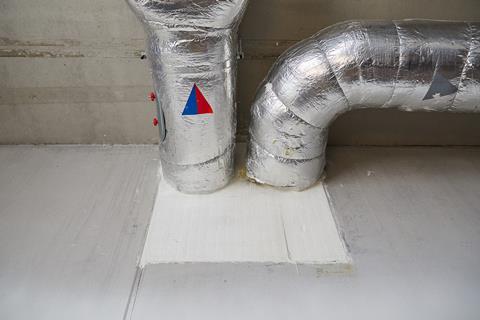
Responsibilities of designers, contractors and others
Legislation and guidance define the responsibilities of those involved in the design, construction and management of buildings. Legal liability may arise if those responsibilities are breached. As the Association for Specialist Fire Protection (ASFP) puts it: “If involved with the provision of a fire protection package, at any level, then you share liability for its usefulness and operation when it is needed in fire.” Whether you supply, install, inspect or maintain a system, you are legally responsible for its performance.
Technically, responsibility is the obligation to manage or carry out an activity, while liability refers to the legal consequences that may arise if that responsibility is not discharged competently and results in harm or non-compliance.
The BSA established the BSR to oversee compliance. It also expanded enforcement powers, and placed greater emphasis on competence, record-keeping and regulatory oversight.
The BSA reinforces and clarifies dutyholder responsibilities during design and construction, including specific duties for the designated principal designer and principal contractor to plan, manage and monitor building safety risks as part of their statutory roles. Following the BSA, amendments to the Building Regulations in England introduced a formal dutyholder regime for design and construction, assigning legal responsibility for compliance to clients, designers and contractors. It also introduces an accountable person role for HRBs once occupied, with statutory duties to assess building safety risks, maintain safety information and demonstrate compliance to the BSR.
In non-domestic buildings, under the Regulatory Reform (Fire Safety) Order 2005, a responsible person is legally required to ensure appropriate fire precautions are in place, are effective, and are properly maintained once a building is in use. The responsible person is the individual or organisation with control of a building or its common parts when it is in use – typically an employer, owner or managing agent. This role remains fully in force and has not been superseded by later legislation. The Fire Safety Act 2021 clarified and expanded the scope of the Fire Safety Order, while the BSA introduced additional, parallel duties – particularly for HRBs – without replacing the responsible person’s obligations.
Note that the statutory dutyholder roles and building-control gateway process apply in England. Different regulatory frameworks apply in Scotland, Wales and Northern Ireland.
How fire behaves
If legislation sets the rules, it is a sound understanding of fire behaviour and material performance that enables practitioners to apply them effectively.
Stages of fire development
A typical fire follows distinct stages:
- Ignition – initiation of combustion when heat, oxygen and fuel are present.
- Growth – fire spreads and intensifies as heat release increases. If uncontrolled, conditions may progress to flashover.
- Fully developed – peak heat release is reached, placing maximum demand on fire-resisting construction and posing the greatest risk to structural integrity.
- Decay – fire intensity reduces as available fuel and oxygen are consumed.
Recognising these stages is vital, as each influences the effectiveness of fire stopping and compartmentation strategies. The underlying science is often represented by the fire tetrahedron whereby fire requires four things: fuel, heat, oxygen and the chemical chain reaction. This principle underpins both passive fire protection – such as compartmentation – and active measures such as sprinklers or extinguishers.
Combustibility and product performance
The key to understanding how construction materials will perform in a fire is understanding their combustibility. A material’s combustibility influences whether, and to what extent, it contributes to a building’s fire load.
Reaction to fire performance is assessed using European test methods that examine factors including:
- How easily a product ignites
- The amount of heat it releases
- Its behaviour when exposed to fire, such as melting, charring or producing flaming droplets
- The volume and rate of smoke production
- The spread and development of flames across its surface.
Test results are classified in accordance with EN 13501-1, the European reaction to fire classification system, which assigns Euroclass ratings from A1 and A2-s1,d0 (non-combustible), through B to F, with F indicating no determined performance or failing to meet class E criteria.
Materials are also given supplementary classifications for smoke production (s) and the formation of flaming droplets or particles (d).
The Euroclass system is harmonised across Europe and is also the system used across the UK. Historically, the UK used a national reaction to fire classification system alongside Euroclasses during the transition to European standards. This national system had significant limitations, most notably the use of the Class 0 designation.
Class 0 was not a measure of non-combustibility, but a classification based on performance in surface spread of flame and fire propagation tests. Class 0 does not correspond directly to Euroclass ratings and is no longer appropriate for demonstrating compliance under current standards.
Declarations of performance
To reduce uncertainty when choosing materials, specifiers should request a product’s declaration of performance (DoP) from the manufacturer.
Where required under the Construction Products Regulation, this legally mandated document sets out a product’s declared performance in relation to its essential characteristics and its contribution to the basic requirements for construction works.
A sound understanding of fire behaviour and construction product performance is essential to making safe and compliant design and specification decisions.
Compartmentation
Compartmentation is the silent backbone of fire safety. By dividing a structure into fire-resistant sections, it can slow the spread of flames, smoke and toxic gases, buying critical time for occupants to escape and for fire crews to intervene.
Compartmentation is a fundamental fire safety measure in many building types – particularly residential, healthcare and other higher-risk buildings. The extent of compartmentation that is required varies according to building use, height, size and occupancy risk.
Compartmentation relies on the use of fire-resisting walls and floors. These elements are tested and classified for integrity (E) – their ability to prevent the passage of fire and hot gases – and insulation (I) – their ability to limit heat transfer.
Where an element is loadbearing, it will also be required to satisfy a loadbearing capacity criterion (R), demonstrating its ability to carry its design load during fire exposure without collapse. The required fire-resistance period depends on factors including the building’s use, height and occupancy.
Compartmentation is not only about controlling fire spread; it is about protecting people from smoke and toxic gases, which are the leading cause of fire-related deaths. By containing fire, compartmentation minimises exposure, preserves escape routes, buys firefighters time and protects structural stability.
Fire stopping
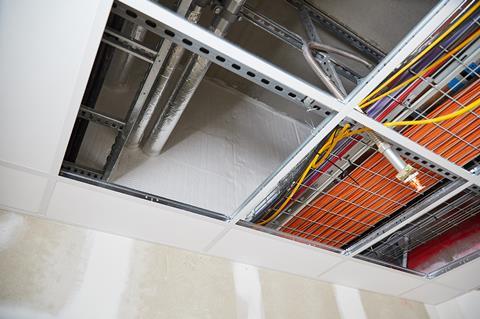
Fire stopping is used to reinstate the fire-resisting performance of walls and floors where they are penetrated by services such as cables, pipes or ductwork. If these penetrations are not properly sealed, the compartmentation is compromised, creating a pathway for fire, smoke and toxic gases to spread beyond the fire-affected area.
Fire stopping products include penetration seals, linear joint systems, fire-resisting cavity barriers and loadbearing void fillers. Related measures, such as structural fire protection, are used to protect loadbearing elements so they can maintain stability when exposed to fire. Together, these systems play a critical role in limiting fire spread.
Key categories include:
- Linear gap and joint seals – used to close movement joints and gaps at floor edges or between walls and floors
- Service penetration seals – systems designed to maintain fire resistance where pipes, cables and ductwork pass through fire-resisting elements
- Penetration void fillers – products used to reinstate fire performance in walls and floors following the installation of service
- Structural fire protection – systems such as boards, sprays or coatings that protect steel, concrete or timber elements, enabling them to maintain loadbearing capacity under fire conditions.
Each system plays a specific role in maintaining effective fire compartmentation. However, even well-tested products will not perform as intended if they are incorrectly installed.
Final thoughts
Fire safety is not delivered by regulation alone, but by the competence and judgement of those who apply it. Designers, specifiers, contractors and maintainers each influence how a building will perform in fire – and each carries legal responsibilities for the decisions they make.
Treating fire safety as a whole-building system is therefore critical. Structural protection, compartmentation, fire stopping and escape strategies must be aligned, evidenced and properly executed. When they are, fire safety moves beyond paperwork and becomes a lived, reliable reality.
Please fill out the form below to complete the module and receive your certificate.