







This year’s Serpentine Pavillion by Isabel Abascal and Alessandro Arienzo of LANZO Atelier is a low-key triumph that melds together Mexican and British references effortlessly and intelligently, Mary Richardson reports
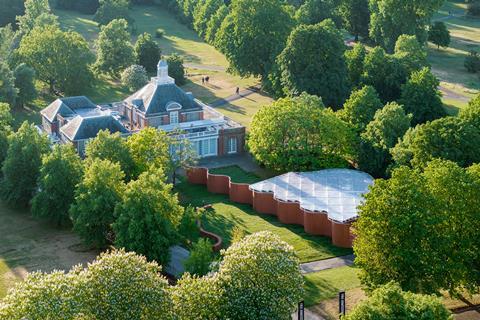
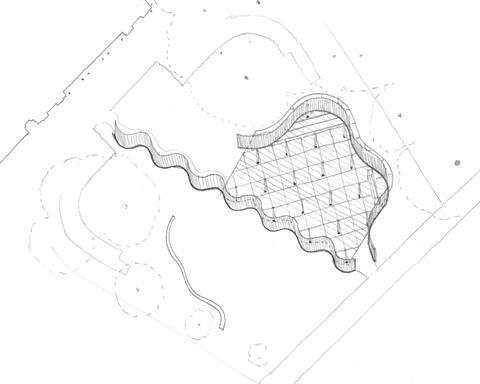
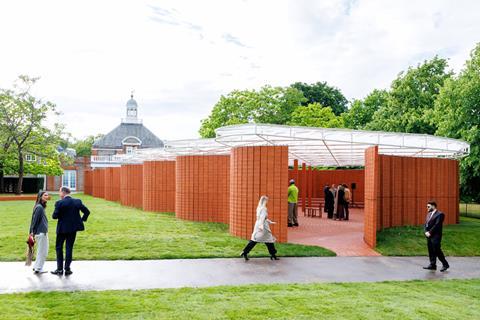
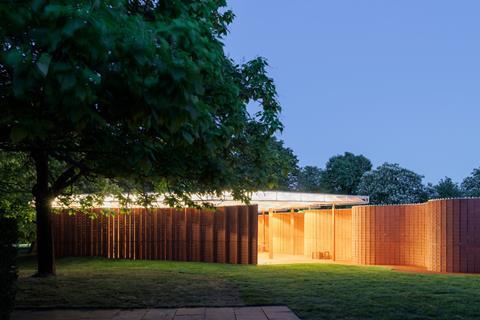
The first brick pavilion in the history of the 25-year series is dominated by a long, serpentine (pun absolutely intended) wall that runs along one side, echoing the shape of the historic serpentine, or crinkle-crankle, walls of Suffolk. It is visual wordplay – but this year’s pavilion is so much more than a simple one-liner.
Young Mexican practice
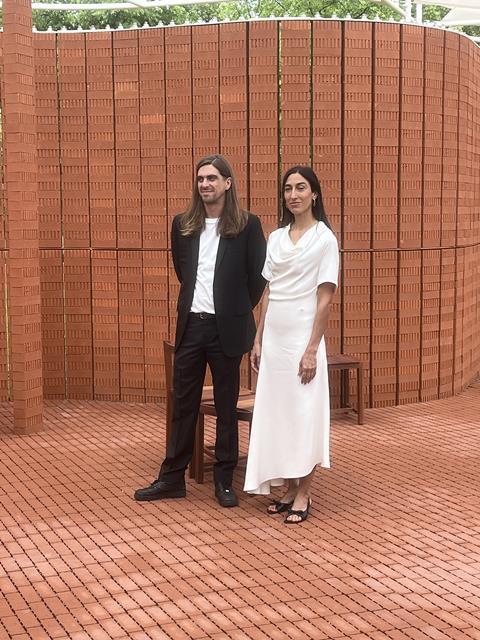
Atelier LANZA is a Mexico City-based studio founded in 2015 by Abascal and Arienzo. Their practice spans buildings, installations, interiors, furniture, exhibition design and printed matter, but is unified by a attentiveness to the everyday and the informal, and a conviction that beauty emerges from use and encounter rather than from gesture alone.
Notable projects include a series of indoor/outdoor public kiosks and washrooms along a bicycle track in Ecatepec, Mexico, that have planting at their core; a striking installation of stacked brick circles in Logroño, Spain; the rain-chain-curtained cylindrical Palacio de Hierro 10 Years pavilion above a fountain in Mexico City; as well as private houses and restaurant interiors across Mexico.
They have work in the permanent collections of SFMOMA and the Denver Art Museum; and they have been recognised with the Architectural League of New York’s Emerging Voices Award.
As practitioners who operate at the cusp of art and architecture, they are generally good at pavilions, which, at their best, are artworks as much as structures.
Serpentine wall inspiration
Inspiration for their pavilion, which they have named A Serpentine, was found initially online. “When we first saw a picture of a serpentine wall, we just knew that that had to be the starting point,” says Abascal with a huge grin. And it has proved a point of inspiration for the anniversary pavilion.
Good ideas often seem obvious once someone has thought of them. You find yourself wondering why no chain of thought – or concerted googling, at least – before now has made the link between the Serpentine Gallery’s name and that traditional British landscape design element the serpentine wall. So it is good to see the connection has now been made.
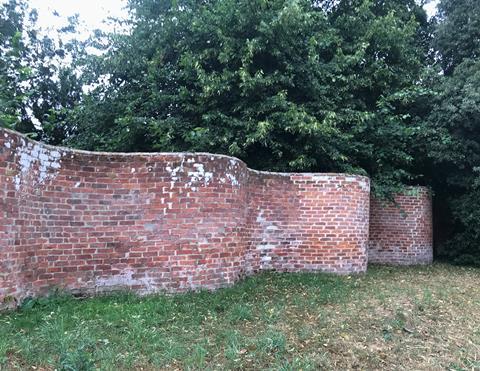
There is something fun and joyful about wavy serpentine walls, regardless of their practical benefits, which were, in fact, numerous: self-supporting at just one brick thin; helping Brick Tax evasion in the 18th and 19thcenturies; offering warm, wind-sheltered pockets perfect for training fruit trees. They are thought to have be brought to Suffolk by the Dutch who drained the Fens, though the principle goes back to ancient Egypt.
Considered and contextual
Some of the pavilions over the past quarter century have felt like “starchitect art object” dropped in beside the gallery from nowhere, with little thought to context. This year’s thoroughly contextual offering is an altogether more considered and humbler affair – and all the better for it.
This structure is of its place: made of brick in celebration of Britain’s brick built-environment heritage; brick as London vernacular; brick as earth; brick as echoes of those crinkle-crankle walls.
Arienzo recalls noticing a broken planter on a visit to London to prepare for installation. Seeing that it was made from the same stock as they had just chosen for the pavilion, he felt vindicated in his choice, “I knew then that we’d chosen the right brick – the bricks of normal life.”
Local bricks
The pavilion’s bricks talk too to the bricks of the Serpentine Gallery itself, which was originally built as a cafe in the 1930s. The forms of the two structures, too, enjoy a conversation.
The Sienna Red stock was made at Wienerberger’s Ewhurst brickworks in Ockley, Surrey, just 30 miles from the gallery; a historic brickyard from which millions of bricks were brought in the years after the war to help rebuild London after the Blitz.
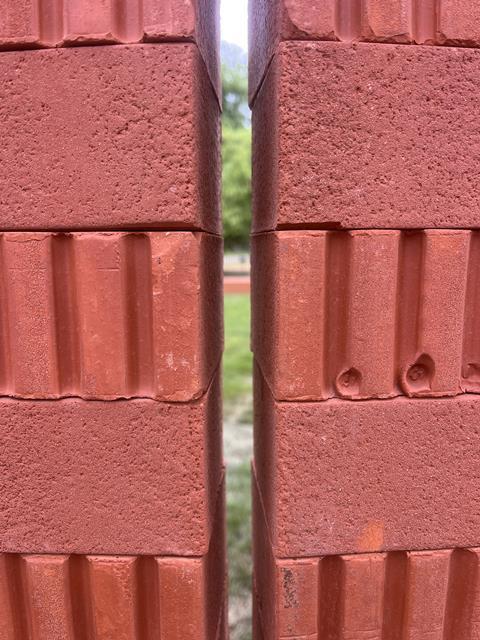
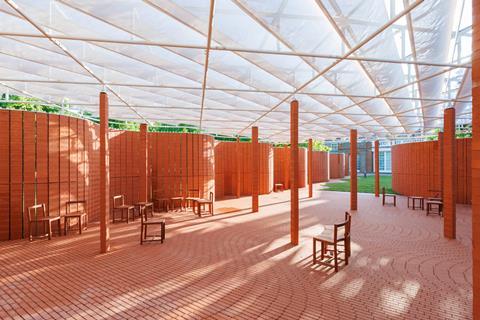
Instead of being laid with mortar, these bricks are threaded onto vertical steel rods – alternating one face-forward and one back-to-front (for the more interesting, ridged texture on the reverse) – as a means to ensure the whole structure can be taken down easily at the end of the summer.
Thin vertical gaps between the stacks of bricks give the wavy walls a porous quality and offer glimpses of the world outside – or inside – the structure.
The roof consists of a steel frame supporting a transparent roof with angled sunshades beneath it. Abascal and Arienzo wanted the space to feel bright and be filled with light.

Patterned floor design
Arienzo is particularly proud of the floor, which is laid with Belgian porous pavers in a beautiful curving, sinuous pattern that he designed himself. “It’s pretty amazing,” he says. “There is a recent book about patterns of bricks in the UK, and it doesn’t have this in it, but it should. I’m pretty proud of it. It follows the curvature of the floor, but there’s quite an illusion to it because, if you see it from a certain perspective, you don’t see the waves in it.”
Abascal adds: “In Mexico City, floors are important. It was important for us to have the ceramic floor.”
As Mexican as it is British
In fact, this pavilion is as much of Mexico as it is of Britain. And that is where its gentle intelligence lies: in its fusing together of the two countries’ influences so successfully. You can draw a line from the pavilion back through LANZA’s own Forest House – with its curved brick walls, permeable boundary and volumes defined in response to one main wall – back through the work of Alberto Kalach and Tatiana Bilbao, back to Barragán.
With its inside/outside spaces; and its use of walls to frame the landscape, and to shape human engagement with space and with the natural world; this pavilion fits clearly into a distinctly Mexican tradition. As Arienzo says: “I feel that it could easily have been built also in Mexico.”
He talks about being inspired by the apparently “playful” way bricks are thrown between workers on construction sites in Mexico; and about finding a sense of playfulness and joy in very ordinary materials.
Visiting a serpentine wall
The pair describe their first visit to see one of the longest surviving serpentine walls, in the village of Easton, Suffolk, as a moment of pure joy. Abascal says: “It’s extremely long. It’s really beautiful. It’s so well preserved. We were driving along and suddenly we saw it. It was just like our vision.”
Arienzo adds: “Something very interesting happened: we started looking at those walls as if we weren’t architects. We became like kids. It’s just such a fun thing to see. We started playing around – clapping our hands to hear the echoes, and playing hide and seek.”
The couple hope their own serpentine wall will inspire similar delight in visitors young and old. And it is certainly easy to see how children will enjoy the structure. The couple say they brought their own young children on site during a visit and loved seeing them spinning around the brick columns that support the roof.
Walls that gather together
A key message Abascal wants the structure to convey is that walls don’t have to divide people – that they can be structures that gather people together. There is, for example, an extra low snaking wall, just a few courses high, that delineates an outdoor space to one side of the main pavilion; a device redolent of their 1973-2021 installation of three low, large brick circles for the 2021 Concéntrico festival in Logroño. It is a playful addition to the structure, which extends its reach out into the grounds of the gallery, and will act as both a perfect seat for tired visitors, and a balancing wall for children to play on – the wiggly little wall is a structure just made for interaction.
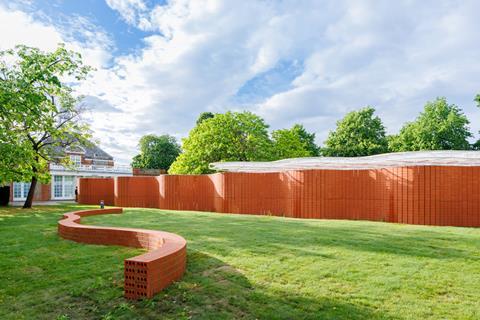
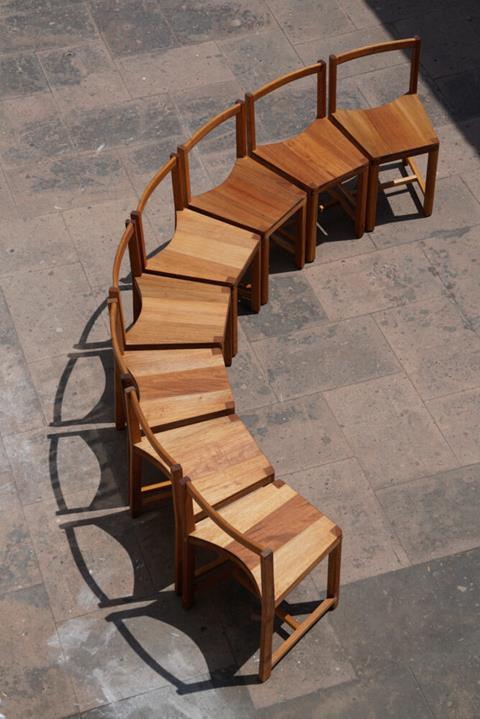
There are so many reasons to like this pavilion. As well as everything already discussed, with its clever use of pedestrian materials and its humble aesthetic, it is an apt pavilion for 2026. Something more bombastic, showy and shiny would have grated in a cost-of-living-crippled country racked by permacrisis. It works practically as a space for people to gather and mingle in. The chairs designed by LANZA match the space well and are nice objects. And, in what should perhaps be the ultimate compliment, this pavilion is not particularly Instagrammable.
Best of all it has managed to unite Mexican and British influences within a single coherent idea, and coherent and interesting structure.
A Serpentine has put life back in the pavilion franchise by presenting us with the antithesis to starchitectural bombast – a building that asks what architecture is for; that gathers people rather than impressing them; and that borrows intelligently from history without being nostalgic. In a trademark Atelier LANZA move, it is made of ordinary materials and asks us to find the extraordinary in them. In its unostentatious way, this pavilion has a great deal to say.







2 Readers' comments