


Velux’s innovation centre has many lessons to teach about adaptive reuse and timber construction. To mark the publication of More Than a House: An Experiment in Transformation, which tells the story of the sustainable transformation, I went along to take a look
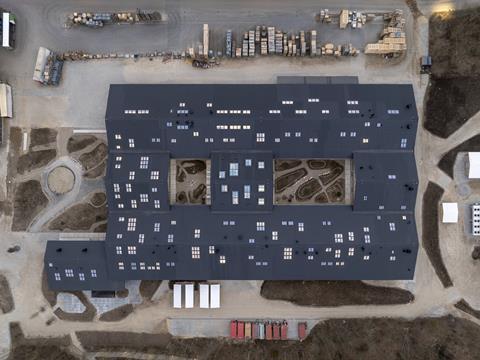
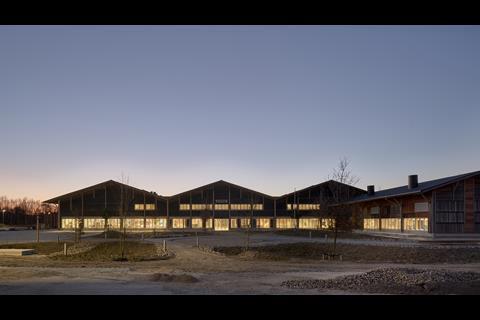
Velux, the Danish window firm, has transformed a 30-year-old wooden warehouse into its new R&D centre. The result is a model of good practice in both retrofit and workplace design – which also has lots to say about the longevity of timber construction.
Origins of the brand
The LKR Innovation House – the word “house” was chosen to help foster a sense of community and belonging at the centre – lies in the town of Østbirk in rural East Jutland, which became home to Velux’s manufacturing operations in 1950.
The name Velux comes from “Ve” for ventilation plus “lux”, Latin for light. And, as you drive through the Danish countryside to get to the Innovation House, it is easy to see what inspired the famous pivot-hinged roof windows. The high, steep roofs of traditional Danish houses contain huge attic spaces that for centuries – dimly lit by small gabled dormers or not lit at all – went underused. It was these spaces the Velux roof window was originally designed to unlock.
The aim of the firm’s new centre was to bring together the various innovation and research teams from across the business who were housed in different offices across several sites. The opportunity to create it arose when production was moved out of town and a 9500m2 storage warehouse became surplus to requirements. A decision was taken to convert it into an innovation hub housing the company’s test facilities and 500 research and development staff.
Inspired in Birmingham
As detailed in the new book, the story of the original wooden warehouse is in itself a tale of innovation. Built in 1995, its design was inspired by a sign on a timber trade association stand at an Interbuild show in Birmingham that read: “Every time you don’t specify timber you’re helping to destroy our planet.”
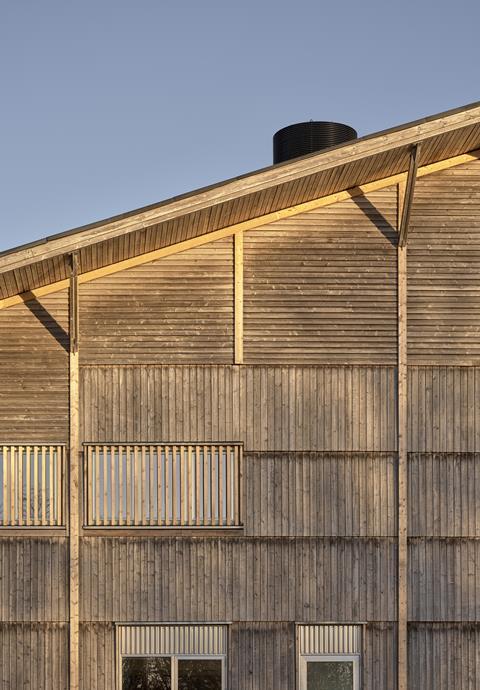
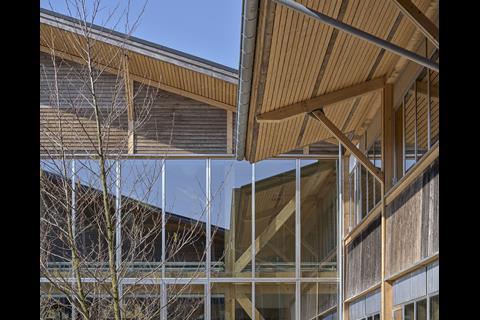
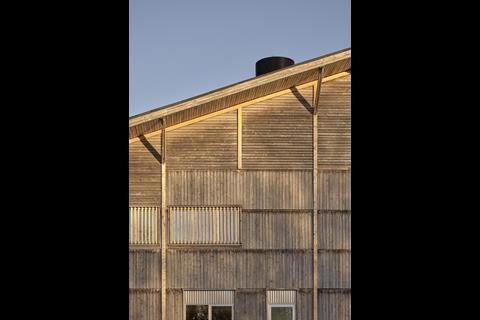
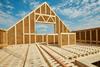
Its loadbearing structure was made of glulam – an early example in Denmark of its use at this scale – with facades of untreated spruce. The choice of spruce was inspired by a chance discovery. In the late 19thcentury, the Danish Forest Association had built some experimental huts to test the durability of Danish red spruce as a building material. When these were rediscovered and examined almost a century later in the 1980s, the untreated spruce had lasted well – particularly in areas where the timber could easily dry out after getting wet. This suggested that, with the right design, untreated spruce was viable on building exteriors – such as the warehouse facades.
Patented wooden facade design
A team at Velux designed prefabricated modular spruce panels, and went so far as to patent a special joint for them. This involved interlocking double tongue-and-groove edges forming a pressure-equalised joint between panels – rainscreen principles in timber joinery – with all metal fixings concealed behind the boards. Most boards were arranged vertically to help them shed water, and, at the same time, large overhangs and deep base details helped protect the timber from rain and splashback.
All the thought put into the design paid off. The panels retained their structural integrity throughout the 25-year working life of the warehouse – and acquired an appealing silvered appearance. When the building was redesigned for its new use, the panels were removed, numbered and insulated before being reinstalled.
New courtyards
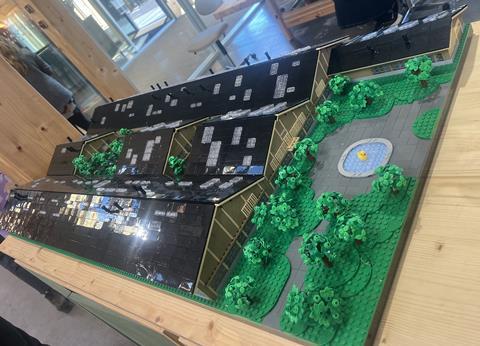
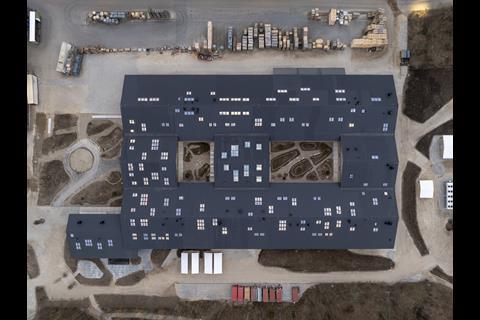
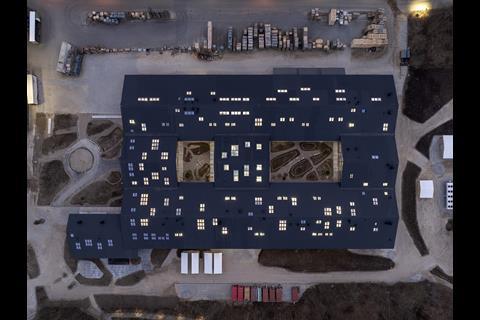
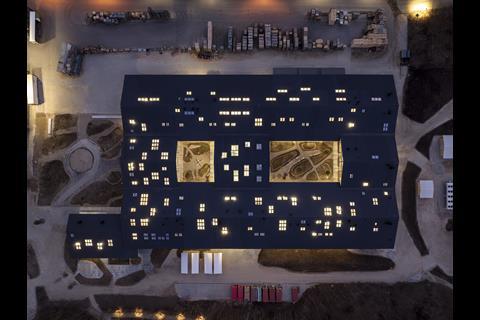
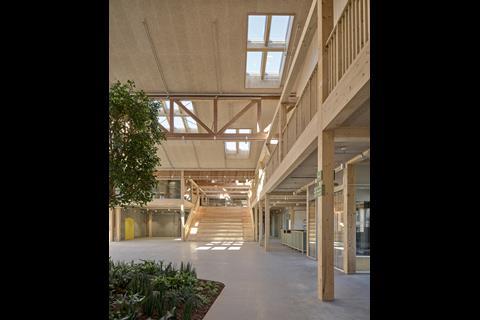
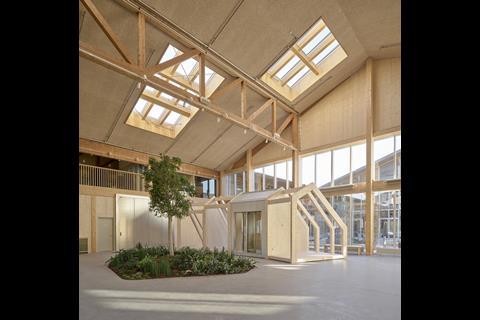
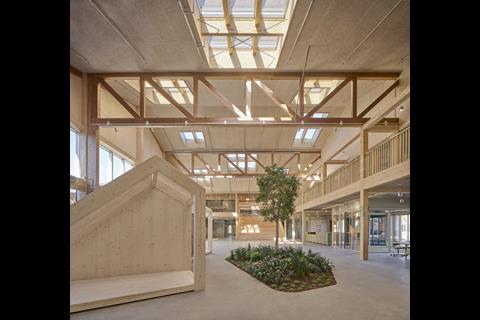
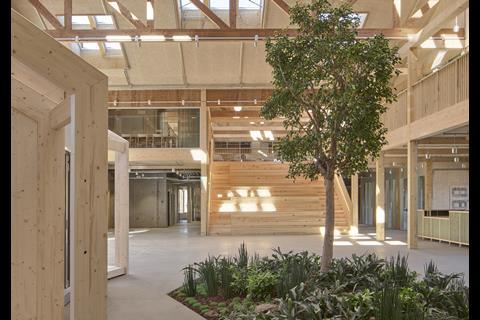
The key intervention of principal designers Praksis Arkitekter in their transformation of the building from functional warehouse to creative hub was to punch two holes into the large building to form two courtyards. These have introduced light – and nature, through courtyard planting schemes intended to offer solar shading in summer – into the structure.
New timber structure
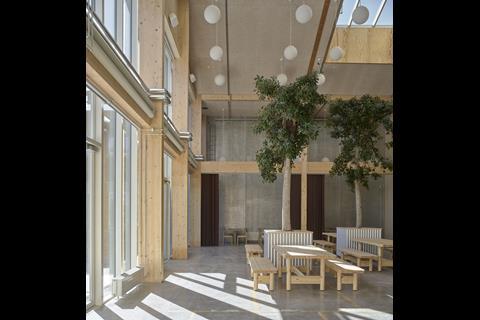
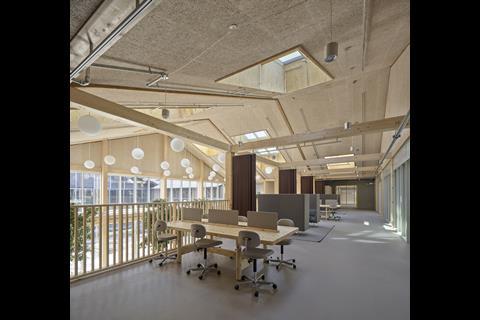
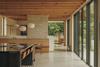
To turn the space into office space, a new three-storey engineered timber insertion was slotted into the warehouse, increasing its floor area to 14,000 m². This has a flexible grid that encompasses a variety of workspaces, project spaces and meeting rooms of different sizes. Timber circulation galleries overlook the double-height spaces like the foyer and canteen.
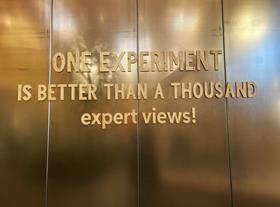
A large sign in the foyer reminds staff and visitors of the maxim of Velux founder Villum Kann Rasmussen: “One experiment is better than 1000 expert views.” Workshops staffed by skilled engineers enable the fabrication of prototypes and tests, while a product library allows easy access to all current product models.
More than 400 windows (of course)
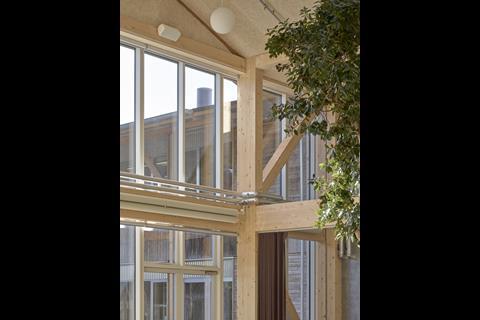
Then – of course – there are the Velux windows in the deep, reinsulated roof. In fact, there are more than 400 Velux windows across the roof and facades. Mette Tony of Praksis says of the roof lights, “[They are] all calibrated to the spatial conditions below. Some were raised to give clear sky views, others positioned low to create more intimate working light. Deep reveals were calculated to optimise daylight angles through the thick roof build-up.” They all have awnings for heat protection in the summer.
Natural and mechanical ventilation
The windows reduce the need for artificial lighting and support passive indoor climate management. The building uses a mix of both natural and mechanical ventilation. Mechanical ventilation (with and without active cooling) is used in areas with strict indoor climate requirements, high occupant density and/or solar exposure. Naturally ventilated areas rely on openable facade and roof windows, large room volumes and open connections between floors. Window operation is automated and centrally controlled, which allows zone-by-zone regulation. Exhaust fans support air exchange during periods of high CO₂ concentration, rainfall or limited wind pressure. Window openings respond to outdoor temperature and are restricted when the outside temperature falls below 14°C”. The building’s original deep overhangs reduce solar gains.
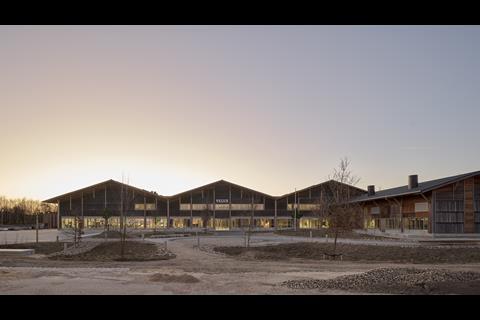
Although we are all becoming more and more used to timber builds, it still feels fresh to see a modern office of this spatial and technical complexity made almost entirely of wood.
Much of the engineered timber is left plain, keeping the space light and neutral, though some details are painted with coloured linseed oil stains, with areas of the building given different colour themes. Furniture on the other hand is neutral so that it can be moved around as needed. Coloured woollen curtains act as space dividers and sun shading and help absorb sound.
A key move in increasing the building’s biophilic design was moving the car-parks further away so that planting could surround the building – letting occupants feel like they are in a natural environment. The building sits within a landscaped park, a gift to the town from the company and its employee foundation.
Material reuse
Materials were reused wherever possible. The (uninsulated) concrete pad was retained. Sections that were no longer needed – in the new courtyards, for example – were removed in large squares and used as paving around the site. Sections of glulam frame removed to make the courtyards were repurposed into furniture like benches in reception.
Old office furniture from around the company was chipped to make MDF for new furniture to go in the building, while the office chairs are reused and refurbished examples of a standard repairable model.
All together about 55 percent or 4,576 tonnes of material has been saved compared to what it would have taken to construct a new building of the same size and function.
Whole-life carbon
Unlike UK voluntary whole-life carbon codes, the Danish system combines embodied and operational carbon into a single headline figure. Since January 2025, Denmark’s building code has required almost all new buildings to calculate and report their whole-life carbon performance. Limits are set by building type, averaging around 7.1kgCO₂e/m²/year, and are scheduled to tighten further in 2027 and 2029.
Danish figures cover lifecycle stages A1–A5, B4, B6, C3 and C4, with module D reported separately. UK voluntary standards expect full A–D coverage. The underlying European standard, EN 15978, is undergoing revision now and is expected to be published soon. It will add a new pre-construction module (A0) and a user-activity module (B8), and split module D into sub-modules – changes that should help nudge the various national whole-life carbon standards closer over time.
New book
Somehow this transformation of a redundant warehouse into a light and airy workplace seems fitting for a company whose business began as a means to bring new life to dark, underutilised spaces. The LKR Innovation House is proof that retrofit workspaces don’t need to mean compromise for their occupants. Today this is an exceptional place, but soon this type of intelligent repurposing ought to be the norm.
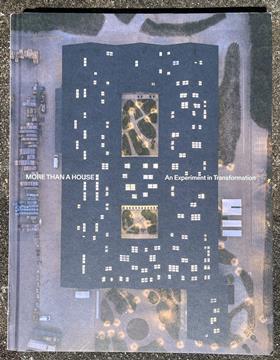
More Than a House: An Experiment in Transformation, published by the Danish Architectural Press and Velux, edited by Kristoffer Lindhardt Weiss and Jesper Værn, documents the project in detail, with beautiful photography by Adam Mørk.
Project details
Architect Praksis Arkitekter
Consulting engineer Søren Jensen
Landscape designer DETBLÅ
Spatial design BRIQ
Construction KG Hansen
Client consultant DAI
Interior design Holmris B8, Spant Studio, FRIIS & MOLTKE, Kasper Mose


No comments yet