








London’s first large-scale construction reuse hub is taking shape in Silvertown, east London, attempting something the built environment has so far struggled to achieve: turning reuse and the circular economy from paper-exercise “nice idea” into functioning supply-chain infrastructure. I went along to take a look
Tipping Point East (TPE), backed by the GLA and Newham Council, aims to pilot systems for recovering, processing and redistributing construction materials at scale. The project is intended as a demonstrator for how a circular construction economy might actually operate in practice.
The site is run through a partnership between three organisations, Material Cultures, RESOLVE Collective and Yes Make. The latter design-and-build collective is responsible for establishing and operating the construction reuse hub, having run a similar scheme at a smaller scale from a base at Paper Garden in Canada Water. There, it has already diverted around 800 tonnes of construction material back into use via community and public-sector projects.
The man charged with scaling this success at TPE is Yes Make’s creative director and co-founder Joel de Mowbray. He was on hand at TPE HQ to explain the vision and show us around TPE’s base, which consists of a couple of old warehouses and extensive surrounding yards on a former industrial brownfield site sandwiched between the Royal Docks to the north and the Thames to the south. Next door to the east is London City airport.

Yes Make-ing it happen
De Mowbray appears to be exactly the right person for the job, combining boundless enthusiasm for the task at hand with reserves of resilience and a deeply down-to-earth practicality. He describes the ambition to create a “parallel supply chain” for construction materials – one capable of dealing with the practical realities of reuse.
Under the London Plan, major developments are required to produce circular-economy statements. But de Mowbray says, “There’s all of this consultant-based activity taking place and, in the absence of infrastructure like ours, that doesn’t actually translate into increasing reuse. It’s more of a reporting function as opposed to an impact function.”
Construction’s hidden surplus
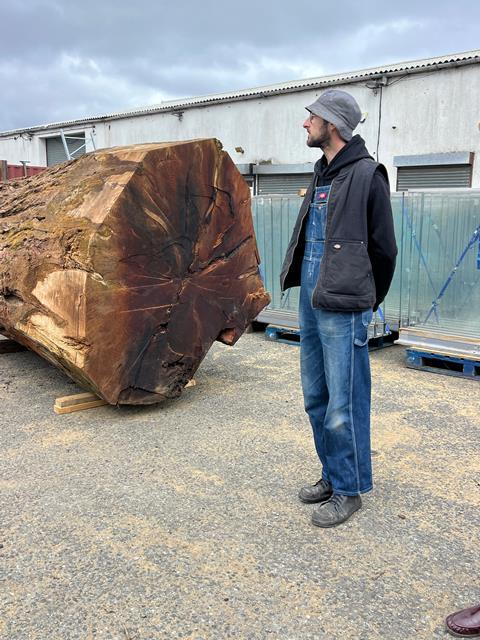
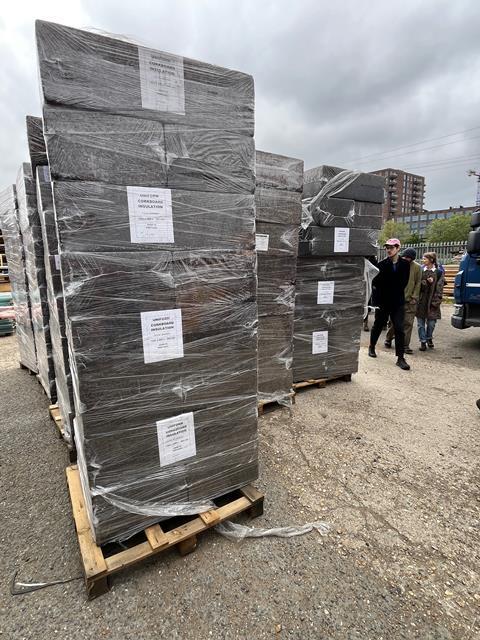
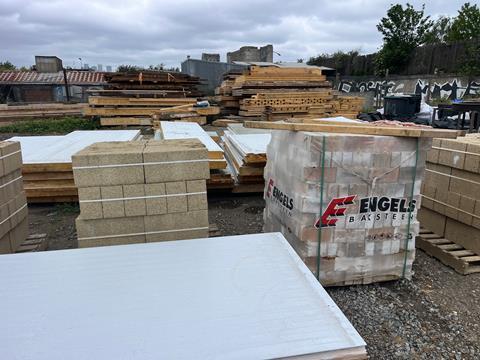
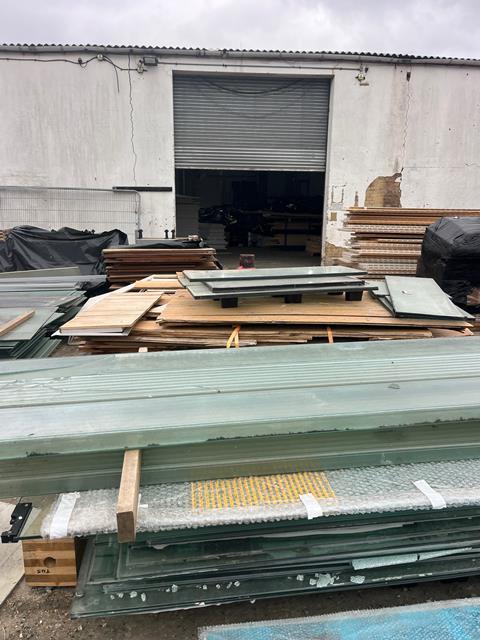
In the yard, stacks of timber, pallets of bricks and cork insulation, piles of facade panels and structural components are neatly arranged. Although the facility doesn’t officially open until later in the summer, word is out and materials have begun to arrive. As he talks, De Mowbray stands next to a giant sequoia trunk felled at an arboretum just outside London, which lies on its side in giant chunks waiting to be milled into useful timber.
Many of the building materials at TPE have never actually been used. De Mowbray estimates that around 60% of incoming material consists of brand-new surplus products – typically timber, brick, insulation, sand and cement left over from projects because of standard overordering. “It’s that five percent quantity surveyor’s safety factor on the materials order on just about every site,” he says. “When you think of reuse, it doesn’t necessarily mean it’s ever even actually been used.” Building basics are unsurprisingly the most popular with those using the depot, snapped up almost as soon as they arrive.
Making the figures add up
He continues, “There are a lot of assumptions around circularity, especially in the construction industry, where it is seen as more time consuming, more expensive, more this, more that. But a lot of those are quite broad assumptions that don’t really apply when you dig into the detail. Yes, there are some materials where the reclaiming is a nightmare. Getting 2.7m interior glazed partitions down from an 11th floor when they don’t fit in the lift and there’s no hoist on site – that probably is going to be more time consuming and expensive.
“But on the other hand, when we work with film and TV in these huge aircraft hangars at ground level, it is way cheaper to give the material to us than it is to pay for skips to dispose of it. Even in most conventional construction environments, for most items, we will save the contractor, both on labour and waste disposal as a result of our involvement.”
Bridgerton set repurposed
Film and television production is a significant source of materials. He says, “We’re working on two two-storey community buildings in London Bridge and the entire floor structure and deck for that will come from the set of Bridgerton. All of the Walker sets are going to be donated for free and fabricated by Automated Architecture that do site-deployed robotic micro factories. And all of the roof lattice for that is going to come from that one tree.” He gestures to the sequoia.
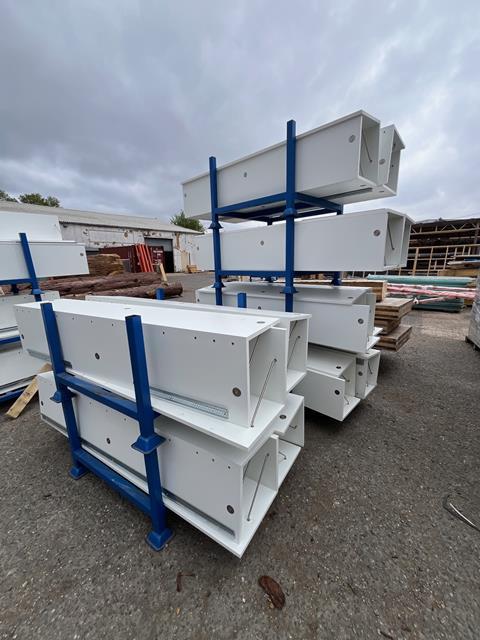
RESOLVE collective – a group that uses architecture, engineering, technology and art to help address social challenges – sources most of its materials from the culture sector. Materials saved include everything from high-end vitrines to an almost endless supply of art crates. The latter form a notorious waste-stream because they are built bespoke to specific artwork dimensions, often glued and screwed together with materials that aren’t designed for disassembly, and then discarded after a single journey. The team is working on designs that will repurpose them as bookcases.
RESOLVE will be redistributing materials to individuals and community groups via a separate subscription-based model. Most recently they have found themselves responding to requests for materials to build sound systems.
Priced to sell
For anyone purchasing construction materials, the assumption has generally been that reclaimed materials will cost more. But De Mowbray is aiming to incentivise use of TPE by providing materials cheaply: “at a minimum of about 30% less than RRP, regardless of whether or not they’re brand new, because, ultimately, we’re trying to stimulate a shift towards a circular economy approach”.
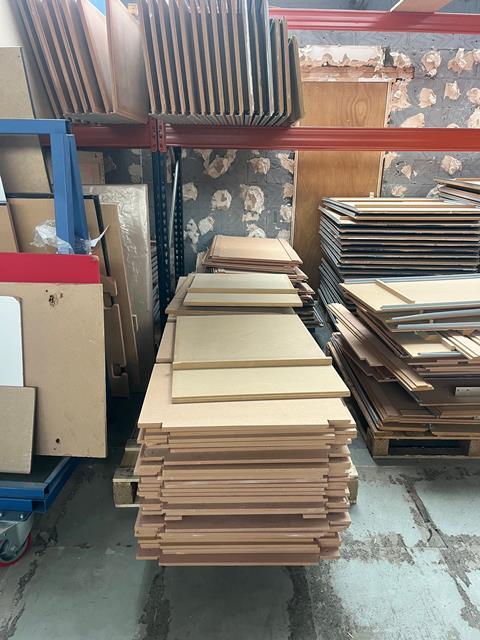
The team is currently working with contractors to recover 4.5m by 6m facade panels from a commercial building in Canary Wharf. “Their plan was to unbolt them, get them onto a flatbed and take them off for disposal,” de Mowbray explains. “We’re working with them and collaborators to use them for two-, four- and six-storey housing projects, where we’ll be able to use them almost like IKEA flat pack.”
That single building contains more than 300 panels. Because they want to be able to engage with more large demolition projects like this, TPE is keen to open up the extra storage yards surrounding their inital one.
They are winning trust and the material supply chain is sending more and more their way. But the potential volume of reclaimed materials involved quickly exposes one of the central tensions in reuse: large commercial developments produce significant quantities of potentially reusable components, but those same projects are often unable to reincorporate them directly because of programme constraints, certification and procurement structures. “There is a mismatch,” de Mowbray states. “It creates an interesting dilemma because we are now getting major buildings’ worth of stock in a context where the majority of buildings at that scale are unable to specify these materials back into that building.”
The “little ships” principle
The challenge TPE is trying to address is both logistical and compliance-based: how to move large quantities of materials from one building into another while navigating procurement systems, warranties, insurance, certification and programme risks.
De Mowbray’s response is what he calls the “little ships” principle – a concept inspired by the Dunkirk “little ship” on which he lives. Rather than trying immediately to push reclaimed components back into major commercial projects, he plans to route them initially into smaller buildings where procurement structures are more flexible and compliance pathways easier to navigate.
“What we need is little ships,” he says. “Whereby we programme these materials into smaller buildings where it is perfectly appropriate and contextual that the materials can be used while we develop all that compliance and regulatory capability to be able to recertify and warranty materials so that they are able to go back into the scale of buildings that they come from.”
Insurance, certification and risk
Some of the most persistent barriers to reuse are institutional. Even getting his own organisation insured has been a challenge for de Mowbray. “Material supply, workshop fabrication, and contracting all sit under different insurance regimes,” he says. “Most organisations stay within one. We span all three.”
Processing materials
Materials received at the site go through a seven stage onboarding process that takes in historic information about its prior use, and a quarantine stage. Testing and processing of materials is done to order.
Not every material is recertified to the same level. Structural timber may be regraded visually; electrical systems may be PAT tested; other materials may simply be sold “as seen” – it all depends on the intended end use and preference of the purchaser. “That way, you only pay for what you need,” de Mowbray says.
The site is still under construction but the infrastructure is going up fast. There is already a “materials in” unloading area, and, while I was there, students from Central Saint Martin’s were working on a “goods out” bay – made from a canopy strung between two shipping containers – and a solar kiln for drying timber.
Material-led design
One way to facilitate reuse at the level of the individual project is by adopting a material-led approach to design, in which you look at the materials available and design something using them rather than starting with an idea of what your project should look like. Yes Make has adopted this approach on many of its builds to date. Because they operate simultaneously across material recovery, fabrication and construction, the team can feed available stock directly into projects already in development. Designers are encouraged to respond to what is physically present in the yard rather than specifying materials up front.
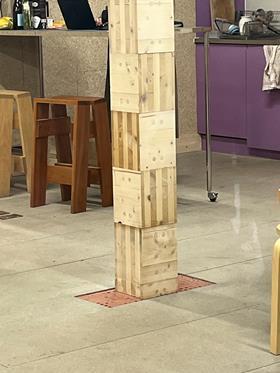
The TPE office inside the former Swissport warehouse was designed by Material Cultures and constructed largely from reclaimed components sourced through the yard. The fit-out incorporates CLT panels salvaged from a dismantled Mayfair development, internal glazed partitions recovered from an office in Holborn and flooring taken from decommissioned film sets. On the walls are experimental materials developed by Material Cultures for exhibitions: straw boards and hemp shiv and bio-based resin panels.
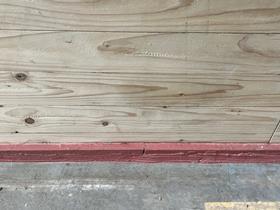
The soleplates are made of drainage grilles salvaged from Smithfield Market after the team found themselves short of timber of the right dimensions and began searching the yard for alternatives. This ilustrates how material-led design can work in practice: projects evolve around changing inventories; design decisions are adjusted as opportunities emerge. It is a way of working that can work really well for individual projects with flexible clients. Whether it can scale, remains to be seen.
The challenge of scaling
The operation itself is set to scale significantly when the site launches formally later in the summer, supported by a digital platform through which materials will be able to be ordered and tracked.
At present, the project is sustained through a mixture of public-sector support, grants and research funding. The GLA and Newham Council are providing support on the basis that the scheme supports the London Plan’s circularity agenda and Newham’s Just Transition Plan. The latter is claimed as the first local-authority strategy in the UK that formally ties net-zero targets – operational carbon zero by 2030, borough-wide by 2045 – to social equity, jobs and adaptation, in what is one of the most deprived boroughs in London.
The challenge lies in how to integrate reuse into procurement, insurance, regulation and design culture at scale in a way that allows circular construction to operate routinely rather than exceptionally. TPE is attempting to build the infrastructure for that transition – whether the industry is ready to meet it halfway is an open question.
European precedents
Although there is no circular economy hub of a similar scale in the UK, across Europe there are several large construction reuse hubs and circular-construction initiatives including Rotor in Brussels, baubüro in situ in Switzerland, BlueCity in Rotterdam and Lendager in Copenhagen. The model that seems to work is a split between a commercially trading arm (salvage, resale, and design consultancy) and a research, training and infrastructure arm funded by foundations, EU programmes or public bodies.
TPE has ambitions to become the biggest construction reuse hub in Europe. It has the site for five years – during which time thousands of new homes are going to be built all around it. To what extent it will be able to integrate its stock into the supply chain for those new builds remains to be seen. We will be back over the coming years to see how they are getting on…
Get involved
Tipping Point East plans to put its stock list for resale online later in the summer, enabling potential customers to view what is available and place orders. In the meantime, if you are a developer, construction firm or demolition contractors looking to bring materials to site, contact Freya the material yard manager at Yes Make. They are unable to accept ad hoc deliveries.
If you are interested in finding out more about the project, TPE runs paid-for visits to the site. You can find out more on the TPE website.







No comments yet