





We met the man with the best job in concrete to find out about the latest advances in the most promising decarbonisation technologies, from 3D-printed buildings to carbon-negative concrete

Edelio Bermejo (right) has one of the most interesting and important jobs in construction. As head of global R&D and innovation at Holcim – one of the world’s largest building materials companies – the French materials scientist spends his days trying to make one of construction’s most carbon-intensive materials more sustainable. Concrete remains central to Holcim’s business because it remains central to construction itself. It is also one of the industry’s biggest decarbonisation challenges.
Researchers are experimenting with everything from 100% recycled concrete and carbon-negative biochar mixes to 3D-printed buildings that use dramatically less material. Some of these ideas may never become mainstream – others are well on their way.
Bermejo likes to demonstrate the latest developments through what he calls his “lighthouse projects”: real buildings that showcase new technologies under real-world conditions. His hope is that they will demystify unfamiliar materials, encourage designers and contractors to try them, and ultimately persuade regulators and standards-setters to rethink what is possible.
When we met to discuss some of these projects, he said, “Construction can be conservative, both clients and regulators. But if we can show what can be done, prove it, in these lighthouse buildings, that should help give people confidence in the new materials and technologies.”
Bermejo has spent three decades in the cement industry. He holds a PhD in materials science and has worked across research, product development and international management, including several years running a Lafarge division stretching from Turkey to the Seychelles. So he understands both the scientific possibilities and the commercial realities of changing an industry that remains fundamental to the built environment.
Why concrete is so difficult to decarbonise
Concrete’s sustainability problem begins with cement. Cement production is responsible for roughly 7–8% of global carbon dioxide emissions. Around two-thirds of those come not from burning fuel to heat the cement kilns but from chemical reactions inherent to the traditional cement-making process. When limestone is heated to produce clinker – the reactive ingredient in cement – it releases CO₂. Even a kiln powered entirely by renewable electricity would still generate these process emissions.
The scale of concrete use makes the challenge even greater. Around 30 billion tonnes are produced worldwide every year, making it the world’s second most-used material after water.
There is unlikely to be a single breakthrough that solves the problem. Instead, manufacturers are pursuing multiple approaches simultaneously: replacing clinker, incorporating recycled materials, improving manufacturing, capturing carbon and simply reducing the amount of concrete required in the first place. Each of Bermejo’s lighthouse projects sheds light on a different part of that picture.
Lighthouse project #1
Recygénie, Paris – ”100% recycled concrete” building
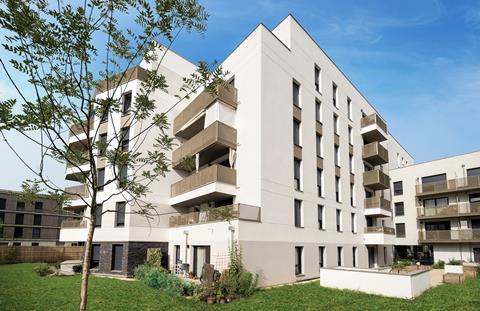
At Gennevilliers, on the outskirts of Paris, a cluster of 1960s apartment blocks needed replacing, so social housing provider Seqens partnered with Holcim to see how much of the demolished buildings could be reincorporated into their replacements.
The result was Recygénie: what Holcim calls the first 100% recycled concrete building. All three ingredients in the concrete – cement, aggregate and water – are recycled. The cement came from what Holcim claims as another world-first innovation: 100% recycled clinker, produced at its Altkirch plant in France using recycled sand, paper industry by-products and steel slag in a lower-temperature kiln than conventional clinker production requires. Holcim estimates that the recycled cement saved around 3,000 tonnes of virgin raw materials.
The aggregate came entirely from crushed construction and demolition waste, much of it from the buildings demolished on the site itself. Recycled wastewater and harvested rainwater replaced fresh mains water.
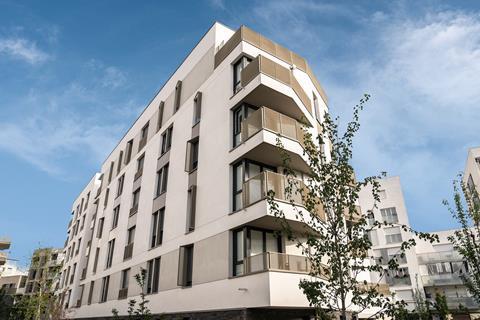
The resulting concrete was used in the foundations, walls and roof of two buildings in the new 220-home development. Altogether, it is estimated the project conserved around 6,000 tonnes of raw materials.
Behind the project sits a wider circular economy strategy. Construction and demolition waste is collected, sorted and processed into recycled aggregates and recovered cementitious material that can be fed back into new concrete. In the UK, Holcim recycled around three million tonnes of construction and demolition waste in 2025 through a network of around 50 recycling sites.
This is a canny business model as well as an exercise in circularity. Contractors pay for waste to be removed; Holcim reduces its reliance on quarried virgin materials; and the resulting materials are sold back into the market as new construction materials with recycled content.
The biggest challenge at Gennevilliers wasn’t technical but regulatory. French building rules limit how much recycled material can be used in structural concrete, so Holcim worked with France’s national building research institute, CSTB, to demonstrate that the fully recycled mix met the same strength, durability and safety standards as conventional concrete.
Even Bermejo is cautious about how widely this model is replicable. He has acknowledged that a fully recycled approach can’t be replicated everywhere, because there isn’t always enough demolition waste to meet the demand from new construction. Recygénie is probably best read as a proof of concept.
Lighthouse project #2
Wood Wharf, Canary Wharf – recycled aggregates and “coffeecrete”
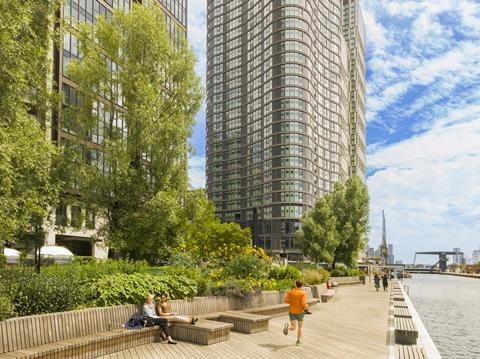
In London, Bermejo has been overseeing innovation at Wood Wharf, a mixed-use extension to the Canary Wharf estate, where Canary Wharf Group set a minimum target of BREEAM Excellent across the development.
Here too, demolition waste was treated as a resource. Rubble from a jetty demolished as part of the scheme was taken across the Thames to Holcim’s recycling plant in Greenwich, where it was processed into recycled aggregate before being returned to Wood Wharf for use in the new buildings. The short journey made the circular approach commercially as well as environmentally viable here.
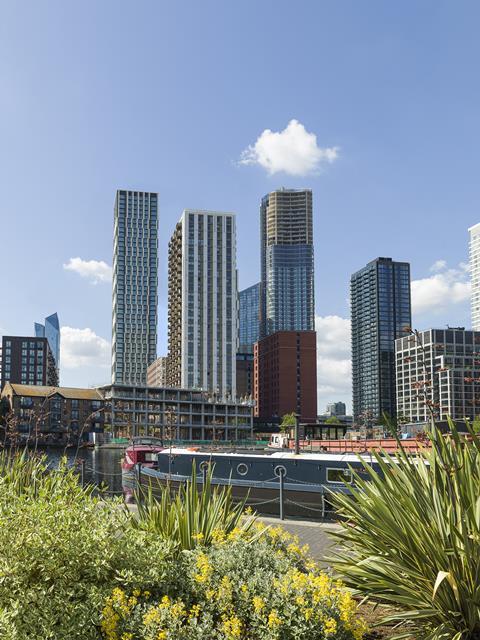
Wood Wharf was also a testing ground for another decarbonisation tool: biochar concrete. Biochar is produced by heating organic waste in an almost oxygen-free environment. Rather than releasing its carbon back into the atmosphere as it decomposes or burns, much of it becomes locked into a stable charcoal-like material that can then be incorporated into concrete. As well as significantly reducing embodied carbon, researchers believe it could even improve concrete’s performance.
Bermejo smiles when he explains how the team decided what waste material to use at Wood Wharf. “There wasn’t a lot of natural material locally, but they do drink a lot of coffee at Canary Wharf. So we thought about using coffee grounds to make the biochar.”
The Canary Wharf estate generates around 190 tonnes of waste coffee grounds from its cafes and restaurants every year. Together with coppiced timber, these became the feedstock for a six-month research programme involving Arup, Ramboll, Thornton Tomasetti and researchers from the universities of Cambridge and Queen’s Belfast.
The resulting carbon-sink “coffeecrete” has a projected negative global warming potential of -14kgCO₂e per cubic metre. It was first used as the underwater counterweight for the public artwork Whale on the Wharf, before being cast into a full-scale test slab beneath the new Wood Wharf theatre and, finally, into raft foundations at Bank Street.
The concrete will be monitored over two years to generate the kind of verified real-world performance data that will be needed if biochar concrete is to move into mainstream production.
Lighthouse project #3
ELEMENTAL, Venice Biennale – climate-positive modular housing
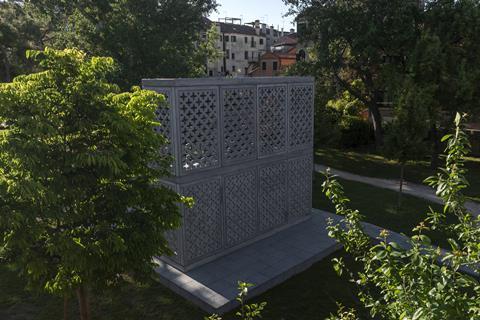
At Venice in 2025, Holcim partnered with Chilean practice ELEMENTAL, founded by Alejandro Aravena, on another biochar experiment.
The collaboration produced USB Core (Basic Services Unit), a 21m² modular housing prototype based on ELEMENTAL’s philosophy of incremental housing: build the hardest and most expensive elements – kitchen, bathroom and load-bearing structure – then allow residents to complete and expand the remainder over time as their circumstances allow.
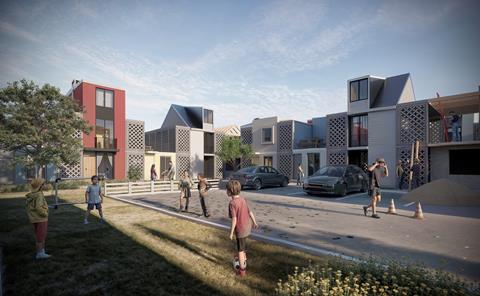
The approach has already been used in more than 4,000 homes across Latin America. What made the Venice prototype different was the material – a net-zero concrete using 100% recycled aggregates and biochar, allowing the housing to potentially function as a permanent carbon store.
Lighthouse project #4
ViliaSprint², Bezannes – Europe’s largest 3D-printed residential building

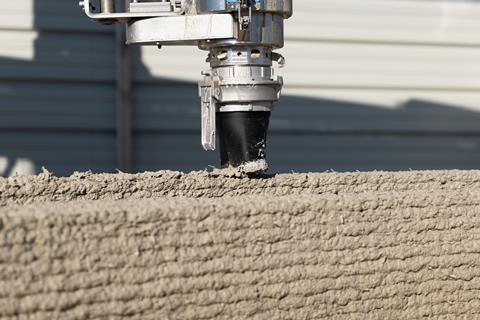
3D printing promises to tackle several construction challenges at once by reducing material use, cutting carbon, shortening construction programmes and reducing the need for labour. Because the printer deposits only the concrete required by the design, it can also reduce waste and allows designs to incorporate curves and complex forms that would be difficult or expensive using conventional methods.
A robotic printer extrudes a specially formulated concrete mix layer by layer, eliminating the need for traditional formwork. The mix incorporates reinforcing fibres that perform some of the role normally carried out by steel reinforcement.
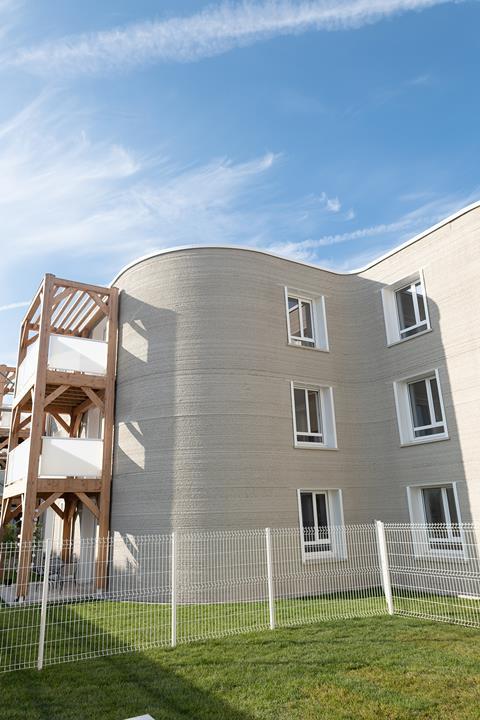
The 3D-printed ViliaSprint² development in Bezannes, near Reims in northern France, completed in April 2026, is Europe’s largest 3D-printed residential building: a three-storey, 12-home social housing scheme covering almost 800m². The walls of the entire building were printed in three months, with just 34 days of printing. The almost identical conventionally built block on the same site took around six months. Three operators using digital tablets managed the printing process, replacing the six-person crew a traditional build would have required.
The aesthetically appealing curved design made possible by the printer reduced concrete consumption by around 10% compared with a conventional rectangular building, while the concrete mix itself achieved a 30% reduction in CO₂ emissions compared with standard concrete of equivalent strength.
Holcim reports productivity improved rapidly over the course of the build as the team gained experience with the equipment, and is already moving on to larger follow-up projects. While 3D printing has been used extensively for single-storey buildings in parts of Asia, projects such as ViliaSprint² aim to show the potential of the technology for multi-storey residential projects in Europe.
Lighthouse project #5
Essential Homes – Norman Foster emergency shelters
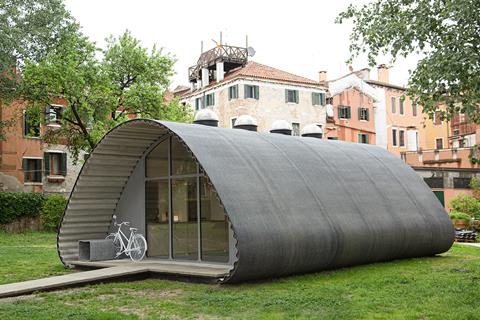
By the end of 2025, almost 120 million people worldwide had been forcibly displaced by conflict or persecution. While emergency shelters are intended to provide short-term accommodation, displacement frequently lasts for years. To help provide housing solutions to such issues, the Norman Foster Foundation and Holcim have worked on a prototype for housing modules for refugees.
The initial concept emerged from a shelters workshop organised by the Norman Foster Foundation. Foster and Holcim then developed the ideas into a full-scale prototype, first unveiled at Venice in 2023. The shelter is constructed from rollable sheets of Concrete Canvas, a concrete-impregnated fabric that can be transported easily before being unrolled and hydrated on site to form a rigid shell. Each living pod, complete with insulated floor and roof, sits on a waterproof membrane, eliminating the need for excavation, while the base is weighted using recycled demolition waste. Pathways between shelters are formed from permeable concrete containing luminescent aggregate, allowing them to glow after dark without the need for electric lighting.
The project is a reminder that innovation in concrete is not confined to reducing carbon. It can also be about creating buildings that are quicker to deploy, use fewer resources and improve living conditions for people in some of the world’s most difficult circumstances.
Lighthouse project #6
Lakeside, Warsaw – recycling insulation into cement
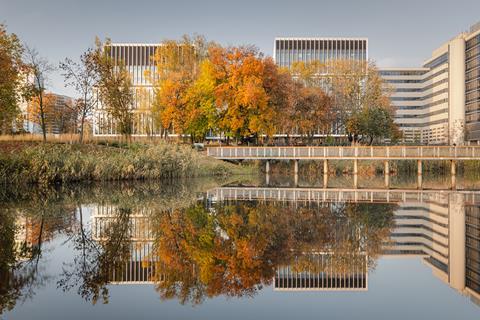
Not every innovation requires a radically different building system. For Atenor’s 22,700m² Lakeside office development in Warsaw, cement was manufactured using recycled mineral wool insulation recovered from demolition waste. Mineral wool has traditionally been difficult to recycle, with much of it ending up in landfill. By incorporating it into cement manufacture, the project demonstrated another way in which construction waste can be returned to the production cycle rather than discarded.
Further steps towards decarbonisation
Demonstrator projects like these may attract the headlines, but Bermejo is clear that many of the biggest sustainability gains will come from less eye-catching improvements applied consistently across the industry.
Some innovations do involve new materials, such as permeable concrete to help prevent flash flooding, light-coloured concrete that helps reduce the urban heat island effect, activated-charcoal concrete capable of filtering pollutants from the air, or prestressed concrete that achieves the same structural performance using less material.
One development with lots of potential is limestone calcined clay cement (LC3). Heating suitable clays to around 700–800°C makes them chemically reactive, allowing them to replace a substantial proportion of clinker – the most carbon-intensive component of cement. Depending on the formulation, LC3 can reduce embodied carbon by as much as 40% compared with ordinary Portland cement. Such clays exist all over the world – just not necessarily near cement works which have historically been built near limestone quarries – so the widespread adoption of calcined clay will require the solving of new logistical challenges.
Bermejo points out that, sometimes, innovation is not about inventing new materials at all, rather about making working practices more sustainable in more mundane but equally important ways. The group has reduced freshwater consumption at some of its plants by partnering with neighbouring industries to use their wastewater. In Mexico, for example, freshwater extraction has been cut by 58%, partly by using wastewater from neighbouring tequila distilleries. Elsewhere, cement kilns have been adapted to burn waste-derived fuels instead of fossil fuels.

Broadening the portfolio
Holcim’s ambitions now extend well beyond developing new types of concrete. Over the past few years, the Swiss-based group has deliberately repositioned itself from being primarily a cement manufacturer to becoming a broader supplier of construction materials and building-envelope products. Alongside investing in lower-carbon cement technologies, it has expanded through a series of acquisitions in green roofing (seen left at the Kaktus Towers in Copenhagen), insulation and other specialist building products.
It has backed that repositioning with some ambitious targets. By 2030 it wants low-carbon cement and concrete to account for more than half of its cement and ready-mix sales. It also aims to recycle more than 20 million tonnes of construction and demolition waste a year, cut Scope 1 CO₂ emissions by 30% against its 2020 baseline, and reduce freshwater withdrawal by a third.
Of course, that emissions goal is measured per tonne of output rather than in absolute terms – meaning total emissions could still rise if production volume grows faster than efficiency gains do.
The future
Many concrete questions still remain to be answered. None of these innovations removes the need to confront cement’s remaining process emissions. Most industry decarbonisation pathways ultimately rely on carbon capture and storage – despite that technology’s high cost, limited commercial deployment in the industry and uncertain public acceptance.
Equally, none of these new materials – some occupied for barely a year, others still being evaluated – yet has a long-term proven track record. They are hopeful techniques and technologies with potential, which collectively could make a significant dent in concrete’s carbon footprint.
That matters because concrete is not going away any time soon. If construction is serious about reducing embodied carbon, making concrete more sustainable is not an optional extra but an essential part of the industry’s future.
Bermejo believes the biggest obstacles are no longer technical. When I ask whether his lighthouse projects are more likely to be held back by engineering challenges or regulation, he doesn’t hesitate. ”Regulatory, every time.” He cites 14 months as a typical approval period for projects using unfamiliar materials. Meeting the demands of risk-averse regulators and insurers may likely prove the biggest challenge of all.
In closing it is worth remembering the scale of the issue. The industry has made genuine progress: according to the GCCA, the carbon intensity of cement production has fallen by around 25% per tonne since 1990 thanks to clinker substitution and cleaner kiln technology. Yet total emissions have continued to climb as global demand for cement has grown, more than doubling since 2000 – because production growth has consistently outpaced the sector’s ability to decarbonise. A handful of lighthouse buildings, however inventive, are not yet evidence that that trajectory has turned. But they offer hope.







No comments yet