





Each year Tunstead quarry and cement works in Derbyshire quarries six million tonnes of limestone and can make up to a million tonnes of cement. When I went to look round the plant I found a team dedicated to decarbonising – but facing economic headwinds, Nimbyism, competition from cheap imports, and regulatory lag
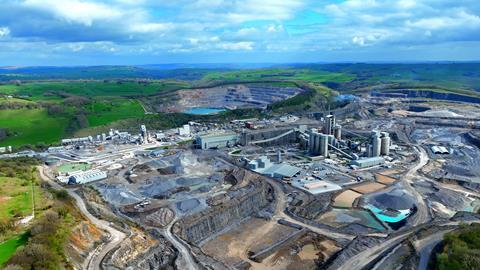
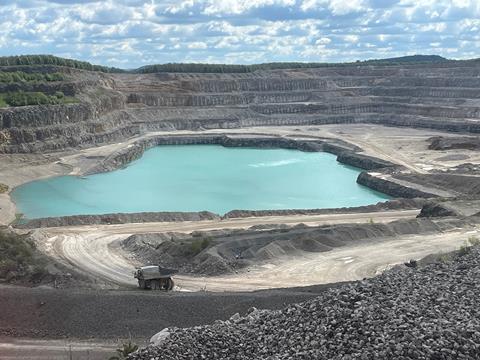
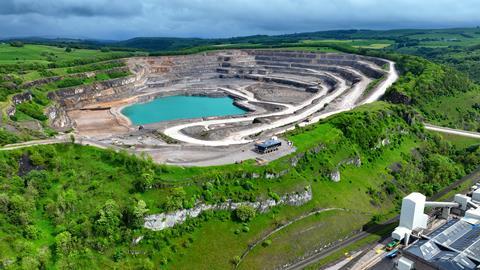
Tunstead is the UK’s largest limestone quarry: 340 hectares; deep enough to bury Salisbury Cathedral; and big enough for the giant dump trucks buzzing around it to look like tiny toys when you stand on the rim of the workings. Yet it is hidden in plain sight.
The quarry and works sit within a fold of the White Peak limestone plateau, three miles from Buxton, and partly inside the Peak District national park. But most of the holidaymakers and day-trippers who pass the site never realise it is there because it is well hidden: operations sunk into the ground, and noise and dust absorbed by the topography and rigorous environmental management.
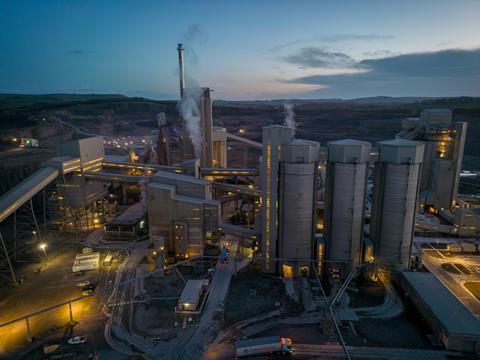
Framed certificates fill the smart plant offices: ISO 14001 (environment), ISO 9001 (quality), ISO 45001 (health and safety), and ISO 50001 (energy). The place feels calm, clean, tidy and well run; they are five years without a lost-time injury. Worked-out areas are returned to nature as calcareous grassland, a rare habitat. A pair of peregrine falcons nest apparently undisturbed by the blasts, and the plant has its own beehives.
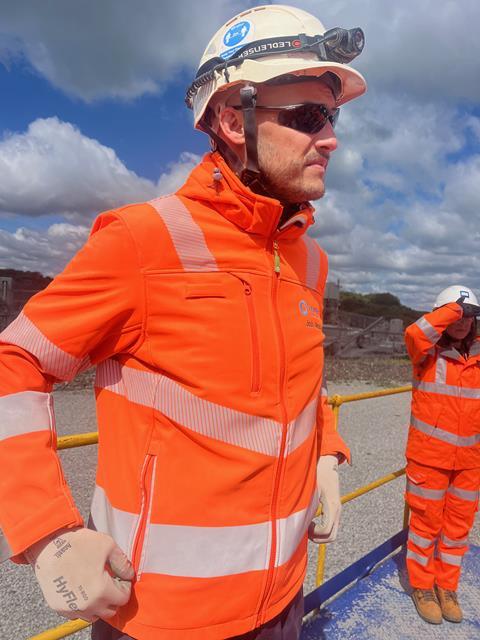
Scale of operations
Tunstead is the UK’s largest supplier of limestone and limestone products. And the cement works on the site makes a significant proportion of Tarmac’s third of the UK bagged cement market. About 300 people are employed; generations of the same families have worked here, and people stay: the current team is aged from 17 to 74, and the average length of service is 15 years.
Tarmac is one of the UK’s largest construction materials businesses, supplying cement, aggregates, asphalt and concrete products across the country. Now owned by Irish building materials giant CRH and operating more than 350 sites nationwide, it traces its roots back more than a century through the legacy of Blue Circle cement and the historic Tarmac businesses.
Decarbonisation at Tunstead is part of a company-wide long-term carbon-cutting strategy that includes alternative kiln fuels, recycled aggregates, lower-carbon concretes and carbon-reduction technologies in cement plants.
Blasting the modern way
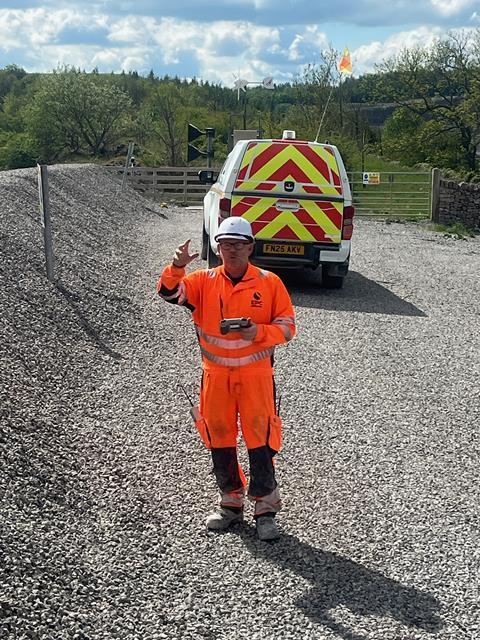
Tunstead actually contains two quarries – two enormous grey scoops in the ground next to each other, one of which also contains the cement works.
Limestone is blasted out of the quarries using emulsion explosives. Josh Mason, senior operations manager, explained, “When that’s in transit, it’s not even explosive at all. Not until it’s actually in the hole. Everyone thinks: sticks of TNT. Big plunger. Gunpowder trails everywhere. Unfortunately not.” Monitored by drone, the explosions happen in series, milliseconds apart. “If it all went off at once, everybody in Derbyshire would ring and say there’s been an earthquake.” The shot I saw displaced around 44,000 tonnes of stone, a relatively modest amount by Tunstead’s standards. It was an impressive sight, but not dramatic enough to alarm anyone.
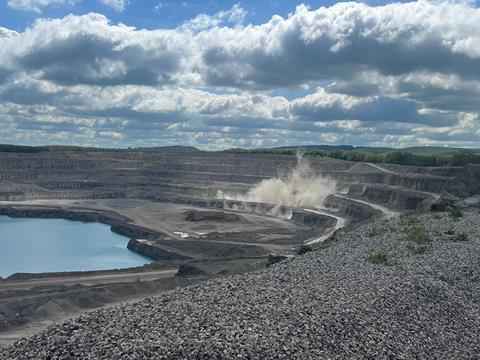
“We try to crush around 140,000 to 150,000 tonnes a week,” Josh added. “If we can do that in a couple of blasts, we’re doing well.” The blasted stone is trucked to a gyratory crusher – a vast pestle-and-mortar device the size of a small house – which reduces it from boulders to a maximum of 280mm, then screens and crushes it further, down to 40mm, 125mm kiln feed or 2mm.
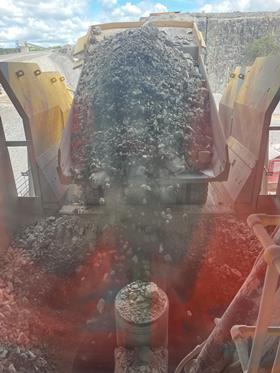
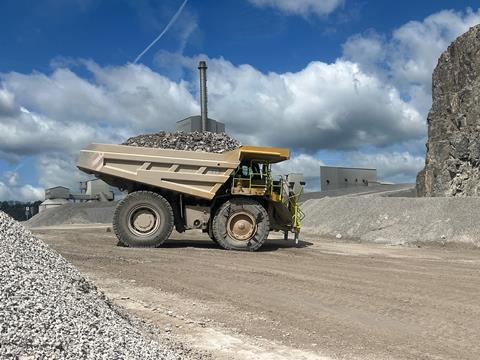
At maximum capacity, 22 giant dumptruck loads an hour rumble down into the crusher’s cavernous dump pocket. The 40mm-minus material goes directly for use in infrastructure jobs. Lately much of it has ended up in HS2.
The works has its own sidings and roughly 70% of everything the site produces leaves by rail. Around 60 trains a week depart, with up to 100 lorry deliveries making up the remainder.
High-tech control room
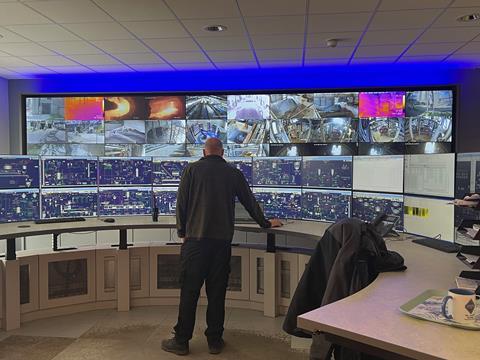
The plant is run from a high-tech control room that looks like mission control, with a floor-to-ceiling wall of screens. On the big display, you can see the kiln flame burning white-orange on a live feed, surrounded by thermal imaging and CCTV of different areas of the plant. In front, engineers lean over dense blue schematics of the entire system, mug of tea in hand, watching the numbers, adjusting the variables, keeping the whole thing in balance.
The clinker problem I
Cement has been manufactured here since 1966, when a wet process plant was set up to make productive use of the limestone and clay slurry generated as the quarry washed limestone for the chemical industry. The current state-of-the-art dry process plant was commissioned in 2004.
Decarbonising concrete is inherently difficult because of the chemistry involved. Clinker – the “active ingredient” that gives cement its binding power – is produced by heating a finely ground mixture of limestone and clay in a rotary kiln at 1,450°C.
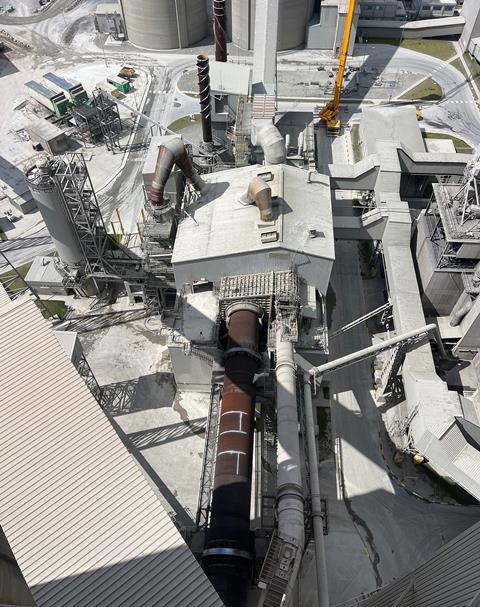
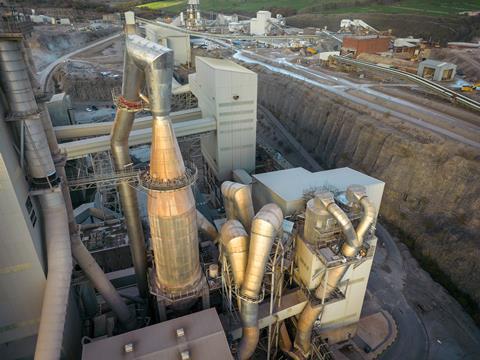
At Tunstead the kiln is a huge rotating metal tube – think: ship’s funnel on its side, slowly spinning – about 10m off the ground, surrounded by all the other pipes and vents of the plant. You can feel the heat coming off it from a distance. The powdered limestone and clay is fed in at one end, and it travels along the tube while being blasted with intense heat from a burner at the other end. By the time it reaches the hot end, the minerals have partially melted and fused together chemically into new compounds. Those compounds cool into small, hard, grey lumps: the clinker. “When the clinker drops out of the kiln,” Ian Smith, production manager, explained, “it’s like a volcanic eruption. It’s a hot melt at that point – a glowing, molten-ish mass – like lava.”
The cooled clinker is ground with gypsum to produce Portland cement. The clinker-making stage is the most energy- and carbon-intensive part of cement manufacture not only because it requires an extremely high temperature but because the chemical decomposition of limestone releases CO₂. The chemistry is unavoidable, the reaction creates CO₂. Roughly 60% of traditional cement’s carbon emissions come from this calcination reaction. So even if the kiln ran on renewable electricity – which it currently cannot – you would still get these process emissions. So this is not an industry that can simply swap energy sources and declare its carbon problem solved.
What Tunstead can do – and has been doing for 20 years – is attack the other 40% of CO₂ emissions, those that come from the fuel used to power the kiln. A programme of fossil fuel displacement began with tyre chips in 2006, followed by meat and bone meal in 2008, solid recovered fuel (SRF) and woodchips in 2011, and tyre fluff in 2016. All of these are still being burnt as lower carbon alternatives to coal and petroleum coke to power the kiln.
Using waste as fuel
SRF is fuel produced from non-recyclable commercial and household waste that is sorted, dried, shredded and pelletised to create a fuel that can be used in high-temperature industrial processes. Cement kilns increasingly use it as a partial replacement for traditional fossil fuels, helping to reduce the amount of waste sent to landfill at the same time as lowering the sector’s reliance on fossil energy sources. The SRF at Tunstead comes from East Yorkshire.
The transition has not been simple. SRF, unlike coal, is inherently variable – the calorific value of one load can differ substantially from the next. “One minute you’re putting ten tonnes in, the next you’re putting 18 tonnes in,” explains Smith. “It’s all over the shop. The quality of heat you got from coal was so consistent. But now we’re living in a different world.” To cope, the plant has had to invest in sophisticated automated control systems that continuously monitor temperature profiles through the kiln tower and adjust fuel feed rates in real time.
Burning SRF in cement kilns requires careful control because chlorine in waste-derived fuels can contribute to operational problems and to the formation of chlorinated pollutants including dioxins and PCDD/Fs. However, chlorine bypass systems, such as the one at Tunstead, help remove chlorine from the kiln-preheater cycle and can cut PCDD/F emissions by half.
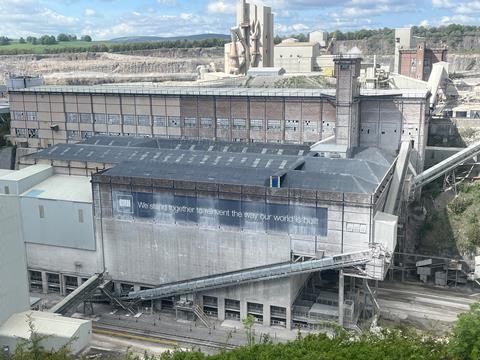
The kiln has two heating stages: the calciner and the main burner (where the clinker-forming temperature is achieved). The calciner now runs almost entirely on around 360 tonnes of SRF a day. The main burner is harder to transition because the flame there needs to be intense and stable, and the chemistry of clinker formation is less forgiving. The plant is currently working with a supplier to develop a higher-quality, drier, more consistent SRF that can be burned in there.
Further decarbonisation is achieved by means of everything from efficiency savings from plant automation to the use of electric vehicles. Achieving a 55% reduction in CO₂ from kiln fuel has taken a great deal of hard work: 20 years of incremental engineering change, innovation, adaptation – and significant investment. But getting beyond that will require a step change.
Peak Cluster – the pipe dream?
Tunstead is part of the proposed Peak Cluster carbon capture and storage (CCS) scheme that promises to be one of the sector’s most ambitious decarbonisation initiatives. Centred on Derbyshire and Staffordshire – which together account for around 40% of UK cement and lime production – the scheme would capture CO₂ emissions from four major plants, including Tunstead, Breedon Group’s Hope plant and Holcim’s Cauldon works, before transporting the gas via a proposed pipeline network for permanent offshore storage beneath the Irish Sea.
Closely tied to the wider Morecambe net zero storage proposal, the project would capture more than three million tonnes of CO₂ annually. Supporters suggest it is critical industrial infrastructure capable of safeguarding domestic cement and lime manufacture; however, the scheme remains at the consultation and development stage and will require major investment, planning approvals and national CO₂ transport and storage infrastructure before it can become operational. It also faces active local opposition. Derbyshire County Council has voted to oppose the pipeline on safety grounds, and there is an organised campaign against it among residents along the proposed route.
The clinker problem II – and the standards gap
The other major decarbonisation lever available to cement producers is to reduce the proportion of clinker in the final cement – the “clinker factor.” Less clinker means less limestone decomposed and less CO₂.
Portland Limestone cement (PLC) is one way to do this. PLC blends a reduced amount of clinker with a higher proportion of finely ground limestone, reducing embodied carbon by roughly 10–15% versus traditional CEM I cement, with no impact on performance. Tarmac has transitioned Tunstead and another of its three UK cement works to produce PLC as standard.
BS EN 197 permits limestone additions of up to 35% in some cement classifications, but higher-limestone cements remain underused in UK practice, held back by specifier habits, cautious procurement, and the practical reality that concrete standards, design codes and professional indemnity frameworks tend to lag behind what the cement standards technically allow. Tarmac is pushing to change that. “It’s the way the market will go eventually,’ says Garry Gregory, packed products director. ”We’re just waiting for it.”
Standards in the sector are slowly shifting in an attempt to keep up with research and evolving good practice. BS 8500, the British standard governing concrete specification, was significantly updated in November 2023 to permit a much wider range of lower-carbon cements – including to allow the replacement of up to 65% Portland cement using two supplementary cementitious materials (SCMs), by-products or natural materials that can partially replace Portland cement in a concrete mix, reducing the amount of clinker needed, depending on the specific SCM combination and exposure conditions of the structure.
Traditionally, the cement industry has reduced its reliance on carbon-intensive clinker by substituting in fly ash from coal-fired power stations and ground granulated blast furnace slag (GGBS) from steelmaking. However, as both coal generation and steel production are in decline, both materials are becoming scarcer. Attention is turning to calcined clays – particularly in combination with limestone fines to make LC3 cement – which can replace up to half of the clinker, offering a more reliable and scalable low-carbon alternative.
Work is also underway on a BSI performance-based specification framework for concrete, which would allow concretes to be assessed against measurable outcomes – strength, durability, resistance to carbonation etc – rather than simply prescribing compositions. This new approach has the potential to unlock the use of newer formulations and ingredients that don’t yet fit neatly into existing standard formulations.
Standards move reactively and incrementally. Each new low-carbon formulation – higher limestone blends, calcined clay additives, or novel binder chemistries – must pass through years of research, testing and standards revision before it can be specified on a mainstream project. The result can be a significant gap between what the industry can manufacture and what engineers, contractors and procurement teams are professionally and legally permitted to specify. In the absence of formal standards approval, the liability for any non-standard mix that fails falls on the specifier – which creates a powerful professional incentive to default to conventional formulations regardless of the carbon cost.
The price of imported concrete
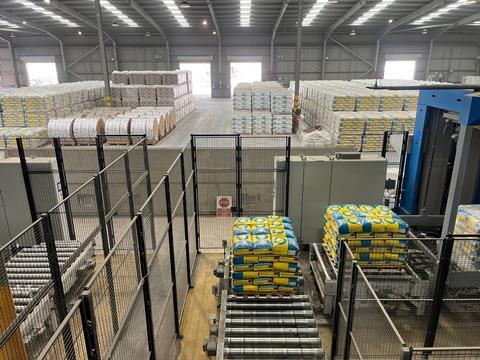
At the same time, sites like Tunstead are facing commercial pressure from cheaper imported cement. Imports now account for almost a third of all UK cement sales – up from just 12% in 2008 – with around 3.6 million tonnes of foreign cement entering UK ports in 2024. UK domestic production, meanwhile, fell to a 75-year low in 2024, at 7.3 million tonnes, roughly half the volume the country produced in 1990.
The Mineral Products Association (MPA) meanwhile claims cement is the UK industry most exposed to carbon leakage – the offshoring of emissions to countries operating under weaker climate regulations. Cement for UK construction is increasingly being sourced from outside the EU, from places like Turkey and north Africa. Industry debates remain over the carbon intensity of imported clinker, including significant differences between overseas producer-reported emissions and the default emissions factors used within carbon border adjustment mechanism (CBAM) methodologies.
CBAM is the tariff-like system that adds a carbon tax onto imports of certain goods, based on the emissions embedded in producing them. The EU’s CBAM system formally began at the start of 2026, though importers won’t actually have to purchase certificates covering embedded emissions until February 2027.
A UK CBAM is expected to be introduced in 2027. Under this, importers of cement and other carbon-intensive goods will be required to pay a charge reflecting the carbon cost of production in the country of origin, equivalent to what UK producers would have paid under the UK emissions trading scheme. At Tunstead they are counting on this to level the playing field.
Why we still need concrete
All of this matters because, however much we embrace timber and other renewables and minimise the use of concrete, for here and for now, construction still needs it. Piles, ground beams, slabs, sewers, tunnels, basements, retaining walls, lift shafts and culverts all still depend on its combination of mouldability, compressive strength, impermeability and durability in wet and chemically aggressive ground. And, for many of these uses, there are not yet like-for-like alternatives available at the scale, cost and performance profiles required.
And then there’s the infrastructure: Sizewell C alone will likely require 750,000 tonnes of cement; a new hospital, perhaps 8,000 tonnes. The grid reinforcement, flood defences, road and rail upgrades that the growth agenda requires: all depend on a lot of concrete.
Keeping our hands clean
The fact that Tunstead is so well hidden reflects well on the site’s working practices, but it also feels very apt. In the UK we seem to like our heavy industry out of sight, out of mind – and probably out of the country (so there’s no need to count the carbon).
“Extractive” is (appropriately) a dirty word these days. But, for me, there seems to be something spoilt and overly fastidious about the middle-class recoil from the realities of extracting and manufacturing the materials we need to live our comfortable contemporary lives. It puts me in mind of Martin Wiener’s English Culture and the Decline of the Industrial Spirit, one of Thatcher’s favourite reads, which argued that Britain never forgave itself for inventing the industrial revolution – and that, from the moment the first mill owners sent their sons to public school to learn how to ape country squires, we began a long, repulsed retreat from the very things that had made us successful.
Carbon-intensive and extractive industries are unfashionable – even the ones making extensive efforts to decarbonise. I can’t help but feel that the need to demonise them is just another iteration of the long-standing British elite’s disdain for industry. Of course, we need to reduce carbon, but for the foreseeable we also need concrete – not to mentaion successful industry that can pay taxes and employ people like the team at Tunstead. Plants like Tunstead don’t deserve to be a dirty secret. They are making something we need – and putting in the hard yards to do it in a sustainable way – whether we like to acknowledge that fact or not.







No comments yet