





Ways to scale the use of UK hardwood in construction were unpacked at a V&A museum symposium that tackled the question: what if our built environment was shaped by local, climate-resilient, mixed-species forest? The audience heard about projects across the country that are facilitating the use of homegrown timber – and about the challenges that remain to wider adoption of hardwood
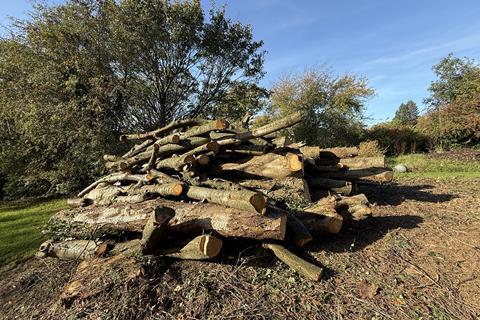
Some of the most urgent work being done to facilitate the wider take-up of timber is being undertaken by researcher Marlene Cramer of Edinburgh Napier University. Cramer started her talk at the event on March 11 by pointing out that currently 85% of hardwood harvested in the UK is burned for energy production.
Testing timber’s structural properties
She is determined to change that figure by researching the structural properties of homegrown hardwood species with a view to assigning reliable strength classes. The data she is collecting is one vital element of the information required before architects can begin to work more widely with UK hardwood.
Building on early 20th century research into the structural properties of timber and on John Laver’s 1983 book The Strength Properties of Timber, Cramer is testing all kinds of British timber to record its strength.
She explained, “Lots of the existing data is 100 years old, which is a bit of a problem, because timber properties are not something static. They change depending on what happens in the tree’s life. So they change if a forest changes.” Timber properties also change if the climate changes. So structural properties recorded 100 years ago might not be the same as those of timber now. Existing data is also insufficient for many of the species, having come from just a handful of trees.
Cramer continued, “You need to harvest lots of trees from lots of different locations because, again, the properties vary depending on where you get the trees. And, importantly, the test standards since 1929 have changed. Nowadays, we need to test specimens that are of a size used in typical buildings today.”
Cramer is working away slowly compiling data about the mechanical properties of different species. It is a huge job. There can be a great deal of variation even between pieces of timber of the same species, which means you need to test a lot of wood – thousands of pieces, in fact.
For many UK-grown hardwoods – and even some softwoods – there is still limited standardised test data to assign reliable strength classes. As a result, these timbers are often unable to be graded for structural use under current standards, which restricts their use in loadbearing applications. Cramer is committed to carry on testing to slowly collate the body of test data required.
Edinburgh Napier University has been a leading academic centres for timber engineering and off-site construction research since the 1990s. Through industry partnerships, applied research and training programmes, Napier has helped develop design guidance, testing methods and skills programmes for the UK timber construction sector, and its researchers have played an important role in initiatives such as the Centre for Advanced Timber Technology at the New Model Institute for Technology and Engineering in Hereford.
Studio Weave’s successful use of salvaged wood
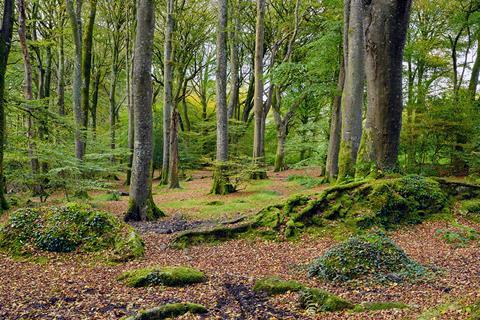
The topic of using felled timber was also explored. Je Ahn, founding director of Studio Weave, spoke as a designer who has successfully incorporated salvaged timber into projects. He talked about the practice’s Lea Bridge Library Pavilion (2022) and its mycelium pavilion – made from ash dieback casualties – that won Best Construction (Show Garden) at the 2025 Chelsea Flower Show as part of the Avanade Intelligent Garden. (Both projects were undertaken in collaboration with furniture designer Sebastian Cox.)
Ahn highlighted the importance of managing client expectations when working with non-standard reclaimed materials. He recalled that the timber for the library pavillion’s internal joinery and wooden furniture – which came from trees of different species that had needed to be felled in various public spaces across London – came in a variety of shades, which meant the finished results are not a uniform colour.
He reflected too that the client also wanted to know if the timber was FSC certified – which, as a collection of trees salvaged from parks, it evidently wasn’t.
The conclusion must be: client education and flexible procurement and specification requirements are both crucial when using non-standard reused and salvaged materials.
Expanding on the theme he continued, “When you translate reuse into professional practice, it is actually quite complicated – certifications, chain of custody, insurance: all of these are completely stacked against it. Stone is relatively easy because the properties are easy to verify. Timber, it gets slightly trickier. A lot of elements we find, unless they are understood historically, we are not really able to reuse them because our professional indemnity will say, ‘You don’t have the knowledge to reuse that material.’ The risks are real – I am not saying they are not important. But unless we are able to create some kind of sandbox where designers can experiment, we won’t be able to find these new ways of working.”
He also pointed out that cost remains a critical barrier to material reuse too, stating, “Every time you try to reuse a material, the premium is a minimum of 50%. Because it requires labour to bring it down, labour to transport it, labour to process it. So at the moment, by default, it’s a kind of luxury.”
Built Environment – Smarter Transformation
Louise Rogers, from another Scottish institution BE-ST, the Scottish built-environment innovation centre, talked about the work being done there to facilitate building with UK-grown mass timber. She accepted that the common perception of homegrown timber is that it is “wet, wavy and weak” – fit only for pallets and fencing, but said that the kind of work taking place at the Hamilton centre was demonstrating the huge potential of UK wood in mass timber products. The centre is a mass timber centre of excellence with CLT manufacturing capability, and undertakes acoustic, thermal, fire performance and structural testing of mass timber products.
Other speakers included Jonathan Smales of Human Nature, who talked about the Phoenix development in Lewes, which aims to be the biggest timber development in the country.
Postscript
The Make Good symposium expanded on the themes explored in dRMM’s Building from Forests exhibition at the V&A, an installation that explores the role that British hardwoods could play in shaping the future of architecture and design. The free display runs until 30 October 2026.




No comments yet