







Bringing together designers, makers, councils and communities, Tipping Point East aims to make circular construction practical, affordable and socially useful
When it comes to building sustainability, two barriers frequently crop up: the perception that greener choices carry additional cost and inconvenience, and the absence of formal infrastructure that would make adopting them straightforward. The Tipping Point East facility in east London is striving to tackle both – providing a formalised system for disposing of and reusing waste, and making it affordable and accessible to do so.
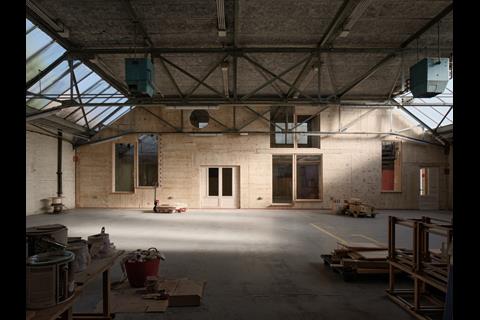
“We’re trying to change how the construction industry operates at scale,” says Talia Berriman, head of green economy at the local authority, Newham borough council. Located on an industrial site in the Royal Docks – an area undergoing rapid regeneration but that remains among the most economically deprived in the country – it describes itself as the UK’s first circular construction hub, and aims to be Europe’s largest when fully operational.
Closing the loop in Newham
Its origins are partly serendipitous. The three design practices behind it – Yes Make, Material Cultures and Resolve Collective – were looking for new studio space at around the same time, and saw an opportunity to combine their complementary skills and overlapping interests. But it was also a direct response to a pressing need.
“We have a target of building 45,000 homes over a 10-year period in Newham, as well as a lot of retrofit projects that need to happen – all of which require raw materials,” says Berriman. “Meanwhile, half the waste produced in the borough comes from construction, and most of it is sent to landfill.” In 2022, Newham council commissioned Material Cultures and engineer Arup to carry out a feasibility study for a project that would close that loop: reducing waste and carbon emissions, while bringing investment and jobs to the area.

From online exchange to physical hub
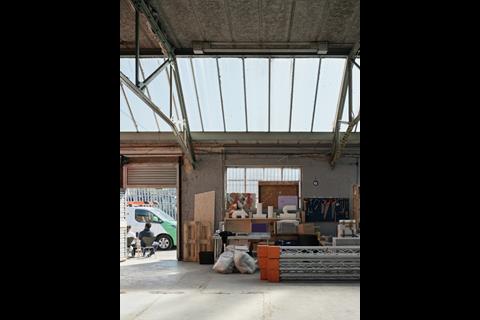
The concept was first piloted as a year-long digital project, “a kind of eBay marketplace for construction materials”, says Berriman. It took its current physical form after securing a £150,000 grant from Innovate UK and a parcel of land on a five-year lease from the Greater London Authority – the mayor’s office sees the project as part of its ambitions to make the capital net zero carbon by 2030 and to build 36,000 homes and create 55,000 jobs in the area surrounding the site.
“The idea from the start was that this would be a climate future centre, focusing on bio-circularity and, ultimately, architectural interventions that demonstrate how you can deliver really great design solutions with that approach,” says Material Cultures co-founder George Massoud. The design and research practice, whose recent projects include the rejuvenation of a community food-growing and enterprise hub in north London, describes its mission as working towards a bio-regional construction industry that is integrated into regenerative and socially just land and building systems.
The success of this is really important, because it needs to show how this key piece of infrastructure can change the way that we build
George Massoud, Material Cultures
On the face of it, the model is straightforward. Tipping Point East (TPE) collects and stores waste from construction projects and from deinstallations at cultural institutions such as museums, then redistributes it to individuals, community projects and construction schemes. The practicalities are more complex: it operates as a charity, with a mixed funding model drawing on grants and philanthropy, alongside service delivery for private clients and smaller revenue streams such as site tours – all of which provides limited long-term security for a project the team sees is much needed. “The success of this is really important, because it needs to show how this key piece of infrastructure can change the way that we build,” says Massoud.
Designing from the stockpile
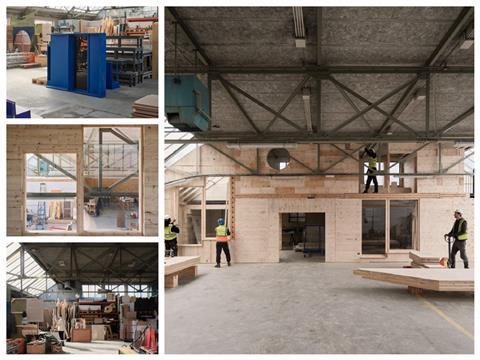
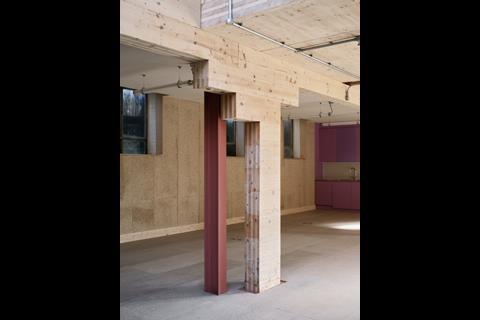
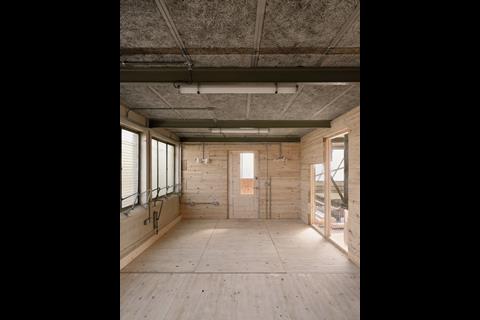
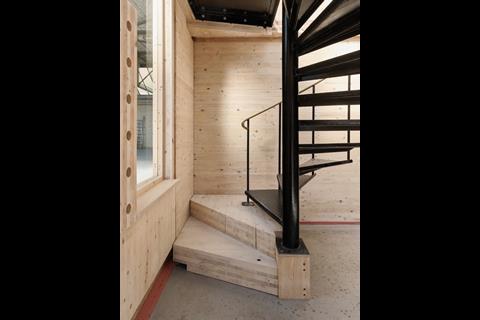
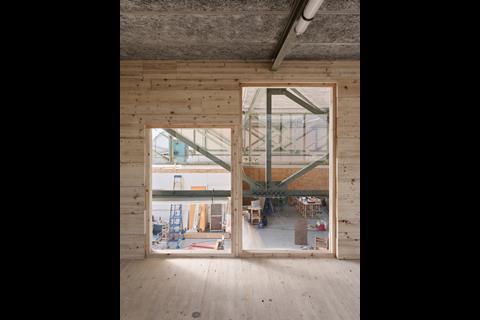
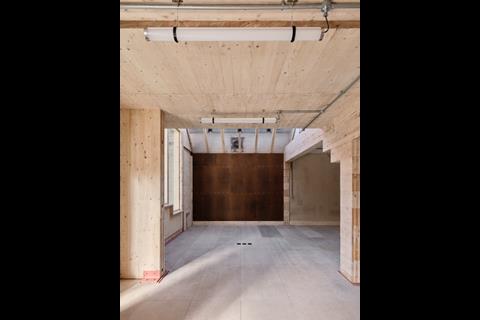
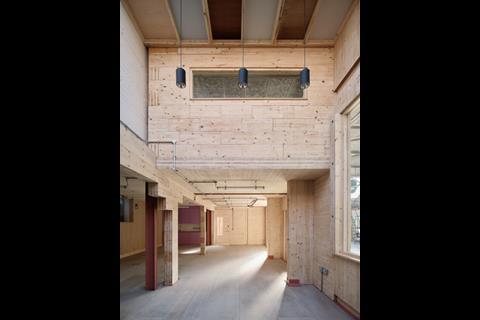
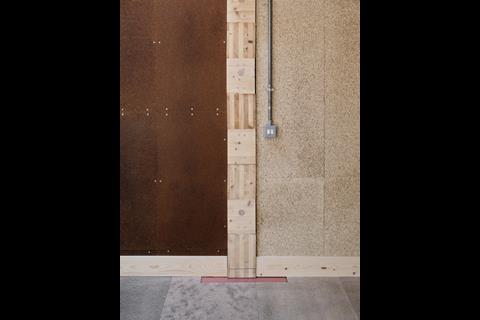
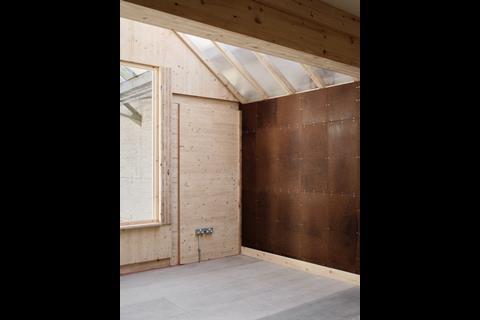
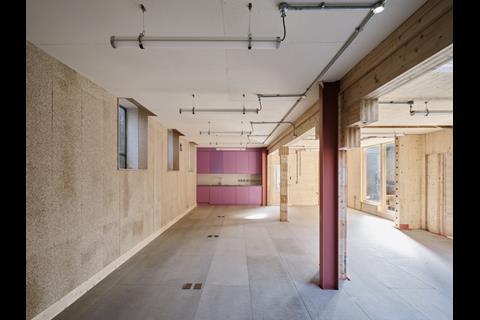
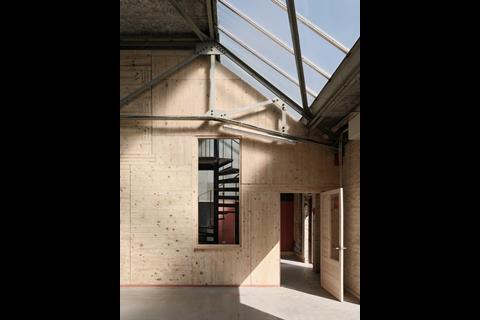
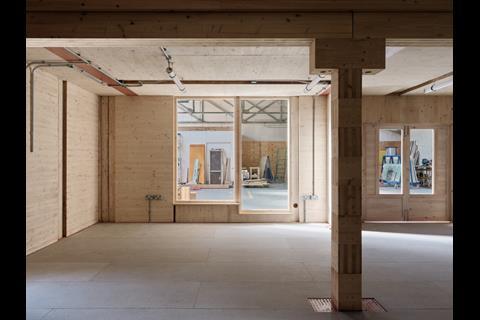
That ambition begins with the project itself. Material Cultures designed the offices on site by reimagining the process around what was already available. “We had loads of CLT, so we made it one of the main materials,” Massoud says. “Working this way, you have to be flexible, responsive and reactive, and develop a material strategy quite early on. It’s also a non-linear process, with a lot of back and forth, which could make it inefficient at times, but also leads to a lot of surprises and a more playful outcome.”
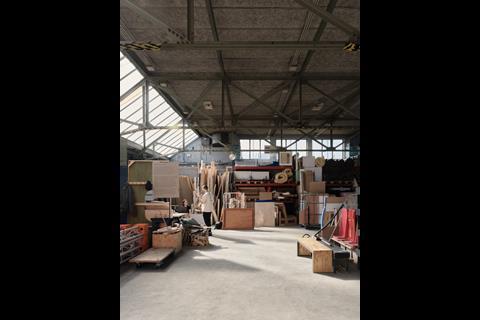
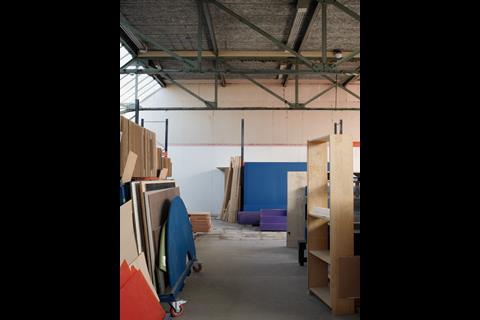
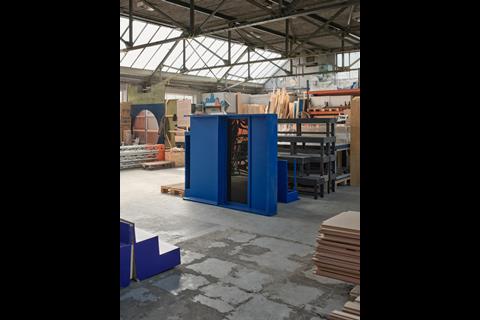
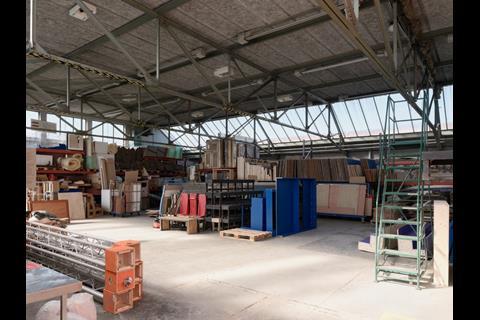
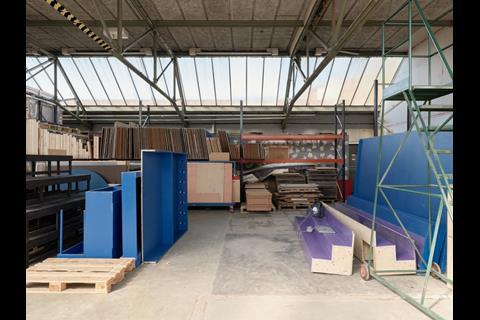
TPE supports people to adopt a similar approach by providing space for materials to be stored and processed, a browsable salvage library, and the design, making and building skills of three teams. Skills sharing is also vital – they run training courses for people to work with reclaimed materials, as well as with natural ones such as earth, hempcrete and timber. “If we are to design and make things differently, we need to learn how to do it,” Massoud says.
From opportunistic salvage to serious infrastructure
Initially, the operation was largely reactive. “People would send me a photo and say, ‘we’ve got this, could you use it?’ – and we’d jump on it in a heartbeat,” says Joel De Mowbray of Yes Make, a regenerative design and build practice that focuses on using reclaimed materials to create public space in collaboration with local people – a process that evolved to form the basis of TPE, as De Mowbray was increasingly invited to take waste from construction sites.
As the scale of project grew, a more formalised structure became necessary. “Now, when a project is at its earliest stages, we develop a material recovery plan – an audit of the available materials and how you go about getting them out of the building and onto a vehicle.” That has made it easier to bring materials to site, particularly from larger developments.
The compliance regime around larger buildings means they can supply us with a ridiculous abundance of materials, but they don’t have the ability to apply those to their own projects
Joel De Mowbray, Yes Make
Sending materials back out for use is more complex. “The compliance regime around larger buildings means they can supply us with a ridiculous abundance of materials, but they don’t have the ability to apply those to their own projects,” De Mowbray says. The organisation is working on providing certification and warranties to meet the regulatory standards, so that it can come in routinely as a technical specialist consultant for architecture projects at RIBA stages 2 and 3.
The opportunity is there for the taking: De Mowbray says TPE has been offered an entire 11-storey building containing materials equivalent to around 60 three-bedroom homes, and the organisation is currently finalising an expansion of the site to accommodate acquisitions of this size. In the meantime, it is focused on supplying smaller projects – among them a sports facility in Southwark by Cullinan Studio and Bankside Open Spaces Trust, which needed to reduce costs through a smarter approach to materials.
Opening the material library
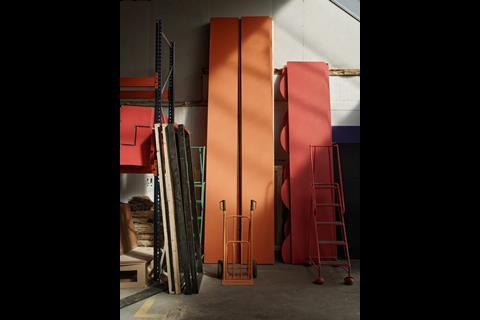
Over the summer, TPE will launch an online tool allowing users to browse available materials – a practical step towards making the model more accessible and scalable. This material library contains plinths, vitrines and other items previously used by the likes of V&A, the Design Museum, the National Maritime Museum, Christie’s and Hauser & Wirth – pieces that larger institutions tend to build from scratch for each exhibition, but that smaller organisations tend to be less fussy about.
The idea is to make such materials available not just to the construction sector but to everyone, via a membership platform. Users range from early-stage creative practitioners to local social and cultural projects such as youth centres, libraries and local archives, with an approach that reflects the practicalities of such contexts and needs.
The process of redistributing materials is one that Resolve Collective, the third practice behind TPE, already had experience of, having tested it in multiple contexts – including exhibitions at the Barbican and Tate Liverpool – working with excess and discarded materials from cultural institutions and developing models for putting them into the hands of community organisations.
“We’re not interested in a material’s so-called ‘market’ or ‘resale value’, but in distributing it to places and people with limited resources, which itself becomes a community-building exercise,” says Seth Scafe-Smith, co-founder of Resolve, an interdisciplinary design collective that combines architecture, engineering, technology and art to address social challenges.
Circularity with a social purpose
The social justice dimension is not incidental. Scafe-Smith points to the precarious condition of much social infrastructure in the UK, and the compounding effect of material scarcity on its ability to function and bring people together. “A lot of those people in inner-city neighbourhoods live in quite dense and highly polluted areas, and then also places that are proximate to incineration plants and waste management sites. Our ambition is always to face the entanglements that create these injustices,” he says.
“Vulnerable and disadvantaged communities are more likely to experience the impact of climate change – for example, extreme heat – even though they have contributed to it less,” Berriman adds. “Our aim is for the transition to net zero to be fair and equitable: to make sure people are not worse off and that the impacts of the climate crisis are distributed evenly.” The ambition is for local communities to benefit not only from jobs but from direct access to materials.
Making the economics work
For all the moral force of that argument, De Mowbray is clear that for the professional construction sector to adapt, the incentive has to be commercial. “Economics is the strongest lever if we want to create rapid change,” he says. The idea is to deliver a service that undercuts the cost of waste disposal and incineration, while covering TPE’s own costs. TPE estimates that, over the next five years, it could divert around 950 tonnes of material from landfill.
The supply chain, Berriman notes, is starting to respond: having spent two years in conversation with developers and contractors, they are seeing growing uptake, from smaller projects initially and, increasingly, from larger developers. “When developers say to us ‘we can’t find any reclaimed timber’, we can point them to Tipping Point East,” she says.
From a regulatory standpoint, the council’s new draft local plan stops short of mandating the use of reused materials. “But the carbon targets are quite ambitious, and often that’s the only cost-effective way to get there – new materials with low carbon are still quite expensive. Reclaimed materials are cost-equivalent, if not slightly cheaper,” says Berriman.
What it would take to scale
The scale of operation required to make this the norm is significant. “We probably need about nine initiatives of this size across London to meet the demand for materials,” Berriman says. Stretched local authority budgets make that a difficult ask – but the team believes projects like this generate lessons that can be applied elsewhere more quickly: to additional sites run by other local authorities, or a new Tipping Point site if it needs to relocate when its lease ends.
What’s also required across the industry is a mindset shift. “You can design more sustainable and longer-lasting buildings with these methodologies, and make savings over time, but there needs to be an honest conversation about longevity in costing and planning,” says Scafe-Smith. “We need to be comfortable with the idea that circularity is not an immediate cheap fix – it’s an investment.”
Postscript
Images credited to Henry Woide







No comments yet