

DaeWha Kang has reworked a Zaha Hadid Architects’ research library in Riyadh – that he helped design a decade ago – into a museum about humanity’s most consequential material. He talks to us about returning to your own building, working with Hadid, and why adaptive reuse may be the defining architectural discipline of our age
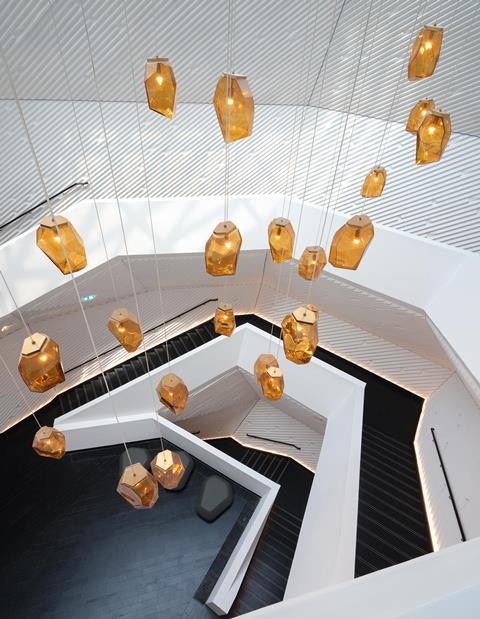
Despite its name and location, the Black Gold Museum in Riyadh by London-based DaeWha Kang Design, is not a straightforward celebration of our relationship with oil – but nor is it a denunciation of it. It is something more interesting. More gallery than museum, this is a building designed to hold space for serious consideration of humanity’s relationship with petrochemicals; their life-changing potential; their impact on the environment – and their uncertain role going forward.
It would be easy to dismiss or overlook this project on ideological grounds, because it engages with a “problematic’ subject. But that would be foolish. The project deserves to be taken seriously, because it is wrestling constructively with an epoch-defining issue – and doing so through adaptive reuse, which has every claim to be the defining architectural discipline of our age.
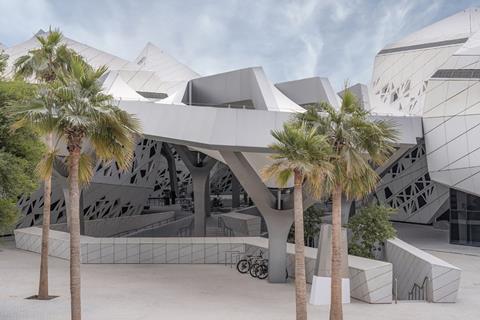
Given that the question of humanity’s use of fossil fuels is perhaps the issue of our times, that remit alone would make this a significant project. But there are many more layers of interest here. The museum is an adaptive reuse of a 2017 research library by Zaha Hadid Architects (ZHA), one of five crystalline-form interlinked buildings designed for the campus of the King Abdullah Petroleum Studies and Research Centre (KAPSARC) – a scheme where Kang was design director. Talking to him was a chance to explore questions about what it was like to work with Hadid; about how such buildings respond to repurposing; and about how it feels to return to rework a significant building like this a decade after first working on it…
From research to reflection
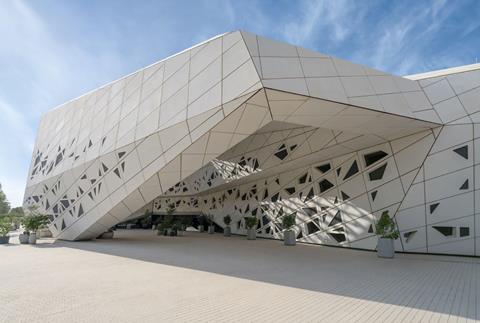
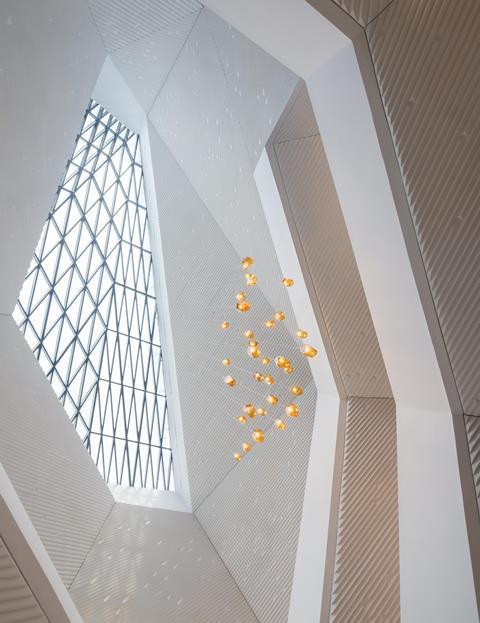
KAPSARC is a flagship Saudi energy research centre dedicated to understanding how oil and wider energy systems shape economies and societies. Its 70,000m² campus lies on the outskirts of Riyadh. ZHA created a cellular honeycomb of interlocking hexagonal volumes emerging from the desert floor. Why hexagons? Well, they tessellate, but they are also the molecular shape of sand (silica crystals are hexagonal) and of oil (hydrocarbon molecules are built around hexagonal carbon rings).
The building was the practice’s first LEED Platinum-certified project – the one that proved that parametric and sustainable could be compatible. A climate-guided plan has the buildings turn their backs to the sun in the south and open to the north and west to draw in prevailing winds, enabling an almost 50% reduction in energy demand.
However, thanks to the digitalisation of scholarship, the research library itself was redundant almost as soon as it was finished; its planned 350,000-book collection rendered pretty much obsolete by technology.
Saudi’s cultural pivot
The solution was to repurpose it as part of Saudi’s Vision 2030 pivot towards tourism and culture – the same impetus that lies behind the huge pipeline of cultural and tourism-led developments: AlUla, the Diriyah Gate, the Royal Arts Complex, King Salman Park, Qiddiya, NEOM, the Red Sea Project, Amaala, Rua Al Madinah… Although some of these have been scaled back of late, the ambition remains to put in place the infrastructure to underpin a non-oil-funded economy before the oil money runs out.
Minimal interventions
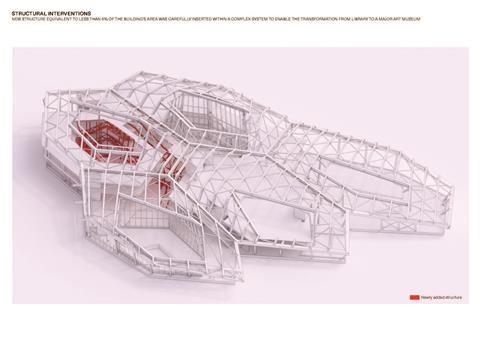
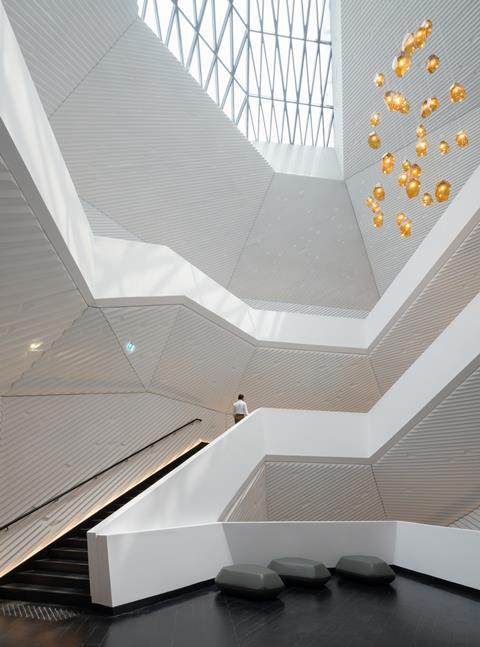
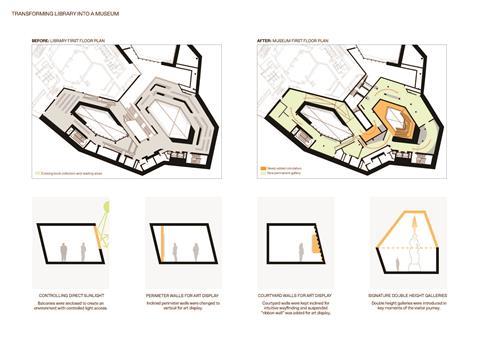
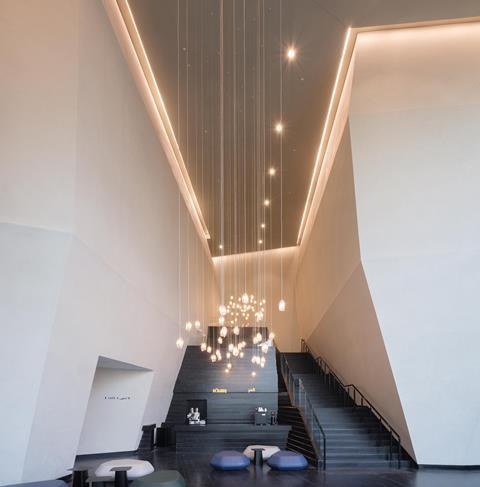
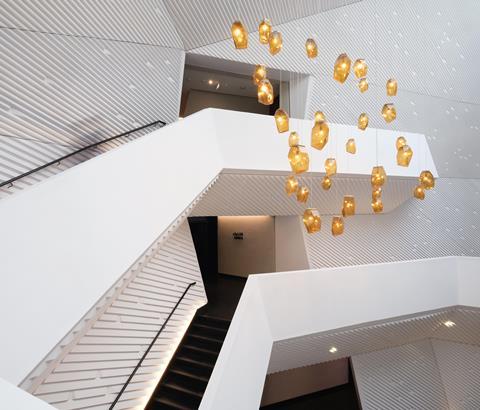
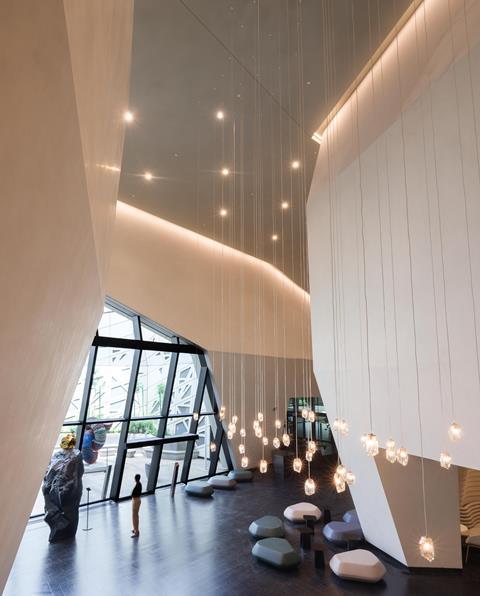
Of the building’s 6,800 m2, only around 440 m² – just 6% – is new. There are obvious challenges in such a repurposing: the requirements of a library are very different from those of a gallery. The solution, developed by Kang and his long-time collaborator, practice associate director Michal Wojtkiewicz, is a new atrium and dramatic central staircase. Visitors arrive into a central orientation space before ascending the new main staircase to visit the four themed galleries in turn, then descend a second new staircase to exit: a clear, choreographed route.
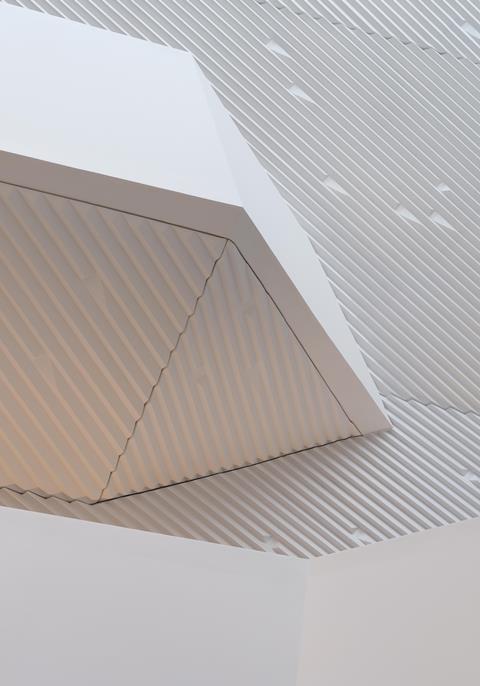
The new main staircase offers the kind of dramatic circulation space that we have come to expect in our art institutions. The treatment feels geological with polished plaster and a ribbed texture with a stochastic pattern of “chips” breaking up the surfaces.
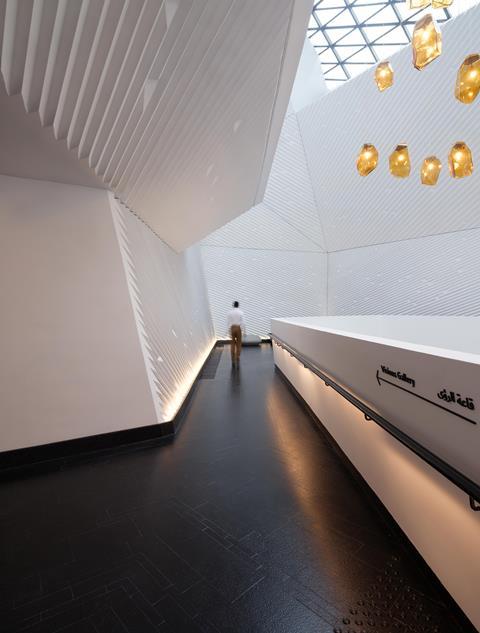
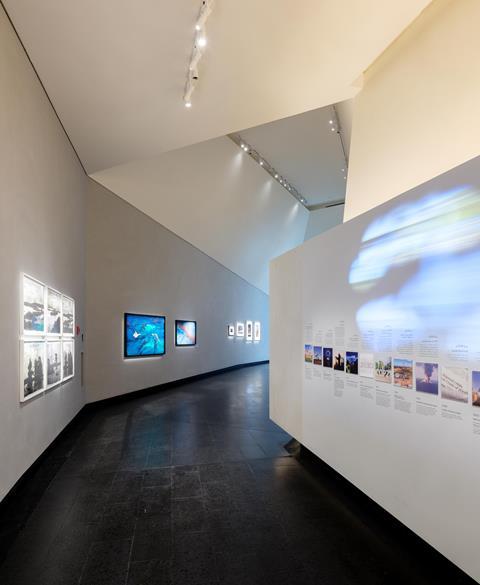
The lack of a clear circulation route wasn’t the only problem they encountered in their change of use. Many of the original internal walls were angled to create hexagonal forms – a particular challenge if you want to hang art works. To deal with this, they boxed in some sections of wall to straighten them, and introduced what they termed “ribbon walls” a section of vertical surface on otherwise angled walls.
Four acts of oil
The new institution was established as a partnership between the Ministry of Culture’s Museums Commission and KAPSARC, and supported by the Quality of Life Program. The reworked building now accommodates 14 gallery spaces, advanced climate control systems and back-of-house art-handling facilites. The museum’s structure, devised by Christian Janicot, working with exhibition designers Agence NC, divides the space – and the large permanent collection of 350 works by over 170 international artists – into four stages: Encounter, Dreams, Doubts and Visions, which trace the story of humanity’s relationship with oil from discovery to future speculation.
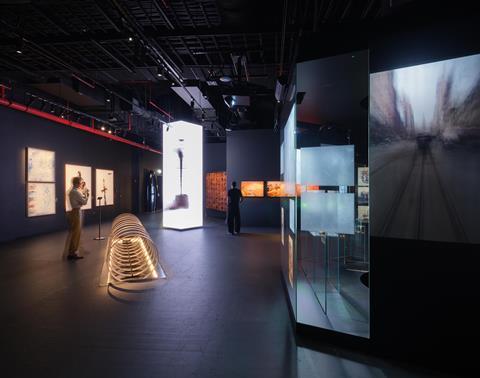
The roster ranges from Saudi figures – Manal AlDowayan, Ahmed Mater, Muhannad Shono, Mohammad Alfaraj, Ayman Zedani – to international names including Christo, Doug Aitken, Alfredo Jaar, Jimmie Durham and Dennis Hopper.
The first gallery, Encounter, explores the story of the early discovery of oil – and its material properties. Kang explains, “Eduardo Basualdo has black fluid coming up out of the floor and bubbling around everywhere. And we have artworks where crude oil is part of the medium.”
Dreams celebrates the 20th century’s naïve love affair with oil and the benefits derived from it: plastics, abundance, high speed travel, energy, the optimism of modernity. The Doubts gallery shifts into critique, exploring environmental degradation, consumerism and dependency; while Visions looks forward with questions – about energy, the environment, the future of civilisation – and what oil’s role will be.
Beyond villain and hero
Oil is framed as neither villain or hero, but as a force that has shaped – and continues to shape – human life in complex and often contradictory ways. It is the nuance and complexity of this framing that is precisely what interests Kang. He wanted to create “a space where we can ask those questions and contemplate” because “that’s what we need right now – rather than a lot of people just shouting at each other on social media. Everything digital is pushing us towards shorter, louder statements. Architecture is the opposite. It’s a space where you can’t just reduce things to slogans.”
The current crisis in the Middle East is a reminder that many of the systems we rely on still depend on oil: fertilisers, pharmaceuticals, plastics, synthetic fibres, fuel for transport. That dependence – and the cheap, abundant energy that has underpinned two centuries of human progress – sits uneasily alongside the environmental costs the world now has to address, which is why the transition is proving so difficult.
“All the difficult decisions we have to make about flourishing as a planet and flourishing as a species are entangled and they’re highly complex. For me the function of a museum is to cultivate a state of mind and a spatial environment where people can think deeply about topics,” reflects Kang.
Coming to work for Hadid
Kang himself is a committed environmentalist. He co-founded the charity Climate Change All Change which links designers with school children to help them come up with designs to beat climate change.
Born in South Korea he studied at Yale and then Harvard, where Hadid taught him as a visiting professor. He recalls, “She just kind of assumed I would take a job with her… I came to London for a bunch of interviews at lots of other offices. And I told her I’d come and say ‘Hello’, and she said, ‘OK, where are you going to sit?’ The rest is history.
“My main interest growing up in nature in Oregon was sustainability and the environment. I thought I’d stay over here for a couple of years – learn how to do pretty things – then go back to America and focus on sustainable design. If anyone asked me how long I was staying in London. I’d tell them I had a two-year mobile contract that I didn’t anticipate renewing.
“But I fell in love with London, and Zaha really knew how to get people excited about work and projects. I found myself very quickly leading projects. Then a competition came in for this energy research centre in Saudi Arabia…” Initially it wasn’t assigned to Kang, but he fought for the project because of his passion for sustainable design. “It was the only time I ever imposed on Zaha, but I really wanted it. They wanted a LEED Platinum building and that was something I really wanted to do…
Hadid’s way of working
“Zaha had a very studio mentality. Her main method of working was to just say ‘No’ to everything until she saw something she liked. So, it was always really welcome for people to propose things. I said, ‘Let’s just do it this way – take inspiration from nature.’”
They won the competition. And then they had to build it. Kang recollects, “We hadn’t built anything of that scale – it was a $1 billion project, 600,000ft2. At that point, I had about two and a half years’ experience, maybe three. Everybody was saying, ‘Can he really run this?’ But Jim Heverin said, ‘Everybody has to start somewhere.’”
So Kang found himself design director for the huge scheme. Needing to find extra team members fast he asked colleague Monika Bilska if she could recommend anyone. Monika suggested Michal and the three have been working together on and off ever since.
Kang recalls, “It was chaotic – you can say that. We won the competition in 2009 and they wanted it built by the end of 2011. So, we were designing it as they built it: as they were building the foundations, we were designing the top of the building. We just tried to be as honest as we could about where we were. We worked as hard as possible, and tried to show through our sincerity that we were going as fast as was humanly possible.” The building finally opened in 2017 and “there was no acrimony about that”.
Gulf starchitecture tradition
Kang points out the Hadid project was part of a long history of commissioning ambitious buildings in the Gulf states. For decades, oil wealth has been translated into starchitecture as a way to project modernity, ambition and global relevance: the Burj Khalifa, Jean Nouvel’s Louvre Abu Dhabi and National Museum of Qatar… “Even in the 70s, 80s, 90s they were commissioning people like Kenzo Tange and Frei Otto. So there was a great deal of sophistication in thinking and philosophy client side. People I have met out there have always been excellent people to work with. They have resource, but they are also thoughtful people who care.”
Kang draws parallels with his home country South Korea’s rapid transformation in the late 20th century, “I felt a strong affinity with it – it’s about compressing centuries of development into a very short time.”
After a decade Kang left ZHA to set up on his own with a practice focused on sustainable design. His first independent project was an adaptive reuse scheme in Korea, converting a car park into offices, which won a national award for reuse. There are several excellent reuse projects in the firm’s portfolio, and it has become something of a specialism – both a pragmatic and philosophical position. “We always ask the question: can we adapt something first?
Adaptive reuse as a philosophy
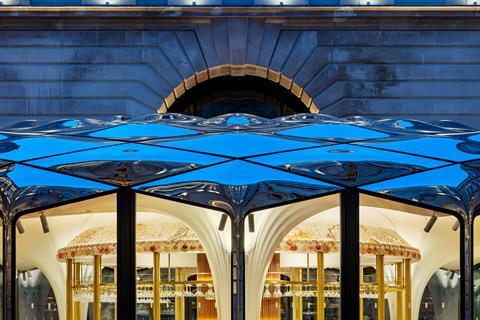
“These are the projects where you bring together history and tomorrow,” he says. At London’s former War Office – now the OWO, London’s first Raffles hotel – they were tasked with the tricky challenge of inserting a restaurant into William Young’s imposing Edwardian Baroque courtyard, where three different planning applications for activating this space had already failed.
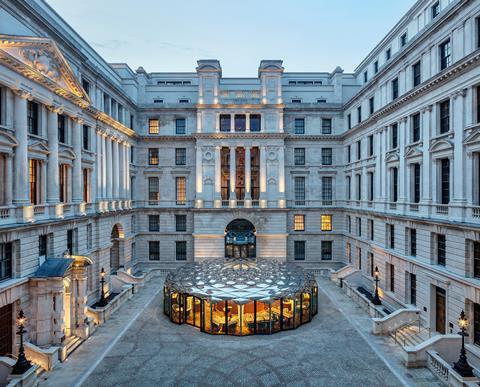
It is hard to compete with a building like that, and the obvious solution is “glass box”. But the Kang take on the glass box is a very elevated, intelligent one: a sculptural, round form with a petal-like rippled roof, which brings a contrasting softness and fluidity to potentially intimidating space. A mirrored surface keeps the visual intrusion of the insertion to a minimum, and a matching round fountain completes the work, which has just won a RIBA London award.
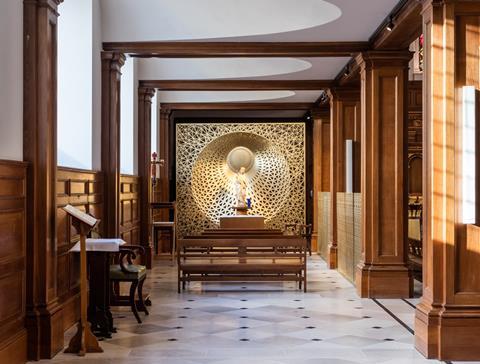
At Wren’s St Andrew’s, Holborn, meanwhile, the studio has reconfigured interior spaces to support contemporary forms of gathering and reflection. Wren’s largest parish church was gutted by a bomb blast during the war, and after the war, Seely and Paget created a mid-century take on the original interior. Kang has given that a thoughtful, very effective refresh, dividing the space and creating two new chapels for smaller services. Key interventions included the addition of a geometric brass reredos in the Lady chapel and new geometric limestone flooring, both inspired by Wren’s early career as an astronomer. The new additions are considered and contemporary and avoid both craven ultra-minimalism and historical pastiche.
Kang says of his practice, “We transform places that had one story into places that have a new story. If we can create spaces that invite reflection, either through their function or also through the way that we design the space, then we have done something worthwhile.”
A space to think
The Black Gold Museum is, in the end, a project about holding space for difficult questions rather than supplying easy answers. The KAPSARC research library was conceived to study the energy systems that shaped the modern world. Its successor invites us to think about what we want to do with that inheritance next.
Less is more
In their makeover of the place for its new role, Kang and his team have done only what needed to be done. They have shown restraint and respect for the original design – their own – a skill they have also demonstrated in their other reuse projects.
Putting one’s ego aside is the temperamental requirement of reuse and retrofit – a very different capability from that of the starchitecture that is the Gulf states’ trademark fare, and one that is going to become the new normal as reuse rather than new build becomes the default.

No comments yet