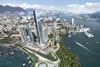

At the end of September, the latest iteration of the masterplan by Foster & Partners for the West Kowloon Cultural District (WKCD) in Hong Kong was unveiled for a further round of public consultation.
Somewhat upstaged by Typhoon Nesat and the winds of change sweeping the political and financial landscape of Hong Kong, the latest West Kowloon proposals prompted a fairly muted media response. There has been little comment on the urban design vision, but much carping that the major facilities will be delivered two years later than expected.

This is blamed on the construction of the Hong Kong to Guangzhou express rail link, widely seen as a white elephant project, whose terminus borders the West Kowloon site. In fact, a more realistic delivery schedule gives the WKCD team much-needed breathing space to handle the struggle ahead with the multiple bureaucracies of Hong Kong. The patience and persistence that will be demanded of Michael Lynch, WKCD’s new chief executive, should earn him sainthood as well as conventional honours.
Even Lord Foster’s impressive public relations machine is struggling to impart a sense of urgent purpose to WKCD as the one major project in Hong Kong that, in physical terms, has the fewest obstacles to coherent development. The redevelopment vision for the old Kai Tak airport site is still not tied down against further stormy weather and the central waterfront redevelopment between the new government offices and the central transport interchange reels from absurdity to absurdity with no purpose or strategy.

One senses that the Hong Kong population is resigned to a further long wait for anything to happen on this piece of land, reclaimed to build the western tunnel across Victoria Harbour. The pragmatism of the city’s leadership is such that major road and rail projects (“economic stimulus packages”) crack on at a fantastic pace, but anything that involves creating places gets mired in endless squabbles and changes of leadership.
On past form, it will probably absorb much of the two years’ grace period to agree the design programmes and select competition winners for the multiple theatres and music venues, let alone put together a funding and operational strategy for each of these.
Arts for arts sake
Foster & Partners’ new presentation for the “stage three public engagement exercise” majors on having fulfilled it’s obligation to integrate elements of competitors’ schemes that won public acclaim in the last round of consultation – including arts pavilions, theatre, open-air performance, travelators, “arts pontoons” and ferry piers to connect the peninsula with Hong Kong’s Harbour District.
The planning concept maintains the hyper-rational tartan grid with transportation segregated below a pedestrian-only street level. The texture of development is now somewhat coarsened from the last iteration, now incorporating six key cultural buildings, all of very similar scale plus four smaller facilities also similar in scale, plus a 400m-long backdrop of “mixed use”- the great hope to bring 24-hour life to the Cultural District.

The elephant in the room is that, regardless of the urban design vision, after five years of consultation and many more of dreaming there is still no real story emerging of how all these cultural facilities will be funded, operated and financed – and how they will co-exist with existing government-operated institutions in Hong Kong.
By popular request, the first venue to be delivered will be the Xiqu (Chinese opera) centre, which now fronts a new urban “square” on Canton Road, connecting West Kowloon to the existing city. The “M+” visual culture museum, whose director Lars Nittve (former head of the Tate Modern) was appointed last year to start building a collection, is another anchor element that is now sited at the far end of the main avenue, where it is dependent on most of the infrastructure to be built before it can proceed.
The proposals remain conditional on several crucial aspects that rely on other parts of city governance for delivery, for example effective overground connections between the Cultural District and the rest of the city. Cycling to WKCD would take great courage and ingenuity and walking from existing landmarks barely less.
The proposals are not sufficiently positive on the opportunity to exploit the magnificent asset of Hong Kong’s harbour to connect places rather than separate them. Unless viable ferry services and water-taxis can be liberated and effective piers permitted, despite the restrictive legislation in place, the journey to the WKCD will be consigned to the netherworld of subway tunnels and endless underground travelators that already dominate the Hong Kong urban experience.
We can only hope that the Foster vision of “A place for everyone” – vibrant streets, alleys and markets, parkscapes and urban squares – will be given sufficient life-support to live and breathe, unfettered by the restrictive bureaucracy of Hong Kong’s other public places. More than once, cynical exhalations of “as if …!” have greeted the Foster illustrations of street vendors and performers, cyclists and general fun and games in public places.
The success or failure of this “new city quarter” and its 28ha city park will rest not so much on intelligent architecture, but on dynamic and responsive urban management – and effective civic leadership.

2 Readers' comments