


An inspiring exhibition underway in Paris analyses the shared transitional spaces in Parisian housing and reminds us of their importance as a place where social life is quietly negotiated, Félicie Krikler writes

In build-to-rent design, we often hear the catchphrase that residents “should feel that they own the whole building”. The journey from the street to the front door is therefore framed as a critical part of the design. And yet, in reality, those journeys can be long, dark and oddly joyless.
I remember visiting a housing scheme in Chicago years ago: 2,000 homes across four buildings. The main entrance consisted of a long line of turnstiles, all operated by fob. Somewhere along the way you manoeuvred through with children, shopping and the quiet urgency of getting to the lift as quickly as possible.
The scale was mind-blowing. It was functional, trackable, probably even safe. But it also felt like the architectural equivalent of eating purely for survival.
This question sits at the heart of all large-scale residential projects: despite the scale and density of the buildings we design, how do we make a home feel like a home?
The exhibition focuses on components of buildings that are often overlooked precisely because they tend to be an inevitable result between legal ownership, technical constraints and regulatory compliance rather than architectural ambition
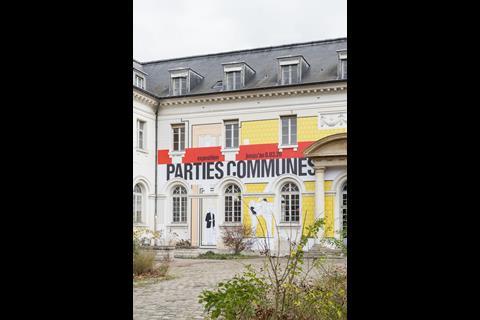
I have recently found myself hugely inspired by an exhibition currently displayed in Paris that address precisely this issue. Parties Communes: une aventure collective is both the title of a book and its exhibition and sets out to document and analyse the past and present role of shared transitional spaces in Parisian housing, across different eras.
The recommendation came from Cécile Brisac, Gensler’s recently appointed design director, during a serendipitous conversation about housing quality and the delicate balance between sociability and regulation.
The exhibition focuses on components of buildings that are often overlooked precisely because they tend to be an inevitable result between legal ownership, technical constraints and regulatory compliance rather than architectural ambition: the spaces that form the journey from the street to the home. Entrances, courtyards, staircases, corridors and ancillary rooms, spaces often treated as merely functional or even leftover space.
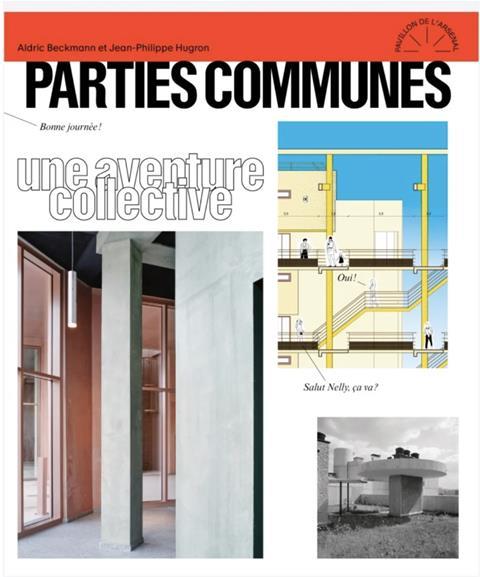
The exhibition is housed in the former Hôpital La Rochefoucauld, as part of the Pavillon de l’Arsenal’s hors-les-murs programme. This unusual setting (a hospital disused since 2019 temporarily reoccupied) adds an extra layer of curiosity and relevance. It reinforces the idea that in-between spaces are never neutral: they are shaped, activated and reinterpreted over time.
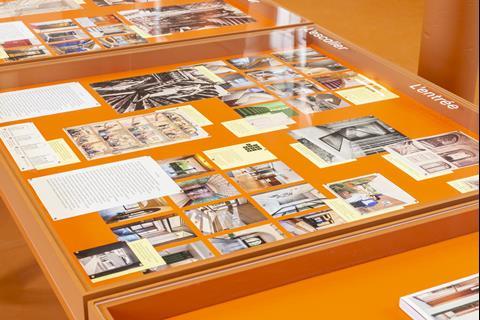
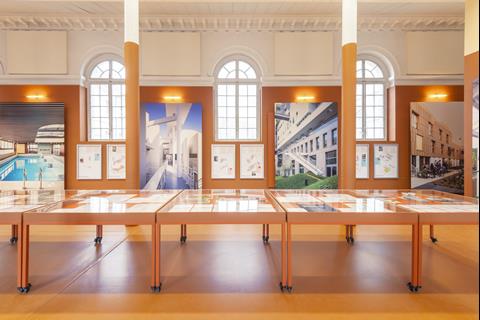
Curated by architect Aldric Beckmann with journalist Jean-Philippe Hugron and architect Rosa Naudin, Parties Communes is structured around three main parts. The first is an inventory of the different components that make up common parts. The second is a series of 20 case studies of Parisian buildings from 1854 to 2024, and the third looks more closely at how these spaces are actually used, and at the relationship between spatial configuration and everyday behaviour.
Interspersed throughout, like some little exciting palate cleansers, are popular cultural references (films, literature, photography) which help us relate to these spaces in a very familiar way even when we may not have experienced them ourselves.
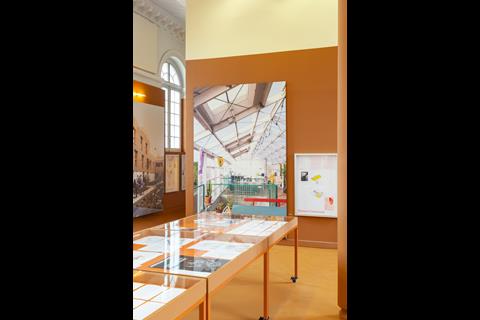
Through archival material, drawings, photographs and beautiful analytical diagrams, the exhibition traces the evolution of communal spaces in Parisian housing; from generous, civic thresholds to increasingly compressed, value-engineered zones. It shows us some wonderful examples of design decisions that can make the all the difference between mundane and memorable. It also analyses ratios of shared versus private space, always situating these outcomes within their historic, social, economic and regulatory context.
These spaces which are often the first to be reduced, rationalised or eliminated remain central to social cohesion, belonging, inclusivity and everyday urban experience
As Aldric Beckmann reminds us, design decisions are intrinsically linked to technical progress. Artificial light changed the plan form by enabling corridors when we previously would have moved from room to room with the “anti-chambre” leading to the “chambre”.
The lift arrival revolutionised circulation within buildings, and even the evolution of construction methods such as the use of reinforced concrete allowed for height and new typologies, reshaping roofscapes and enabling flat roofs and roof terraces.
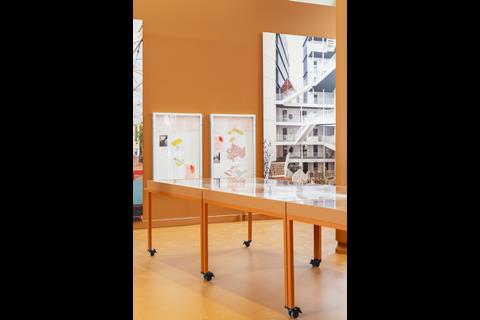
What emerges, almost without the exhibition having to make the argument explicitly, is that these spaces which are often the first to be reduced, rationalised or eliminated remain central to social cohesion, belonging, inclusivity and everyday urban experience. They are where social life is quietly negotiated: a nod on the stairs, a child learning independence in the courtyard, informal conversations that build familiarity and trust.
Against a backdrop of housing densification, viability struggles and mounting regulatory pressure, this feels very timely and quietly political. Rather than proposing a single architectural model, Parties Communes frames common areas as a collective project; shaped not only by design decisions, but also by management practices and resident appropriation. Architecture sets the stage, but life fills them in.
The installation itself reinforces this position. By occupying a temporary, mixed-use site, the exhibition blurs boundaries between exhibition, occupation and public space. It demonstrates that common parts are social infrastructure. Parties Communes: une aventure collective is an excellent reminder that the long way home might, in fact, be the most important part of the journey.
Postscript
Félicie Krikler is a director and head of residential at Barr Gazetas.
https://www.librairievolume.com/product/parties-communes-une-aventure-collective-aldric-beckmann-jean-philippe-hugron
https://www.pavillon-arsenal.com/fr/expositions/13049-parties-communes.html




No comments yet