






It makes no sense for architects to be regulated while other critical built environment professions are not, writes Jack Pringle, chair of the RIBA board
Almost nine years on from the Grenfell Tower fire, where 72 people tragically lost their lives, we are one step closer to implementing one of the key recommendations from the phase 2 inquiry report – establishing a single construction regulator, reporting to a single secretary of state. The government accepted this recommendation and in December last year issued the Single Construction Regulator Prospectus consultation, inviting comments by March 2026.
The prospectus states that a well-functioning building system should achieve the following outcomes:
- Buildings and built environments that are safe, high-performing and deliver a healthy, accessible, secure, and sustainable environment for occupants.
- Companies and individuals enabled to thrive when they operate in the interests of current and future building users.
- That products for building are fit for their purpose and users are provided with accurate product information.
- That the building system is trusted; users have confidence the system will act to prioritise the safety and needs of occupants.
The second outcome is particularly interesting and in discussion with the Ministry of Housing, Communities and Local Government, it seems to recognise that the challenges highlighted by Grenfell are not limited to parts of the construction industry, but point to wider issues across the sector, including broken business models. Not least architects whose services are sliced and diced within Design and Build contracts, leading to a race to the bottom on price and a desire to pass the responsibility buck to the bottom of the chain.
This makes welcome reading for us as it echoes some of the issues I highlighted in my last article, on RIBA’s plans to reboot the architects’ profession and its business model through our Towards Tomorrow’s Architecture programme. We have friends, or at least sympathetic understanding, in high places.
Turning to outcomes one and four above, we have a solution. The RIBA fully accepts the call for a single construction regulator. It makes no sense for architects alone to be regulated, however bizarrely with protection of title and not function, while other critical built environment professions are not.
The prospectus points out that “no single body has a full view of competence, capacity, regulation and enforcement across the building professions”. To drive competence and standards and therefore achieve public accountability, this must change.
There are two fundamental problems with our current system which the government now has the opportunity to resolve
It would also make no sense to spawn a myriad of ARB lookalike regulators controlling each of our many co-professions. Such a structure would result in a lack of clarity, would drive inefficiency and increase bureaucracy. Many of the professional membership bodies have been leading the way on education, CPD and professional standards for decades, and this knowledge must be utilised.
A single construction regulator not only makes sense but is also an opportunity for our profession to frame more sensible regulatory oversight for architects. There are two fundamental problems with our current system which the government now has the opportunity to resolve, via a single regulator, which are a) no real consumer protection and b) a quango (quasi-autonomous non-governmental organisation) regulator, the ARB, controls our profession’s initial and continuing education. Thus, we architects do not control our own profession, its knowledge base and its competence.
Our proposal, that we set out in our response to the prospectus, is that a single regulatory body should indeed oversee buildings, products and professionals. For professions, a built environment council should provide independent regulatory oversight of professional competence across the sector. The council would oversee the approved chartered membership bodies, ensuring consistent and robust competence standards are applied across professions.
From initial to ongoing education, plus codes of conduct and dealing with complaints, the professions are in control of the required expertise and standards they require, as they know best. Chartered bodies already have an obligation to advance the public interest and many of us are already delivering this work. It makes sense to capitalise on it.
In fact, the components relating to buildings and products are largely now already in place with the establishment of the Building Safety Regulator (BSR) and the Office for Product Safety and Standards (OPSS). The built environment council would be the third pillar which would form the single construction regulator.
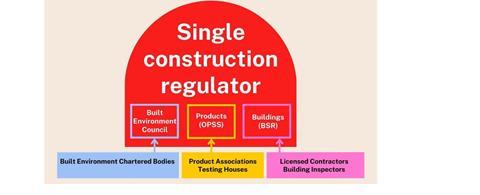
This, combined with continued protection of those able to use the title architect and reserved activities for those competent to submit full planning applications and building control applications will hugely increase consumer protection and the quality of our built environment.
Professional competence must sit at the centre of a well-functioning building system if the proposed outcomes are to be achieved. To achieve this, we need reserved activities for competent professionals and to regulate through a Built Environment Council. This would improve consumer protection and put professions in control of their chartered members expertise and competence and boost the performance of the construction sector and its business models.
Postscript
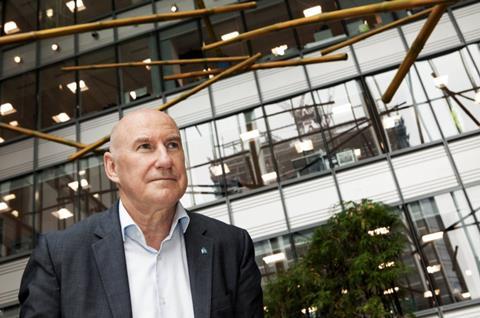
Jack Pringle is managing director of Studio Pringle and chair of RIBA board







3 Readers' comments