






Eleanor Jolliffe has just published a book which celebrates the history of one of London’s best-known buildings. It is fair to say that she enjoyed the experience

In the 12-odd years that I have been writing this column, I don’t believe I have ever written directly about a project I have worked on. It has never felt fair to my colleagues or collaborators to use anecdotes as an illustration of a wider point.
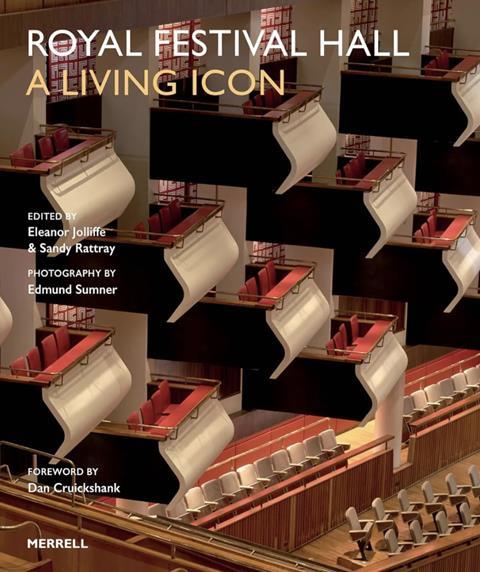
I am making an exception, however, because my colleague Sandy Rattray and I have just published a book celebrating one of them: the Royal Festival Hall.
Over the past few years I have worked on a handful of fairly small feasibility studies, as well as targeted refurbishment, conservation and renewal projects in this modernist masterpiece. Many will already know the history of this supremely democratic building, but it is always worth recapping – it has seen extraordinary change in its 75 years.
Drawings began in the LCC architects offices in 1948, opening in 1951 as the centrepiece of the Festival of Britain; it was significantly reworked and extended, again by the LCC, in 1964; and then significantly refurbished between 2005-07 by Allies and Morrison. This last refurbishment “decluttered” much of the interior to rediscover the original internal spaces, overhauled the auditorium acoustics, and reconfigured the RFH’s relationship to the surrounding city – especially the riverside walk.
Hundreds, if not thousands, of engineers, consultants, contractors, and maintenance people have shaped and re-shaped the building over the decades
The list of architects who have played a part in the life of the building is long and rather celebrated, including Robert Matthew, Peter Moro, Leslie Martin, Edwin Williams, Norman Engleback, Robert Maxwell, Bob Allies, Graham Morrison, Simon Fraser, Diane Haigh, Paul Appleton… To add your own name to the end of this list is something of a responsibility, and you can feel them all peering over your shoulder as you draw a change to “their” building.
Of course, it is not just the architects. Hundreds, if not thousands, of engineers, consultants, contractors, and maintenance people have shaped and re-shaped the building over the decades.
The plant rooms and hidden service voids have scraps of poetry crafted by labourers scribbled on the walls (none of it blue!), and fittings for flag-poles and public art projects have temporarily appeared almost everywhere over the decades. Among many, many others I have had the pleasure of working with David Derny at Price and Myers, and Fabric Supervisor Terry Vickery as I have worked there – their relationship with the RFH is almost older than I am! You cannot easily substitute this kind of knowledge when working on a building like this – you need to get under its skin and understand its quirks, and the RFH has many!
Alongside the people who have dreamed of and shaped this building there is the responsibility to the memory that so many people hold of it. Almost everyone in London seems to have a tangential but strongly emotional connection to the Royal Festival Hall.
I have spent weeks in the building over the past few years ducking around first dates, impromptu dance rehearsals, and toddler groups to get to small works sites.
You can never allow yourself to forget that this building is much more than the sum of its parts. It’s a place that is very much alive, and this life is almost as precious as the (horribly hard to source) hardwood floors
The staff too have strong attachments to the building, and have never been shy in sharing their opinion about what you are doing to it. Some still wave me over for a chat if I am there with friends.
You can never allow yourself to forget that this building is much more than the sum of its parts. It’s a place that is very much alive, and this life is almost as precious as the (horribly hard to source) hardwood floors.
It is this that we tried to capture in the book – a collection of essays and new photographs which celebrates both the extraordinary architecture, how it came into being, and why it is important. We have tried to reveal something of the inhabitation, the many lives, of the building. We have academic experts and historians, but also the piano-tuner, the production team, noted musicians, the artistic director, and, of course, fabric supervisor Terry.
It is a very, very, special building and I hope the mark of me and my small team at Allies and Morrison will feel “meant” rather than glaringly new
It is a very, very, special building and I hope the mark of me and my small team at Allies and Morrison will feel “meant” rather than glaringly new. To design something in concert with these thousands of stakeholders, living and dead, means a quieter, more research heavy, softly treading form of practice than most architectural instincts gravitate to; and it is so, so much harder than new-builds, where you never find 1950s service openings stopped up with something that looks like paper towels, or spaces that no drawing said existed.
However, the time in that building clambering over kit in plant rooms to understand plumbing routes, and trying very hard not to be distracted by the view of London at your feet when undertaking roof condition surveys is precious. I am very lucky that this is not the only landmark I am helping to keep alive – but I am aware how difficult and expensive and unglamorous much of this style of architectural practice is.
It is endless conversations about ventilation routes and fire door ironmongery and the constant weighing of heritage fabric value against modern building and safety standards. It is careful, deliberate, slow, and usually more expensive than anyone wants it to be.
I doubt that my contributions to the Royal Festival Hall will last 75 years – they are too focused on the areas that have the heaviest daily wear. However, I am at peace with that, my contribution to this building is not easy to photograph or notice, and will likely never make it to a postcard or instagram post – but it has revitalised part of a very special place, and kept the building alive.
Plus I got to document something of the richness I daily discovered in a book. What more could I really ask for?
Postscript
Eleanor Jolliffe is a practising architect and co-author of Architect: The evolving story of a profession. Royal Festival Hall: A Living Icon is published by Merrell and now available in hardback




1 Readers' comment