







Interior Architect of the Year 2025 finalist TP Bennett guides us through the unique specification challenges at 1 Blossom Yard, offices of law firm Reed Smith
TP Benett was shortlisted in two catergories at last year’s AYAs including Interior Architect of the Year. Here we take a look at 1 Blossom Yard in London, one of the projects that formed its entry in that category, and ask Mark Davies, principal director at the firm, to talk us through the biggest specification challenges involved.
What were the key requirements of the client’s brief? How did you meet these through both design and specification?
Law firm Reed Smith’s relocation from Broadgate Tower presented a transformative opportunity to reframe its workplace identity. The brief centred on several key objectives: creating an impressive space for both staff and clients that would position Reed Smith as progressive and contemporary; embracing the unique character of the building; and ensuring all employees across the business – not just partners – had meaningful input into the design process.
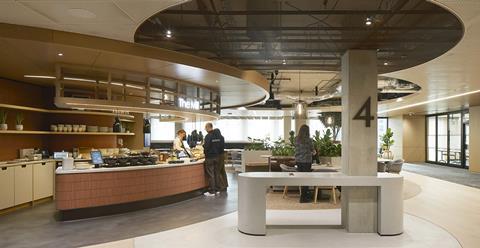
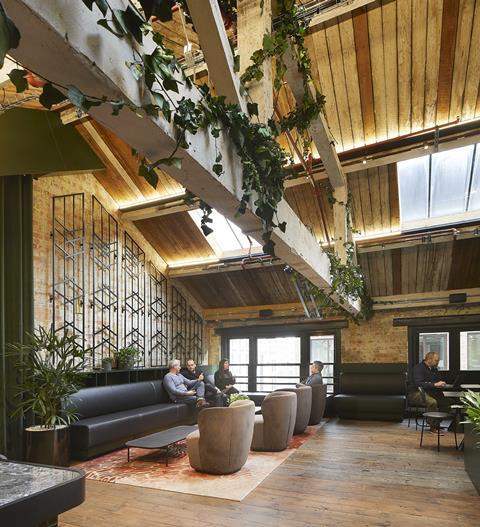
Blossom Yard is a 115,000ft2 workspace in the heart of Shoreditch. Spanning eight floors across two connected buildings – the 1890s warehouse Blossom Studios and new-build Blossom Yard – the design strategy focused on celebrating the contrast between old and new, embracing the character of both buildings. We created a harmonious transition by breaking through walls to create an internal atrium, in doing so revealing the brickwork of the warehouse’s former facade. The first three floors span both buildings, with a bespoke feature staircase within an existing lightwell unifying the atrium and linking a series of destination spaces for welcoming and entertaining clients and staff.
We held comprehensive workshops with employees across the organisation ensuring all voices were represented in the design process. The result helped transform Reed Smith’s workplace from corporate and traditional to modern, characterful and expressive – reflecting the law firm’s preferred ways of working. The final design celebrates this contemporary style of working while taking inspiration from the area’s Georgian and Victorian heritage, to create an innovative and characterful workspace.
What were the biggest specification challenges on the project and how were these overcome?
The primary specification challenge was seamlessly integrating the two architecturally distinct buildings into a cohesive workplace while celebrating their individual characters. This required careful material selection that could bridge heritage and modern contexts without compromising either.
A second challenge was ensuring accessibility between the new Blossom Yard building and the heritage Blossom Studios. To create a seamless journey for all users and visitors, we created an opening between the two buildings and introduced a ramp to overcome the difference in level.
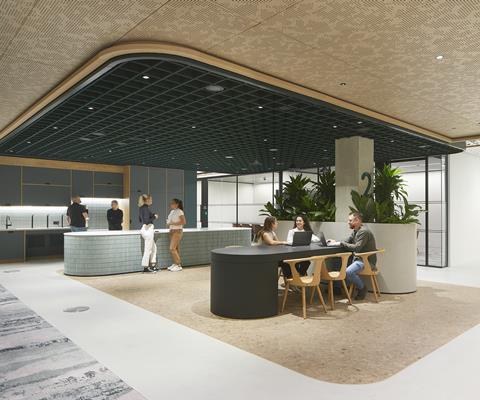
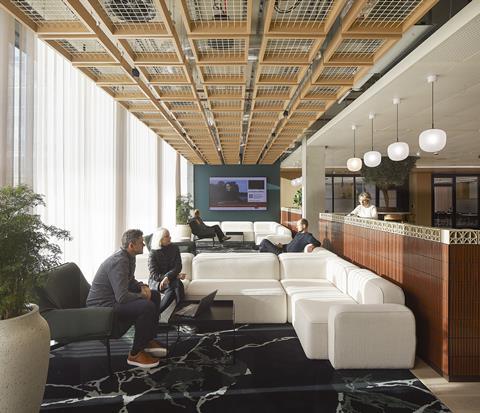
Acoustics throughout the open-plan areas presented a third challenge because the fit-out design had to retain the exposed concrete slab without acoustic spray. To solve this, our designers specified a combination of soffit-mounted and suspended acoustic baffles, carefully coordinated around the existing services to avoid compromising the existing infrastructure, while achieving the required acoustic performance.
What are the three biggest specification considerations for a project of this type? How did these specifically apply to your project?
The legal sector has historically been cautious about adopting new workplace models, retaining hierarchical cellular layouts and enclosed private offices. Reed Smith’s brief presented an opportunity to challenge this convention and reimagine how a future-thinking law firm could work.
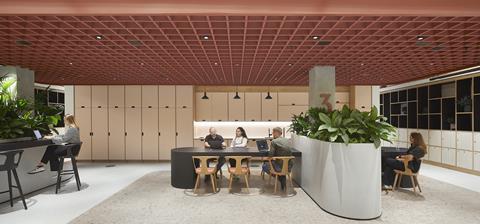
To build confidence in this shift, we created a pilot area in the firm’s previous office, which allowed employees to experience the benefits of more open, collaborative settings before committing to a full-scale transformation. This approach informed the new design, where the ratio of open-plan to cellular space was dramatically reversed from 30 percent open plan and 70 percent cellular in the old office to the opposite ratio in the new space. This not only optimised space efficiency but fostered connectivity, transparency and a more progressive culture, aligned with Reed Smith’s vision for a contemporary law firm.
Legal workplaces must balance the need for confidential, focused work with more informal environments that encourage interaction. For Reed Smith, this meant creating distinct destination spaces that can host clients and facilitate socialising, while ensuring there was still an appropriate provision of varied working environments suited to different tasks. Blossom Studios was curated specifically for welcoming and entertaining clients and staff, with each floor of the historic building serving a distinct purpose: meeting rooms and client arrival at entry level, wellness facilities and charity workspace above, and a club space with bar at the top, providing intimate event capability for up to 60 people. Meanwhile, we strategically placed social areas across Blossom Yard to encourage movement through the building, including refreshment kiosks, a library space and a restaurant and event space capable of hosting 200 people, which is connected to an external terrace and supported by kitchen, reprographics and IT facilities.
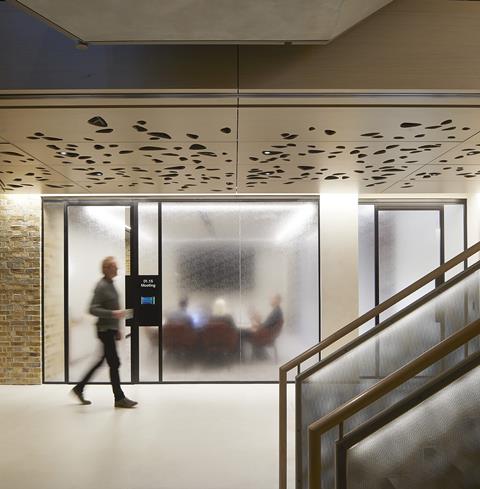
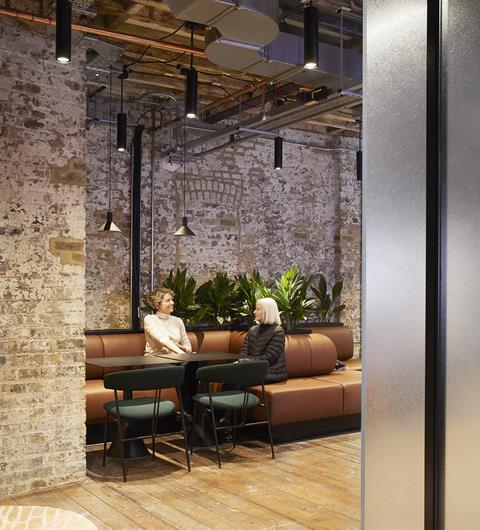
Reed Smith wanted its new office to project credibility and quality to clients while avoiding the traditional corporate aesthetic of legal offices, creating a more expressive and characterful place while retaining a professional tone. We addressed this through a layered material palette that celebrates the heritage warehouse character. Raw brick and plasterwork were retained and exposed, with pops of red and green adding vibrancy. Across new-build Blossom Yard meanwhile, a neutral colour palette with curves and soft edges provides comfort and inclusivity, complemented by concrete textures and timber touches that reference the building’s heritage.
Do you have a favourite product or material that was specified on the project?
The clay plaster specified for the walls brings softness, texture and warmth to the space, offering a sophisticated yet natural aesthetic. The neutral tones selected also complement the existing varied brick textures throughout the project.
Are there any suppliers you collaborated with on the project that contributed significantly? And what was the most valuable service that they offered?
Tai Ping delivered exceptional feature rugs across the project. Working within budget constraints, they collaborated closely with us to create the right bespoke designs without compromising on quality or design intent, producing vibrant, diverse and unique designs specific to every area of the project.
The Furniture Practice delivered appropriate furniture within a tight budget, too, delivering products with the required look and feel for the client, while complementing the design across the scheme.
Microcement supplier IdealWorks ran workshops with our team to give our designers a full understanding of the product and its installation. This ensured we achieved the desired finish across joinery elements, flooring and the feature staircase.
What did you think was the biggest success on the project?
The greatest success of Blossom Yard is that the building has become an authentic reflection of Reed Smith’s culture and values. The building reflects the firm’s approach to contemporary law practice by sensitively integrating a modern workplace into heritage fabric.
The success lies in the flexibility and inclusivity of the space, which was enabled by the collaborative way of working and designing. We worked closely with employees from across Reed Smith to ensure there would be spaces to suit all needs and that the design would reflect the needs and values of the firm. From wellness suites and charity workspaces to club-like social hubs and event spaces, the office offers variety without compromising confidentiality. The reversal of the open-plan ratio, from 30 percent to 70 percent, encourages collaboration, while acoustic solutions ensure privacy where needed.
Employees have embraced the new ways of working, including the open-plan layouts that foster collaboration and the destination spaces that encourage social connection and client engagement. Ultimately, the project proves that a law firm can embrace modern workplace principles. It is a space that reflects Reed Smith’s identity, fosters connection, and positions the firm as a forward-thinking practice that is ready for the future.
Project details
Client Reed Smith
Architect (base build) Allford Hall Monaghan Morris (AHMM)
Interior designer tp bennett
Furniture supplier The Furniture Practice
Flooring suppliers
Mafi, Element 7 – timber flooring
Shaw Carpets
Havwoods
IdealWork – microscreed
Quadrant – carpets
Ceilings
SAS – ceilings
Autex – acoustic ceiling panels
TopAkustik – acoustic timber ceilings
Joinery and fabrication
TMJ – joinery
Fabric and finishes
JBH – fabric walls and ceilings
Tai Ping – rugs
ADS – decorators
Partitions Radii
Blinds and curtains Soltech
Our “What made this project” series highlights the outstanding work of our Architect of the Year finalists. To keep up-to-date with all the latest from the Architect of the Year Awards visit here.







No comments yet