The architect’s first affordable housing development creates a distinct sense of intimacy while complying with tough daylight regulations – and it’s partly thanks to bike sheds, writes Elizabeth Hopkirk

Cambridge is a city characterised by two atmospheric forms of urban void: narrow lanes and college quads. Today, partly as a result of these attractive spaces, the city’s housing is in extraordinary demand – and it needs a lot more if prices aren’t to spiral out of control.
The irony, of course, is that it is nigh-on impossible to build the required new homes in 21st-century versions of those intimate streets. Modern daylight requirements mean buildings of four or five storeys must stand an unfriendly 18-20m from each other. It’s not easy to create a characterful place on those terms and, as a result, soulless avenues and windswept squares are a familiar experience in new developments all over Britain.
Even one of the country’s best projects – the North West Cambridge extension, whose masterplan by Aecom is a contender for this year’s Stirling Prize – has some monotonous wide avenues where kerbside nature strips aren’t enough to disguise the broad expanses of Tarmac.
It is this planning context that makes the intimate spaces which Stanton Williams has created on a 1.8ha plot at the heart of the development all the more remarkable.
North West Cambridge is the university’s strategic response to the problem of how to attract the world’s finest minds if there is nowhere for them to live. An entirely new £1bn neighbourhood, with 3,000 homes, a school, MUMA’s Stirling-shortlisted community centre plus retail, office and research space, is gradually taking shape on 150ha of former greenbelt land.

Phase one is known as Eddington and the university has shown admirable architectural ambition by appointing the likes of Wilkinson Eyre, Maccreanor Lavington, Sarah Wigglesworth, Alison Brooks and Witherford Watson Mann to various lots.
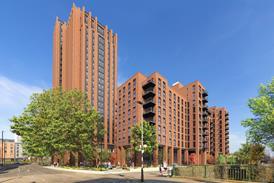
Surrounded by all this is Stanton Williams’ project, on a sloping site originally given to David Chipperfield before the practice and university parted company in 2013 over a difference in vision. It is Stanton Williams’ first foray into affordable housing and the resulting 264 keyworker flats in 10 brick-clad buildings are already 100% occupied.
The scheme complies with level 5 of the Code for Sustainable Homes, including the requirement for 80% of the working plane in every living room, dining room, kitchen and study to receive direct light from the sky – a rule introduced for laudable environmental reasons but which so often results in those unappealing canyons between buildings.
Yet Stanton Williams has managed to create a development with a real sense of place and enclosure. Cobbled footpaths and rainwater rills weave between the buildings while overlapping cantilevers frame tantalising views, tempting the pedestrian on, never giving away too much.

How has the architect done this? Essentially by judicious use of our other old friend, the quadrangle.
A sequence of five open spaces punctuates the neighbourhood, each with its own character and scale. The two set-piece squares at either end, currently known as Market Square and Landscape Court, are edged by buildings in the traditional way. But between them much smaller, more intimate, spaces are created by placing the buildings corner to corner.
The result is a series of places where people will, the architects hope, choose to linger. These are places with informal seating, imaginative planting, the odd pond, no bins (more on that later) and glimpses towards the next space.

Although the buildings and plan are rigorously rectilinear, with pin-sharp corners, there is a softness to the development, thanks in large part to J&L Gibbons’ landscaping which was embedded in the design from the start, but also because of the way the buildings meet.
Every corner is different, from the distance between blocks – sometimes barely a metre – the way they are staggered and how far they overlap. Some creamy cantilevers seem to just miss each other like a clumsy kiss.
All this pushing and pulling is partly a response to the massing of the surrounding developments, so where a Mecanoo block juts out to the south Stanton Williams placed a courtyard in the corresponding part of its plan.

The architect has also used variations in height and massing, playing off four- and five-storey mansion blocks with humble single-storey bike sheds – which form one of the central ideas of the project.
These brick and timber “pavilions” are large and comfortable enough for neighbours to sit in and chat while unloading children and panniers. To encourage this the planting continues inside and they are partly open to the sky. At night the sheds glow like sentinels as the lighting inside leaks out through vertical slats.

The development, which is a pleasant 10-minute ride from the city centre, has a cycle space for every bedroom and there is a secure bike shed no more than 50m from every building entrance – both planning requirements. Across the whole development there will be 12,500 secure bike spaces but every architect has come up with a different response to the brief, in some cases resulting in locked courtyards. Anyone can walk through Stanton Williams’ development – and they surely will once they discover it.
The first three topics raised at any Cambridge planning meeting, says North West Cambridge project director Heather Topel, are bikes, bins and cars. Stanton Williams has banished the latter to the streets bordering its scheme. There are two underground – and pleasingly under-used – car parks which serve the entire development.
In a masterstroke, wheelie bins are done away with in favour of a system common on the continent and ripe for widescale uptake in the UK. Residents bring their rubbish and recycling out to small, fixed street bins beneath which are large pits. When they are 75% full a sensor alerts the council and a refuse truck is despatched. To meet code level 5 there must be bins within 35m of every building entrance.
Although the code is no longer mandatory – it was a victim of the coalition government’s bonfire of regulations – it remains a requirement of the masterplan that took 10 years of negotiation to agree. The council insisted on the highest levels of sustainability and flood prevention if it was to countenance building on the green belt.

Principal director and project lead Gavin Henderson says the proximity requirements for bins and bike sheds caused them some headaches during the design process because of the knock-on effects of a seemingly small decision to relocate a door. “It was like a moving jigsaw puzzle,” he recalls.
The bigger blocks are walk-ups, like traditional colleges, so there are many doors opening from the “quads” on to stairwells. But, unlike colleges, it was important the buildings didn’t turn their backs on the outside world. A second set of doors animates the street elevations, with lobbies running between the two. Because of the slope the courtyard doors are level access and the street doors are reached by steps carefully designed to create “stoops” where people might sit and watch the world go by.
The whole scheme has sociability at its heart, with the network of spaces designed right at the start to create a sense of transition from the life of the city into the heart of the new community.
“If you walk around the broader development there are a lot of very wide spaces,” points out Henderson.
“The constraints mean you can’t do without 18 to 20m between buildings with buildings of this height. You can’t replicate a traditional London street – hence we tried to balance those other spaces with compressed spaces.
“We are trying to get our buildings closer together: to create a sense of intimacy and community. With these pedestrian routes we have moments of compression which will hopefully mean people bumping into each other.”

One of the tightest spaces is Social Court which is modelled on some well-loved progenitors. “We looked at many different courts and courtyards during the design stage from Cambridge to Bruges and Berlin,” says Henderson. “But the main focus has been on the historic collegiate and civic spaces of central Cambridge – such as the Fellows’ Garden at Christ College, Trinity College and the Market Hill.”
Social Court also contains some of the scheme’s many edible plants and one of its two ponds. Fed by run-offs and linked by cobbled drainage channels these are an integral part of the very serious flood mitigation plan, but they’re filled with plants and surrounded by inviting low brick walls.
“Landscape gets value engineered straight away,” says Henderson. “But we always said the most important part of this is the pedestrian experience. The buildings can be visually quiet: landscape is key. I want to see the water coming down and hear the rustle of reeds.

“There’s also a level of tactility to the materials that’s very important to how a building feels. All these things add enormously to your appreciation of a place.”
His aspiration is that once the shops and cafes have all opened residents will come back home to socialise rather than hanging out at bars near their workplaces. Fostering a sense of community is particularly important because the housing is earmarked for postdocs who are typically international, quite transient and don’t arrive on a termly rhythm. An Office of Postdoctoral Affairs has been created to help people settle in quickly and has taken space in the development from where it coordinates social activities and pastoral support.
The university’s Topel, a former director at Aecom who has been involved in the project since 2006 but moved client-side in 2013, is humble enough to admit they are learning plenty of lessons from this huge urban experiment. But it’s pretty clear that most of the lessons from this particular part of the development are ones they’ll want to share.


No comments yet