

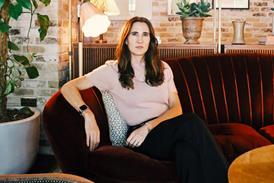







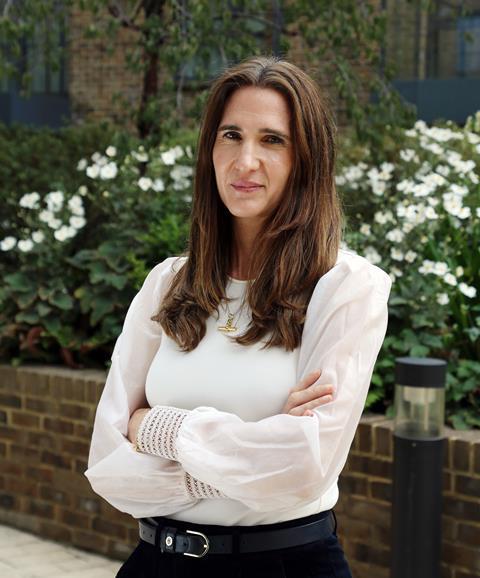
After almost 20 years at Broadway Malyan, 10 Design’s chief executive joined the practice last year. She also chairs Women in Architecture, a volunteer group which offers free mentoring to women in the sector. She tells Tom Lowe about her journey from Spain to Argentina, Los Angeles and finally to London, and what she wants to change in the profession
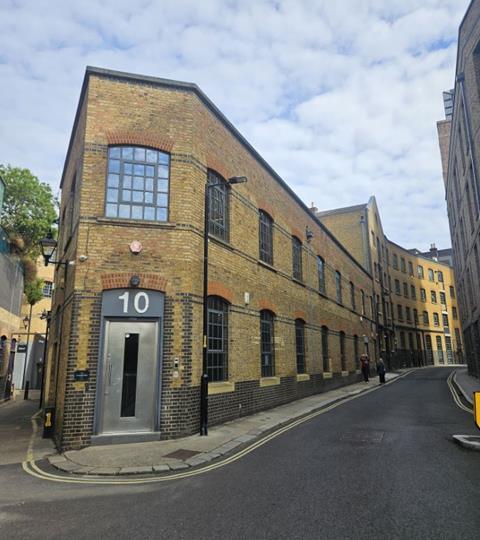
Walking into 10 Design’s light and airy London office, it does not immediately feel like entering the headquarters of a major global practice. The two-storey former industrial building, located on a quiet back street near Waterloo station, is in fact a space which the firm shares with WW+P, which is also owned by the pair’s parent company, French engineering giant Egis.
10 Design’s main address is directly opposite at 10 Valentine Place. The practice seems to have an affinity with the number – it was founded in 2010, by a group of 10 architects from the Asian operation of Scottish practice RMJM. It now has more than 400 architects across nine offices, including Dubai, San Francisco and its original headquarters in Hong Kong.
This makes 10 Design about the same size as WW+P, although the former’s new chief executive Sabrina Klor is targeting a growth rate of, fittingly, 10% a year.
Much of that growth is taking place at its London office, to where the firm moved its headquarters in 2022 following its merger that year with San Francisco-based SB Architects. With its three main markets – the Far East, the Middle East and, now, the US west coast – the practice felt it needed to base itself in a European time zone.
It is still weighted towards its core Asian market, with around 160 staff in Hong Kong and 40 in Singapore, but the new head office is expanding rapidly. It has more than doubled its staff this year from around 20 in January to 45 by the end of September.
“This year has been quite remarkable for London,” Klor tells Building Design. “We set a very aggressive target and, to be fair, [the practice] has done a fabulous job.” Most of these additions have been new hires – “incredible talents”, Klor says, from a “variety of top-tier companies”.
She has deliberately sought out people from different types of practices who bring a diverse array of skills and approaches, “almost like we are reinventing ourselves with the how-tos from all of these different places”. But, unlike the well-established Hong Kong studio, the London office is very much a work in progress.
She does not disclose where these hires have been recruited from, but says the firm has been “very picky” as part of a strategy to curate a team that will enable growth while maintaining the firm’s identity. “We always look at our product and we are setting ourselves up in a way that, no matter how much we grow, that is always protected,” she says.

From commercial towers to retrofit
That identity is also in a state of flux. The firm’s initial growth in the 2010s was based on large, glitzy commercial projects in China, including the 2016 two-tower Greatwall Complex in Wuhan. It later branched out into hospitality and leisure, including Al Seef in Dubai, a 1.8km-long waterfront development combining shops, restaurants and hotels.
Klor, who joined 10 Design as chief executive in August last year after almost two decades at Broadway Malyan, most recently as the latter’s chief operating officer, is a natural fit for this type of work. Her former practice specialised in large, mixed-use projects and urban regeneration masterplanning. Past projects she has worked on include various large regeneration schemes in Nine Elms and the Fulham Wharf scheme in west London.
It’s almost like we are reinventing ourselves with the how-tos from all of these different places
But Klor now wants retrofit and reuse work to be put front and centre of 10 Design’s offering, focusing on landmark projects in big cities. “We feel like the architecture of the future is more about recycling and retrofitting what we already have, and we are a major player in that in all of the cities and the sectors that we operate,” she says.

The firm’s growth is underpinned by the heavyweight backing of Egis, which grew by 10.4% last year to reach turnover of €2.389bn (just over £2bn), and employs around 23,500 people globally. 10 Design is a component of the 10N Collective, a group of design firms under the Egis umbrella which includes WW+P, Canada’s SvN Architects – which merged with WW+P last year – and Spanish practice Fenwick Iribarren Architects.
The group collaborates closely and shares its combined 1,600 staff, but there is no plan to formally merge them into one new brand. “The unique culture and skills of each of the businesses are not going to disappear,” Klor insists. “And that’s very much what we’re protecting.”
Egis’ support gives 10 Design the confidence to grow, although there remain risks, not least in the Middle East market in the wake of the US attacks on Iran. Although Klor confesses the number of inquiries the practice received last year was “much more” than this year, she says its revenue from the region has actually increased because projects which the firm has won have been bigger.
This is partly because clients want projects ready to go when the conflict settles down, but she is not complacent. “It feels too good to be true. I’m waiting for the hit at some point”.

She adds: “I think everybody needs to play with caution. You just don’t know what’s going to happen. We are very aware of the geopolitics. We’re very aware of the risks that are in the markets in which we’re operating, and so our job – my job, mostly – is to be constantly looking at those risks and finding ways to mitigate things should something not go the way we want.”
Klor’s route into architecture
Klor was born in Córdoba, a city in Argentina about 700km west of Buenos Aires. She moved to Spain with her family when she was a child, settling in A Coruña in Galicia, on the northwestern tip of Spain – “a very beautiful place on the coast. Very green. Very quiet.”
It was a career in law, not architecture, which Klor set her sights on from an early age. “All my life I dreamed of being a lawyer, that’s it. That’s the only thing I wanted to be,” she says, recalling that she wanted to fight for human rights and “do the right thing”.
But, when she started studying law in Spain, she “didn’t like a second of it”, finding it too “passive” and involving too much reading. So she dropped out, and, at the age of 18, with no plan for what to do next, she decided to travel back to her birthplace and spend some time with her extended family in Argentina.
Having been born in Argentina and grown up in Spain, I always felt like I was broken inside in a way
She initially lived with her aunt and her grandmother, paying the bills by working at computer shops, selling computers and fixing them. It was while spending time with her aunt, who is an architect, that Klor realised she had stumbled upon something that she enjoyed.
“I was like, ‘wow, I can be creative. I can solve problems. I can influence how people live their life. I think I can do this’,” she remembers.
She enrolled at the school of architecture at Universidad Nacional de Córdoba, ultimately spending six years in Argentina. Architects she looked up to at the time included Daniel Libeskind, OMA and SOM: “I used to get all of these magazines and dream with all of these incredible architects that mostly came from Europe.”
To pay her fees she learned AutoCAD and taught it to fellow students in her apartment, creating a “little business”. Universities at that time in Argentina offered little financial support to students, and her parents had accepted her decision to stay in the country on the basis that she would have to support herself. “It wasn’t easy,” she recalls, “but I loved it.”
For her final year thesis she conceived a “smart building” that used various features to adapt to changing weather, including solar shading fins which could adjust their angle. It generated enough interest in scholarship circles for her to be offered a job in Los Angeles, where she worked briefly before setting her eyes on an Architectural Association course in London.
It was in the international culture of London that Klor felt she had finally found her home. “Having been born in Argentina and grown up in Spain, I always felt like I was broken inside in a way,” she says. “I really grew up in both places, and so you kind of feel like you are from nowhere at the end of the day.”
“When I came [to London], it was very strange because, as soon as I landed, I felt that this was my place in the world. That I belonged here. I loved that everybody was from everywhere, so I didn’t feel that I was a stranger. I didn’t feel that I didn’t fit. I didn’t feel that my accent was a problem.
“Everybody had an accent. Everybody was from somewhere else. Everybody had a different culture. I genuinely felt that I finally found my place in the world when I came here.” Six months after arriving, she met her now-husband, who she lives with in south London with her children.
Klor ended up swapping the AA for a part-time course at the University of Cambridge. Meanwhile, she found a job at Broadway Malyan, where she almost immediately found herself teaching her computer skills to the firm’s directors.
Within six months, she was the lead on her own competition and was, to her surprise, sent off to Abu Dhabi by herself to pitch it to the client. She won the competition for Broadway Malyan, “and from there it was just incredibly fast,” she recalls.
Leading in a male-dominated industry
Within two years she was an associate and within four years an associate director, the youngest director in the company. In her first years in senior positions, Klor, still in her early 30s, found herself being treated differently to her older colleagues in equivalent roles.
Chairing on-site project meetings of 30 people, many of them men in their 50s and 60s, she often felt like she had something to prove. “You can imagine how intimidating that is,” she admits. “So that makes you tough, I tell you.”
People that know me – I enter the room, and I am respected
How did she deal with situations where people were not treating her with the level of respect she felt she deserved? “I always made myself respected,” she says matter-of-factly. “People that know me – I enter the room, and I am respected.”
Five years after joining the firm she was made director of architecture, a position she held for nearly nine years before becoming commercial director and, finally, chief operating officer.
Her style is to lead by example and to treat people the way she likes to be treated. “There’s no need to be loud,” she says. “But it’s not easy.”
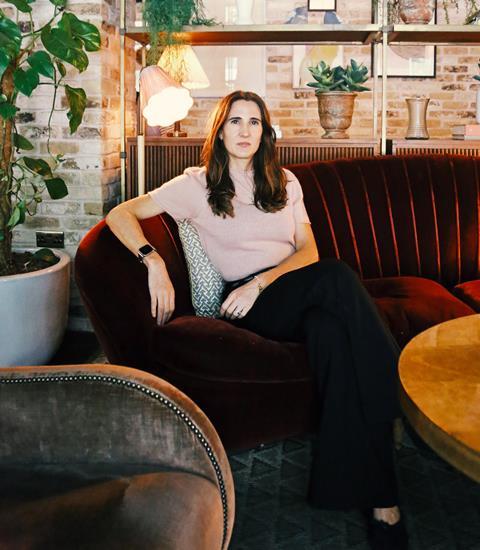
Since April 2025, Klor has chaired Women in Architecture UK (WiA), a volunteer-led organisation which offers free mentoring for women charting their career paths through the architecture profession. Founded in 2018, WiA grew from a series of women’s advocacy groups connected to the RIBA stretching back to the 1980s. It describes its mission as tackling deep-rooted gender disparities within the profession while raising the profile of women’s contribution to the sector.
Klor says she was motivated to join because she wanted to provide the next generation with the support she did not have in the early stages of her career. “I want to make sure that the stuff that happened to me, I don’t want anyone else to go through it,” she says. “I feel like I’m at a place that I can now start to give back, and I’m really keen to give back.”
This is about being fairer with everybody, and about giving the same opportunities to everybody
Klor’s progression through Broadway Malyan coincided with the time when she had her children. Returning from maternity leave, she found the colleagues she had grown with professionally had moved ahead. “I felt like I was falling behind my crew. There was nothing wrong with me. I was still the same,” she remembers. But those breaks from work put a “massive pause” on her career path.
“I just want to make sure that everybody has the same opportunities all the time throughout their different stages of their life,” she says. ”This is not just about women. This is about being fairer with everybody, and about giving the same opportunities to everybody. You want it, you take it. You don’t want it, you step back. It’s on you.”
Klor commits about half a day a week to volunteering for WiA, and chairs full team meetings once a month. She mentors women in all stages of their career, from students and recent graduates to those in mid-career who are contemplating a change. “Those things, you know, it feels very lonely. There are very few people who you can talk to who could keep it confidential and give you advice without trying to gain something from it,” she explains.
She also feels a natural responsibility for young starters at 10 Design, whose traditional part 1 roles are increasingly being encroached upon by AI. The possibility of losing the critical thinking skills developed in the first years working at a practice is, for Klor, the biggest risk which AI poses to the profession.
It is not that AI will replace junior people, she believes, but that the work that junior people create using AI will suffer if they lose critical thinking skills due to a lack of direct experience. Giving an AI task to someone with limited experience, and giving the same AI task to someone who has “lived it, breathed it, seen it, you will get two very different responses from it,” Klor says.

She sees it as 10 Design’s responsibility to offer internships and hire junior people at the start of their careers, who account for around one in 10 new hires at the practice. It is these people who bring the latest AI skills to the practice, which they can pass on to their colleagues.
For this reason, she is not afraid of AI and the impact it might have on the role of architects within the wider project team structure. “The more experienced people are actually realising that the new technology is helping us achieve things that we could never possibly achieve,” she says. “Instead of running three options on design, you can run 15, and therefore the end product ends up being better.”
Could Klor ever run for RIBA president? This prompts a laugh: “You are the first person ever that asked me that question,” she says.
Her 10N Collective colleague, WW+P co-founder Chris Williamson, is, of course, the current RIBA president, and she shares an office space with him. She is also close friends with the next president, Bell Phillips’ Jay Morton, who will become the institute’s fourth female president next year.
For now, Klor is very much focused on the biggest job of her career. The restructure of 10 Design is creating a major new practice hub in London at a time when the profession is facing new pressures and an uncertain future.
Will the firm be able to achieve her growth ambitions in this market? “Nobody has a crystal ball,” she admits. But it is clear she is enjoying the challenge facing her: “Opportunities like these… you don’t have every day to build a studio from scratch and create that.”

No comments yet