
Disparate spaces are linked by a convincing sense of place in Ireland’s last biennale show

The lives of spaces


RIBA, 66 Portland Place, London W1. www.architecture.com. Until April 28

Every two years the Venice Architecture Biennale stages a frenetically exhausting jamboree at its principal Arsenale and Giardini sites, with countries and exhibitors competing to say something about the state of architecture or just to say something that can be heard.

Outside of this hubbub the Irish chose in 2008 to take the elegant Palazzo Giustinian Lolin on the Grand Canal as venue for their quietly thoughtful study of how architecture is experienced and exhibited in a group show titled The Lives of Spaces. The show has since taken a circuitous route from Venice via provincial Irish castles and churches to its final port of call at the RIBA.

Curators Nathalie Weadick and Hugh Campbell have selected nine exhibitors spanning the geography and generations of Ireland’s architectural community. Each has presented an exploration of the exhibition’s title, a study of spaces as experienced, as lived; and that very rare phenomenon for an architectural exhibition, how it actually feels to be in a specific space. The exhibitors examine different spaces and different lives but share a common language of angular white plinth and Beuysian latrine and a limited format of five-minute films, which provides directness and accessibility, appropriately tying in our sense of time and sound to our experience of space.

The exhibition starts with young practice Taka’s study of domestic lives, charting a family’s move from shared to neighbouring houses, and continues through recent civic projects by contemporary Irish architects, each a different study of perception and inhabitation of architectural space. However it is when the films aim at larger subjects of national life that the exhibition really comes into its own.

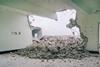
McGrath’s Maze film captures how the building’s history is still a fresh wound

Robin Walker worked with both Le Corbusier and Mies van der Rohe before returning to Ireland, eventually becoming a partner of notable Irish practice Scott Tallon Walker. He built an urban home in Dublin where he and his wife Dorothy were based but also a remote country retreat, Bótharbuí, accessible only from the sea in the Beara peninsula of Cork. An old cottage and two bothies were refurbished and three new buildings added, oriented toward the sea views beyond. The result is a five-bedroom home spread between six closely assembled buildings, rustic modern in style and a little reminiscent of Siza’s early work.

Patrick Lynch and Robin’s son, architect Simon Walker, have produced a film that evocatively shows that despite its remoteness the house became a space for Ireland’s national cultural life as well as the Walker family life. Through the seventies and eighties it became a focus for gatherings where art and politics met, described in Simon Walker’s accompanying essay as a “country salon”. In a few short minutes the film conveys these multiple lives, Seamus Heaney’s reading of his poem about the house overlaying images of the wedding celebrations held there of Robin and Dorothy’s daughter Sarah.

While the Bótharbuí film is celebratory, Dara McGrath’s film charting the demolition of The Maze prison is poignant. Between 1971 and 1975, ex-RAF base Long Kesh became an internment camp, and afterwards HM Prison Maze. In the ordering of the spaces four wings off a central administration block to form an H architecture became political symbol. During the following years the life of the Maze became central to the politics of the Troubles.

The peace process has resulted in both the closure and demolition of the building. The site, in a highly politicised climate, had been earmarked for development as a sporting venue, though this was dropped last year because of the site’s sensitivity. McGrath’s film captures how the building’s history is still a fresh wound, the spaces of confinement strangely broken open. Presented in a separate mirrored room in Venice, the film here sits alongside the other installations yet remains moving.

Topics