

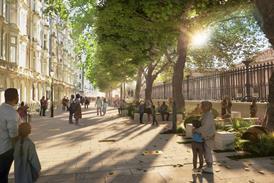






Richard Hilson says architects can use the principles of crime prevention through environmental design to make public spaces safer, using spatial planning, circulation logic, and environmental cues to reduce vulnerability, support risk assessment obligations, and enhance user confidence

The introduction of Martyn’s law – named after Martyn Hett who was killed in the Manchester Arena bombing on 22 May 2017 – creates, for the first time, a legal duty on those responsible for publicly accessible premises to consider, and prepare for, the risk of terrorism.
Drawing on statutory guidance and emerging regulation – including the evolving oversight role of the Security Industry Authority (SIA) – there is an opportunity for security to be reframed as a design-led discipline. Martyn’s Law marks a cultural shift in how we think about safety, responsibility, and the role of design in protecting people.
Good design can make places safer without making them feel intimidating or closed off, and the difference between compliance and true resilience will increasingly come down to the quality of design thinking applied at the earliest stages. Proactive design thinking about security should be embedded from RIBA Stage 1 onwards.
Rooted in lived experience
Driven by tireless campaigning from people such as Martyn’s mother, Figen Murray, the law – officially the Terrorism (Protection of Premises) Act 2025 – is, in spirit, “for people, by people”. It is rooted in lived experience and loss – and that human context must remain central to how the industry responds.
Martyn’s law introduces a tiered “protect duty”, requiring organisations to implement proportionate and “reasonably practicable” measures to reduce vulnerability to terrorist threats. It will evolve through bodies such as the SIA reinforcing accountability across the sector.
However, compliance alone is not enough, and I believe there is a pressing need for security to become a design-led discipline seamlessly integrated into the fabric of spaces rather than layered on as visible or intrusive infrastructure.
The challenge now is about whether a space has been designed to perform under pressure. Poorly considered layout and unclear circulation can undermine even the most robust procedural plan.
In essence, security should not make places feel hostile or restrictive, rather it should enhance confidence and support usability.
Crime prevention through environmental design
One of the most effective frameworks for achieving this is crime prevention through environmental design (CPTED). CPTED is not a new concept; it dates back to the early 1960s and is based on the simple but powerful idea that the design of a space can influence behaviour, reduce opportunities for harmful activity, and increase the perception – and reality – of safety.
What Martyn’s Law does is bring urgency to these long-established principles, turning what was once best practice into something mandatory. The four core principles of CPTED align closely with the requirements of Martyn’s law:
1. Natural surveillance: designing spaces to maximise visibility – where people can see and be seen through open sightlines, lighting and active frontages – increases situational awareness and reduces concealment opportunities.
2. Natural access control: carefully considered entry and exit points guide movement intuitively and reduce vulnerability while maintaining accessibility.
3. Territorial reinforcement: environments that look and feel owned are more likely to be respected. Subtle design cues, such as changes in materials or landscaping, help define public and private space, encouraging a sense of ownership and control. This works well when there is community art and landscaping that give a place a local identity.
4. Maintenance and management: well-maintained environments demonstrate oversight and care, deterring malicious activity and reinforcing public confidence. They send the message that someone has bought into this place and ensures it is looked after and monitored.
Under the new legislation, design teams must be able to show that security risks have been considered and addressed in a proportionate way. This places significant weight on early-stage decisions, from site layout and circulation strategies to material choices and perimeter definition. Security must be embedded from the outset, influencing how spaces are planned, experienced and managed.
Good design allows for intuitive movement and safe crowd flow, minimises hostile vehicle access, and creates environments that are easy to monitor without making people feel overly surveilled. A well-designed space naturally guides behaviour, reduces ambiguity, and supports response. A poorly designed one creates friction, confusion, and vulnerability – conditions that no amount of retrospective intervention can fully resolve.
Access, perimeter and integrated protection
One of the toughest considerations in CPTED has historically been integrating access control and perimeter protection. The most obvious answer is to create fortress-like environments, but that goes against the design ethos of CPTED.
Today we know how to embed protective measures into landscape and architectural features, and use tested, security-rated solutions that can detect, deter and delay threats – without compromising aesthetics or usability. The real test these days is whether protection can be embedded so effectively that it is felt but not seen.
A well designed space will also tackle vehicle-borne risks – an increasingly common concern, and one highlighted last year when Paul Doyle drove into the crowd during Liverpool FC’s championship parade. The National Protective Security Authority (NPSA) provides very good guidance on hostile vehicle mitigation (HVM), including a public realm design guide on designing for public spaces with consideration for HVM.
Navigating the challenge
A defining feature of Martyn’s Law implementation is that it prioritises preparedness culture over physical kit. Emerging guidance consistently emphasises the need for organisations to understand the nature of the terrorist threat and, crucially, to plan how they would respond in the event of an incident.
This subtly moves the conversation away from a purely defensive, hardware-led approach and towards operational readiness. CCTV, HVM, and access control are still integral, but they are only part of the picture. Equal weight is to be placed on staff training, awareness programmes and the rehearsal of procedures to ensure responses are embedded and actionable rather than theoretical. In this sense, the most secure spaces in the future may not be those with the most visible security, but those where people, processes and places work seamlessly together under pressure.
Again, this has clear implications at RIBA Stage 1, where early design decisions can either enable or constrain that culture of preparedness. Designing for Martyn’s Law is also about creating environments that support clear communication, intuitive movement and effective incident response. It should be understood less as a counter-terrorism measure in the traditional sense, and more as an extension of health-and-safety thinking – embedding resilience into the everyday operation of spaces.
New mindset required
Responding to the requirements of this new legislation will demand expertise, innovation and robust, security-rated solutions. It isn’t a one-size-fits-all scenario – the tiered system respects the size and purpose of venues, and designers and specifiers will no doubt design and plan accordingly. Developing the required capabilities will requires sustained investment and specialist knowledge, and the focus from all of us in this industry needs to be on responsibility not commercial concerns.
This is not about reaching a fixed destination, but about embedding a mindset – one that challenges the status quo and remains alert to what lies ahead. As future threats evolve, so must our approach. We must design to meet today’s requirements while anticipating the risks and expectations of tomorrow. As Sun Tzu observed, we cannot rely on past formulas for future success, we must adapt to new realities and those yet to unfold. The question is not whether we can meet the demands of Martyn’s Law – but whether we are prepared to lead beyond them.
We have a duty to contribute our expertise to create safer environments and support clients in meeting their obligations in order to help rebuild public confidence in shared spaces. And this matters because these public spaces are fundamental to our social, cultural and economic life. Their value lies in their openness, accessibility and ability to bring people together – things that are fundemental to our way of life and society’s functioning.
Postscript
Richard Hilson is director of sales and marketing for PFL Access Managment

No comments yet