


Decarbonising our industry means prioritising existing buildings, treating them as structural and material resources, and rediscovering efficient forms and the craft behind the oricesses that earlier builders refined under constraint, writes Rob Nield

Our planet is now 4.6 billion years old. We have been walking around on it for seven million of these, but it is only in the past 6,000 years that we have formed civilisations and built big. Before this, we built simple, modest buildings with locally sourced natural materials – timber, stone, air-dried clay bricks.
It was not until the time of the Egyptians that the power of human labour was harnessed en masse, that we scaled up and built much larger structures: the pyramids, the great stone temples, the Colosseum. We relied on the ability to feed the population to increase output but were still using low-embodied materials with little impact on the planet.
It is only in the past two centuries that we have really accelerated construction exponentially and now build the equivalent of a New York City every month globally, causing irreversible damage to our planet and climate.
How did this happen?
Cheap energy. The advent of cheap coal and the discovery of commercially viable oil wells in the 1800s unlocked our ability to produce steel, concrete, fired bricks and glass at an industrial scale. These are the energy-hungry materials that have allowed us to build bigger and higher unabated.
We must work together to reduce our impact and follow a philosophy that questions the need to build at all
That is not to say that this construction boom has not improved the lives of billions of people the world over, but we have reached a tipping point and need to wean ourselves off our fossil fuel addiction if we are to progress to a more sustainable future.
As an industry, we must work together to reduce our impact and follow a philosophy that questions the need to build at all. And, if we do, can we build less?
Then, once we decide to build something, it should be done intelligently and efficiently, with minimal waste.
The lowest embodied carbon building is the one that already exists, and usefully, most buildings required in the future are already built, albeit not all are fit for the changing needs of the population.
With creative thinking, however, buildings can be refurbished, remodelled, extended up, down, or sideways, increasing capacity. This fusion of old and new needs to be handled sensitively, with diligent engineering to understand the existing structure, load paths and capacities, to ensure that changes made are safe and within the limits of the building.
Yes, there is often more risk involved with existing buildings than with shiny new ones, but this type of work will only increase, and we must upskill ourselves as an industry – both designers and contractors – to embrace the unknown and set up project processes to manage risk and successfully deliver complex refurbishments.
Buildings that cannot be reused in their entirety should be viewed as material banks, holding elements for future use using circular economy principles. Bricks can be cleaned and reused, testing and recertification of steel is becoming more prominent, timber can be regraded and reused rather than burnt as biomass at end of life.
When we do build new, we should limit the embodied carbon, currently more of a moral rather than statutory obligation in this country until Part Z is implemented.
Designing efficiently is a must. Codes of practice exist to provide safety, standardisation and design quality for our built structures. However, we must not hide behind these to justify lazily designed, overweight structures.
First principles understanding of material properties, forms and the flow of forces through a structure should enable us to design buildings that are efficient and inherently elegant: clear, simple load paths, leaving the structural gymnastics to situations where no other option is available.
The future of building lies in using what we already have and learning the lessons from thousands of years of construction
Finding strength through geometry, using ribs and folds to create depth, and curvature to create arches and shells, can minimise material use, taking cues from the designers of Gothic cathedrals and, more recently, the elegant, organic forms of the likes of Pier Luigi Nervi and Eladio Dieste, who were forced by material scarcity to innovate.
More recent advances in engineered timber and post-tensioned stone elements – materials that in their simplest forms have been used for thousands of years – have elevated these natural, low-carbon materials into primary contenders in cost-effective yet beautiful contemporary structures.
The future of building does not lie in continuing to push for bigger, faster, taller. It lies in using what we already have and in learning the lessons from thousands of years of construction.
Build only what is needed. Use materials honestly, and let form do the hard work. Progress now means restraint – and that may be the most advanced idea of all.
Postscript
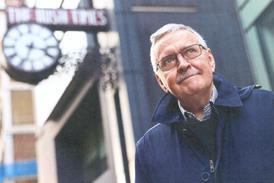
Rob Nield is a director at Webb Yates






No comments yet